

Introduction
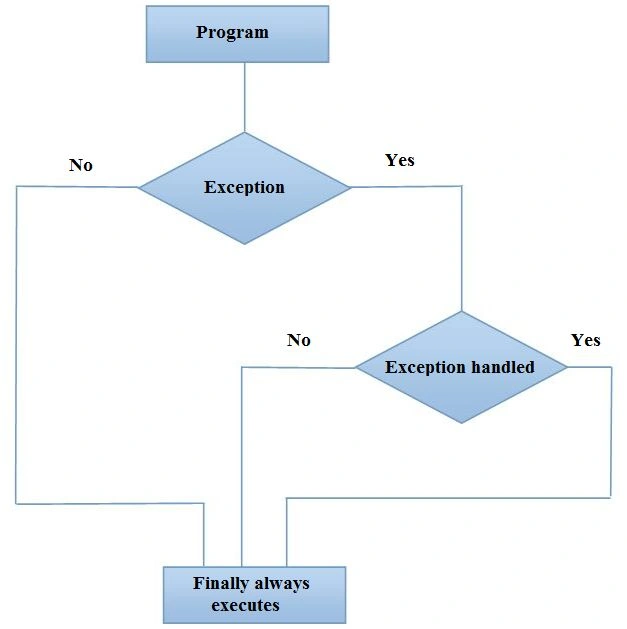
It is a special block in Java. It is a block in a program that always executes. If we want to perform an important task and want it to execute always in any condition then we use a finally block in Java.
Finally, Block in Java
The following describes the finally block in Java:
- In Java, finally is a special keyword.
- It always executes independently of any condition.
- It is optional in Java.
- It should be after the try-catch block in Java.
- For a single try block, there can be a maximum of one finally block in Java.
- Generally, we use a finally for closing the connections or closing the file and so on.
Examples of Finally in Java
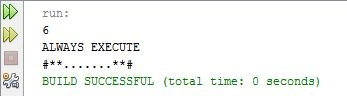
No Exception Condition
- package demo;
- public class Demo {
- public static void main(String args[]) {
- try {
- int fig = 36 / 6;
- System.out.println(fig);
- } catch (NullPointerException e) {
- System.out.println(e);
- } finally {
- System.out.println("ALWAYS EXECUTE");
- }
- System.out.println("#**.......**#");
- }
- }
Output
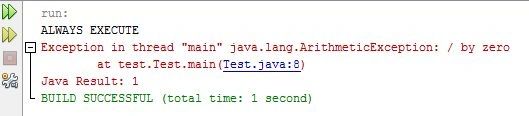
Exception Condition
- package test;
- public class Test {
- public static void main(String args[]) {
- try {
- int fig = 36 / 0;
- System.out.println(fig);
- } catch (NullPointerException e) {
- System.out.println(e);
- } finally {
- System.out.println("ALWAYS EXECUTE");
- }
- System.out.println("#**.......**#");
- }
- }
Output
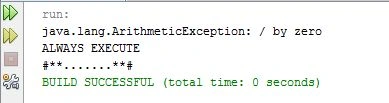
Exception Condition, But Handled
- package trial;
- public class Trial {
- public static void main(String args[]) {
- try {
- int fig = 36 / 0;
- System.out.println(fig);
- } catch (ArithmeticException e) {
- System.out.println(e);
- } finally {
- System.out.println("ALWAYS EXECUTE");
- }
- System.out.println("#**.......**#");
- }
- }
Output
Summary
This article has explained the finally block in Java.
Join the conversation! Your thoughts help the community grow.