

Introduction
Today we are going to discuss about new buzzword, so-called "events" . An Event Lifecycle refers to the stages an event goes through from its creation to completion.
In software architecture, this usually involves:
Event Creation: This creation part is the core of the business application, typically part of the business application boundary in terms of domain context. At this stage, a business event is generated to represent something meaningful that has happened in the system. This event is usually aligned with the domain model and business rules.
Event Publishing: Once the business application has prepared the business events, it then publishes them into the Event Bus or Message Broker ( in conventional terminology). This decouples the event producer from any specific downstream service.
Event Processer or Subscribers: The Subscriber will receive events based on the subscription, to process further their business use case. This allows multiple independent systems to react to the same event without tightly coupling them.
Event Completion: Once all the above stages are passed through, events are stored for further use cases. This final stage ensures traceability, reliability, and reusability of events.
How Event Lifecycle Is Used
Event-driven architecture is widely adopted in most use cases, such as
Microservices applications
Cloud-native platforms
IoT systems
Real-time applications like chat, gaming, and trading platforms etc.,
Making Events Global and Reusable
To make events reusable across systems or lines of business and outside of your organisation, follow these best practices:
Define a clear event schema: Use consistent naming conventions and structured payload formats
Use global event buses or brokers: Allow multiple services to subscribe without tight coupling.
Standardise event versioning: So producers can evolve without breaking consumers.
Leverage the Publish–Subscribe pattern: Producers don’t need to know which consumers exist.
Maintain reusable event definitions: Store common event types like UserCreated or OrderPlaced in a shared registry.
I will recommend adopting CloudEvents for standardisation, since it gives a few advantages, such as standard metadata structure, reducing integration complexity between different teams, systems, or cloud providers, and simplifying event routing and logging because every event follows the same format and Make your events cloud-agnostic and easily portable across environments.
You can position CloudEvents as a “unifying layer” on top of your event lifecycle — making your architecture future-proof, interoperable, and enterprise-ready.
How AWS Powers Event Lifecycles
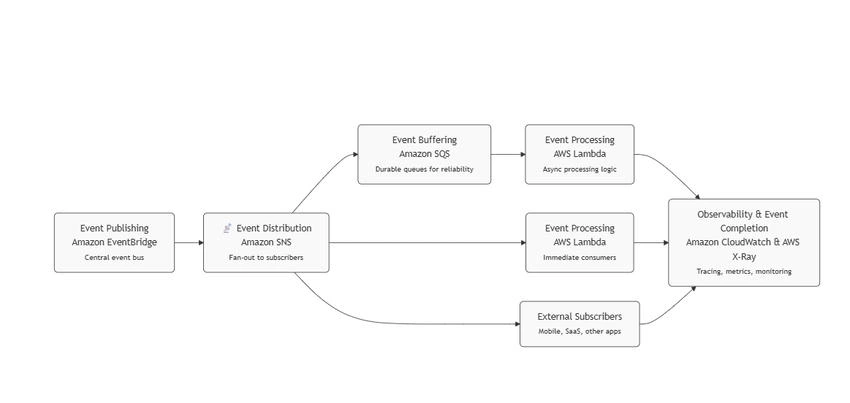
Amazon Web Services provides a powerful and serverless ecosystem to support every stage of the event lifecycle — from creation to completion. By combining different AWS services, you can build resilient, scalable, and loosely coupled systems with minimal infrastructure management.
1. Event Publishing — Amazon EventBridge
EventBridge acts as a central event bus that connects producers and consumers through events.
It routes business events from applications to multiple targets based on defined rules.
Supports schema registry and filtering, ensuring events are well-structured and reusable.
Ideal for creating loosely coupled, event-driven systems.
Lifecycle tie-in: EventBridge plays a key role in the “Event Publishing” stage, where the event leaves the producer system and is delivered to the event bus for distribution.
2. Event Distribution — Amazon Simple Notification Service (SNS)
SNS is a publish–subscribe messaging service used to fan out events to multiple subscribers.
Great for broadcasting a single event to many consumers.
Works seamlessly with SQS or Lambda for downstream processing.
Cost-effective and low-latency.
Lifecycle tie-in: SNS supports event publishing and distribution, enabling multiple subscribers to react to the same event in parallel.
3. Event Buffering & Reliability — Amazon Simple Queue Service (SQS)
SQS provides durable message queues that decouple event producers from consumers.
Ensures no messages are lost during spikes in traffic.
Allows consumers to process events asynchronously.
Increases system resilience and fault tolerance.
Lifecycle tie-in: SQS strengthens the “Event Processing” stage by buffering events and ensuring reliable delivery to downstream services.
4. Event Processing — AWS Lambda
Lambda offers serverless compute to process and respond to incoming events.
Automatically triggers functions from EventBridge, SNS, or SQS.
No server management required.
Ideal for running business logic, transforming data, or invoking other services.
Lifecycle tie-in: Lambda is central to “Event Processing”, where events are consumed and business actions are executed.
5. Observability & Event Completion — Amazon CloudWatch and AWS X-Ray
CloudWatch and X-Ray provide monitoring and tracing for event flows.
Monitor metrics like event latency, delivery success, and system health.
Trace events end-to-end through distributed systems.
Provide visibility and auditing for compliance and debugging.
Lifecycle tie-in: These tools support the “Event Completion” stage, ensuring traceability, reliability, and operational insights after events have been processed.
Benefits of Event Lifecycle
Adopting an event-driven architecture brings several key benefits. It provides flexibility and scalability , allowing new features or services to subscribe to existing events without changing the core system, while enabling individual consumers to scale independently. Because events are processed asynchronously, the system delivers improved performance and faster response times for end users. Events are also highly reusable , powering multiple processes such as emails, analytics, notifications, or workflows from a single source. This approach supports a real-time experience, ideal for dashboards, alerts, or any system requiring instant feedback. Additionally, it promotes a cleaner architecture by decoupling components and reducing complex dependencies between services, making the overall system easier to maintain and evolve.
Event Lifecycle vs Conventional Approach
| Traditional Approach | Event-based approach |
|---|---|
| Tight coupling with each module | Events make loosely coupled |
| Hard to Scale | Easy on the scale |
| Synchronous | Asyncronous |
| Required changes to bring new consumer | Easy to add new consumers |
| Limited Resuability | High reusability |
Conclusion
An Event Lifecycle enables organisations to build resilient, scalable, and reusable systems. Unlike the conventional tightly coupled approach, it provides real-time , asynchronous , and extensible capabilities. By making events global and reusable, teams can accelerate innovation , integrate systems more efficiently , and respond faster to business changes .
Thank you for taking the time to read this article — I hope it gave you valuable insights into events and their benefits with event-driven architecture. Stay tuned for my next post, where I’ll dive deeper into architecture and best practices.
Join the conversation! Your thoughts help the community grow.