
Overview
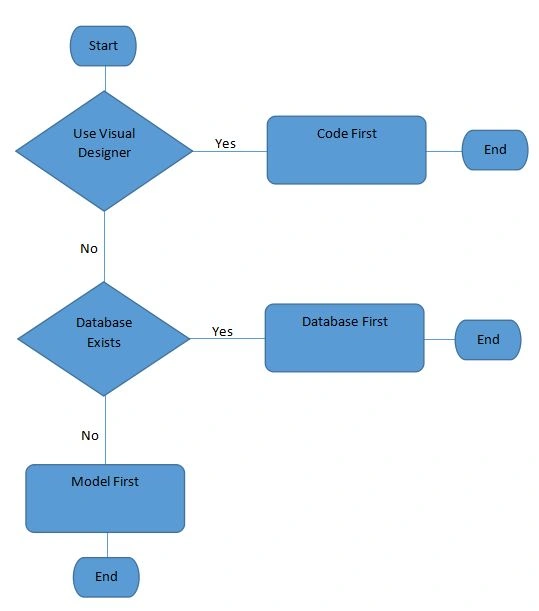
The Entity Framework provides three separate approaches to work with data models and each one has its own pros and cons.
Possible Approaches
Model First

- The database model (Entities, relationships, and inheritance hierarchies) is created first using the ORM designer in Visual Studio. Once the model is ready the database is created from it.
- The Model First workflow begins with an empty slate. You use the visual EDM Designer to design an EDM then generate a database schema from that model.
Code First
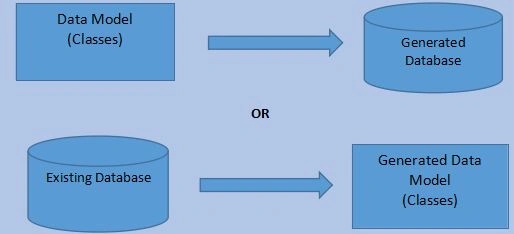
- The classes (known as POCO classes) are created first and then generate the database from the classes directly.
- If the database is ready, the Entity Framework tools can generate the classes and properties that correspond to existing tables and columns.
- The Code First workflow begins with classes that describe a conceptual model. There's no visual model used with Code First.
Database First
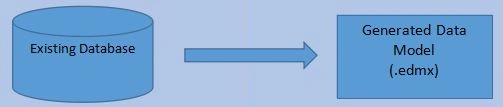
- The model is created from an existing database (like SQL Server, Oracle, and so on).
- Workflow begins with a legacy database and leverages a wizard to reverse-engineer that database into a conceptual model.
Model First vs Code First vs Database First
| Model First | Code First | Database First |
| Define the model and go with the workflow to generate a database script and T4 template to generate POCO entities | Create POCO classes and then create the database from the POCO classes The code defines the database mappings and EF handles the creation of the database with its relations | The EDM wizard creates entities, relationships, and inheritance hierarchies. After modification of the mapping, the POCO class entities are created. |
| For additional features in POCO entities, either T4 modify a template or use partial classes | For additional features in POCO entities you must either T4 modify a template or use partial classes. | |
| Code is automatically generated | Full control over the code, no auto-generated code | The code is automatically generated. |
| This approach is adopted by the architect and solution lead developers | This approach is adopted by developers who follow the path of Domain-Driven Design (DDD) principles | Recommended if the DB is designed by DBAs, developed separately or the DB already exists |
| Manual changes to the database will be most probably lost because the model defines the database | Manual changes to the database will be most probably lost because your code defines the database | Manual changes to the database are possible because the database defines the domain model. The model can be updated from the modified database. |
Vivek TripathiPosted May 20, 2015, 10:02 PM
Nice and compact info. Thanks
Gopi ChandPosted May 3, 2015, 11:16 AM
Diagrams can better explain anything..Good keep it up..
Tom MohanPosted May 2, 2015, 11:37 AM
good show
Abhishek JaiswalPosted May 1, 2015, 4:28 AM
Brief and informative content! :)
NitinPosted May 1, 2015, 3:36 AM
good one
NitinPosted May 1, 2015, 3:28 AM
good one
Santhakumar MunuswamyPosted Apr 30, 2015, 3:06 PM
Good Work