

Pre-requisite to understand this
Basic understanding of:
Client–Server architecture
Web applications (UI, backend, database)
Networking concepts (DNS, Load Balancer)
server crash, network outage, data loss
Cloud or data center environments
RTO (Recovery Time Objective)
RPO (Recovery Point Objective)
Introduction
High Availability (HA) and Disaster Recovery (DR) are architectural strategies designed to ensure that applications remain accessible, reliable, and resilient even in the presence of failures. From an end-user perspective, HA and DR aim to minimize downtime, prevent data loss, and provide seamless user experience regardless of infrastructure issues, hardware failures, or large-scale disasters such as data center outages.
HA focuses on continuous availability, while DR focuses on recoverability after catastrophic failures. Together, they form the backbone of mission-critical enterprise applications.
What problem we can solve with this?
Without HA and DR, applications face significant risks that directly impact end users and businesses.
Problems solved:
Application downtime due to:
Server crashes
Network failures
Application bugs
Data loss caused by:
Database corruption
Hardware failure
Poor user experience:
Application unresponsiveness
Lost user sessions
End-user benefits:
Continuous access to the application
No or minimal service interruption
Faster recovery after major failures
Protection of user data
How to implement / use this?
HA and DR are implemented using redundancy, automation, and geographic separation.
High Availability (HA) implementation
High Availability (HA) ensures your application remains accessible and performant even during hardware failures, traffic spikes, or partial outages by minimizing downtime to seconds or minutes. Multiple application instances run in an Active-Active setup (all handling traffic simultaneously for maximum throughput) or Active-Passive (one primary active, others on standby), deployed across fault-tolerant zones or nodes to avoid single points of failure. A load balancer sits in front, intelligently distributing incoming traffic based on algorithms like round-robin or least connections, while constantly performing health checks—such as HTTP probes or TCP pings—to detect unhealthy instances and reroute traffic instantly. For data persistence, database replication uses a Primary-Replica model where the primary handles writes and asynchronously or synchronously mirrors data to replicas for read scaling and failover; if the primary fails, health checks trigger automatic promotion of a replica to primary, ensuring seamless continuity without data loss.
Multiple application instances (Active-Active or Active-Passive)
Load balancer to distribute traffic
Database replication (Primary–Replica)
Health checks and automatic failover
Disaster Recovery (DR) implementation
Disaster Recovery (DR) protects against large-scale disruptions like regional outages, natural disasters, or cyberattacks by maintaining a fully operational secondary site in a geographically distant region, enabling recovery within minutes to hours (measured by Recovery Time Objective or RTO). Data replication between sites occurs synchronously (zero data loss but higher latency) or asynchronously (some potential loss but better performance), using tools like database log shipping or storage mirroring to keep the secondary in sync. DNS failover or a global traffic manager monitors site health and automatically redirects user traffic to the secondary site via updated DNS records or anycast routing when the primary becomes unavailable. To validate effectiveness, teams conduct periodic DR drills—simulated failures to test failover processes—and maintain regular backups stored offsite, ensuring quick restoration and compliance with Recovery Point Objectives (RPO) for minimal data loss.
Secondary site in a different region
Data replication (sync or async)
DNS or traffic manager for region failover
Periodic DR drills and backups
Sequence Diagram (HA + DR Flow)
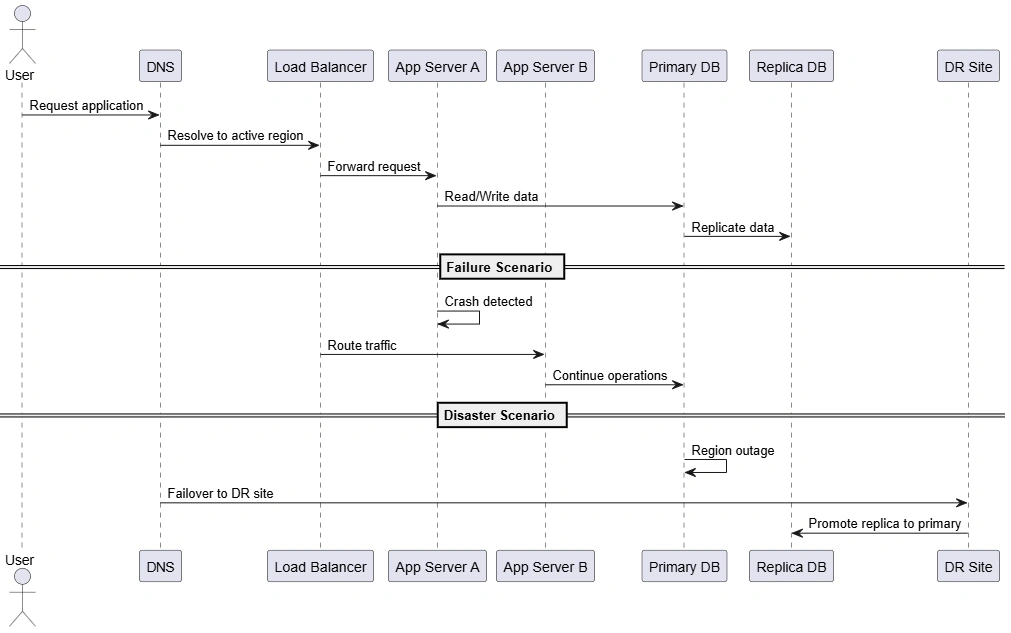
User request is routed via DNS to the active region.
Load Balancer distributes traffic across healthy application servers.
Database changes are replicated continuously.
HA Failover: If App Server A fails, traffic shifts to App Server B instantly.
DR Failover: If the primary region fails, DNS redirects users to DR region where replica DB is promoted.
When a user request arrives, it first gets routed via DNS to the active region, ensuring traffic heads straight to the primary operational zone. A load balancer then intelligently distributes this incoming traffic across multiple healthy application servers, preventing any single server from becoming overwhelmed and maintaining smooth performance. Meanwhile, database changes replicate continuously in real-time across servers and regions, keeping data synchronized and up-to-date without interruptions. For high availability (HA) failover, if App Server A goes down, the load balancer instantly shifts all traffic to the standby App Server B, minimizing downtime to near zero. In a full disaster recovery (DR) scenario, should the entire primary region fail, DNS automatically redirects users to the secondary DR region, where the replica database is swiftly promoted to primary status, allowing seamless continuation of services.
Component Diagram (Architecture View)
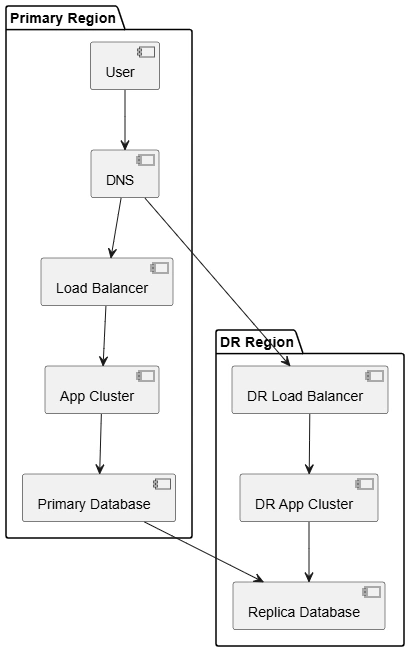
Primary Region hosts live traffic.
Application tier runs in a cluster for HA.
Database replicates data to DR region.
DR Region remains passive or warm-standby.
DNS enables regional failover during disaster.
The primary region serves as the main hub hosting all live user traffic, processing requests efficiently under normal conditions. Its application tier operates in a clustered setup across multiple servers to ensure high availability (HA), so if one server fails, others seamlessly take over without disrupting service. Meanwhile, the database in the primary region continuously replicates all data changes to the disaster recovery (DR) region, maintaining an identical copy for backup purposes. The DR region stays in a passive or warm-standby state, ready to activate with minimal lag but not handling active traffic until needed. During a disaster that knocks out the primary region, DNS plays a pivotal role by enabling regional failover, automatically redirecting all user requests to the DR region where the replica database promotes itself to primary and the application tier springs to life.
Advantages
High uptime
Improved user trust and satisfaction
Zero or minimal data loss
Automated recovery without manual intervention
Business continuity during disasters
Summary
High Availability and Disaster Recovery are critical architectural patterns that ensure applications remain reliable and resilient from an end-user perspective. HA prevents service disruption during routine failures, while DR ensures recovery during catastrophic events. By combining redundancy, replication, automation, and geographic separation, organizations can deliver seamless user experiences, protect data, and maintain business continuity even under extreme failure conditions.
Join the conversation! Your thoughts help the community grow.