

Pre-requisite to understand this
Embeddings – Numerical vector representation of text/images generated by an embedding model.
LLM (Large Language Model) – Model like OpenAI GPT systems that generate human-like text.
Vector Similarity Search – Technique to find semantically similar vectors using cosine similarity or dot product.
API Gateway – Entry point that routes and secures client requests.
Chunking – Splitting large documents into smaller pieces before embedding.
Metadata – Structured attributes (author, date, tags) attached to stored vectors.
RAG (Retrieval-Augmented Generation) – Architecture combining retrieval system with LLM generation.
Introduction
Modern AI applications require more than just a Large Language Model. To provide accurate, contextual, and up-to-date responses, systems integrate Vector Databases, Metadata filtering, Backup Data strategies, RAG Services, and Dynamic Context Discovery (DCD) mechanisms. Together, these components form a scalable AI application that can retrieve domain-specific knowledge, apply contextual filters, dynamically adjust context, and generate reliable answers. Instead of relying solely on static training data, such systems allow AI to access live and enterprise knowledge securely and efficiently.
What problem we can solve with this?
Traditional LLMs hallucinate, lack domain-specific knowledge, and cannot access private enterprise data. By integrating a Vector Database and RAG service, AI applications can retrieve relevant information before generating responses. Metadata improves filtering precision (e.g., by department, date, role). Backup data ensures reliability and disaster recovery. Dynamic Context Discovery (DCD) optimizes which data chunks should be included in the prompt based on query intent. This architecture solves scalability, accuracy, governance, and contextual relevance challenges in AI applications.
Problems solved:
Reduce hallucinations by grounding answers in retrieved documents.
Enable domain-specific AI using enterprise knowledge.
Filter results using metadata constraints (date, department, tags).
Handle large document repositories efficiently.
Ensure system resilience via backup data.
Dynamically optimize context selection using DCD.
Maintain compliance and access control.
How to implement/use this?
To implement this architecture in a single AI app, documents are first ingested, chunked, and converted into embeddings. These embeddings are stored in a Vector Database with metadata attributes. A RAG service retrieves top-k relevant chunks based on similarity search and metadata filters. Dynamic Context Discovery analyzes user intent and dynamically adjusts the retrieval strategy. The LLM then generates responses using retrieved context. Backup mechanisms periodically snapshot vector and metadata stores. The entire solution is deployed in a scalable cloud-native architecture.
Implementation steps:
Data Ingestion – Upload PDFs, docs, DB records into system.
Chunking & Embedding – Convert text into vector embeddings.
Vector Storage – Store embeddings in vector DB.
Metadata Tagging – Attach structured attributes for filtering.
RAG Retrieval – Fetch relevant vectors based on query.
DCD Layer – Dynamically refine context selection.
LLM Generation – Generate answer using retrieved context.
Backup Strategy – Periodic snapshot of DB and metadata.
Sequence Diagram
In this sequence, the user sends a query to the AI App. The DCD engine first analyzes the intent and dynamically adjusts retrieval parameters (top-k, filters, semantic scope). The RAG service queries the Vector DB using similarity search and metadata constraints. Retrieved documents are appended to the prompt sent to the LLM. The LLM generates a grounded answer and returns it to the user. Meanwhile, periodic backups ensure resilience and recovery capability.
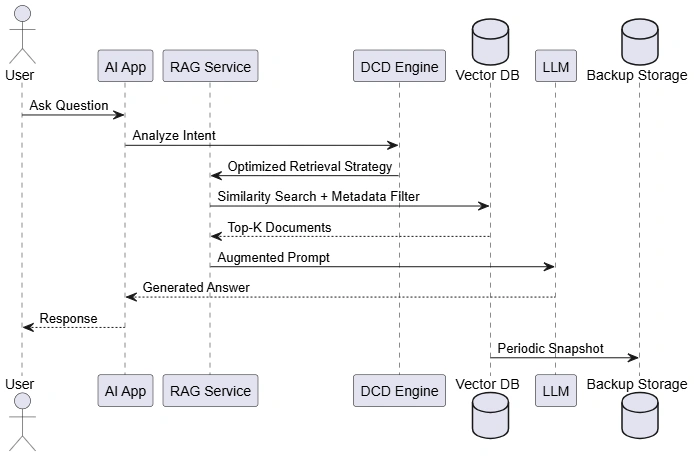
Key roles:
DCD – Optimizes retrieval dynamically.
RAG Service – Bridges vector search and LLM.
Vector DB – Stores embeddings + metadata.
Metadata – Enables filtered, accurate retrieval.
Backup Storage – Ensures durability.
Component Diagram
The component diagram shows logical modules of the AI system. The API Gateway handles incoming traffic. The DCD engine refines query context. The RAG service performs retrieval using the Vector Database. The LLM service generates responses using contextual augmentation. The Backup System replicates the Vector Database regularly. Step numbers illustrate the processing order from query intake to response delivery and backup operations.
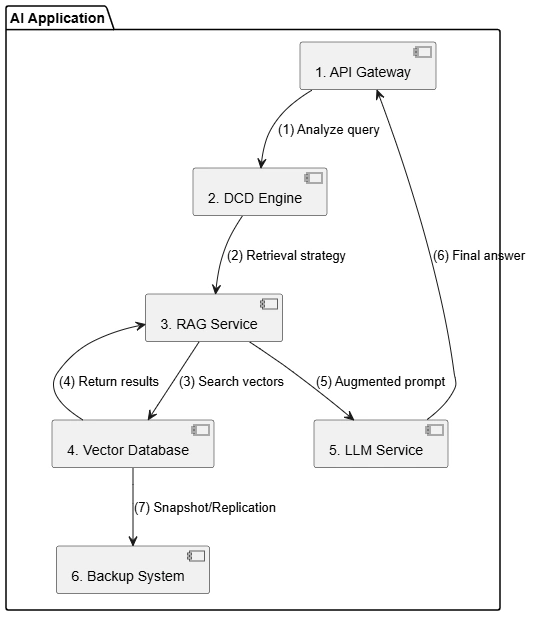
Component roles:
API Gateway – Entry point and security layer.
DCD Engine – Context optimization module.
RAG Service – Retrieval orchestration layer.
Vector Database – Semantic storage engine.
LLM Service – Response generation engine.
Backup System – Disaster recovery module.
Deployment Diagram
The deployment diagram shows physical distribution. The client application communicates with the cloud-hosted App Server containing API, DCD, and RAG components. The App Server interacts with AI services hosting the LLM. The Data Layer contains Vector DB and Metadata Store. Backup Storage ensures resilience. This architecture supports scalability, fault tolerance, and secure enterprise AI deployments.
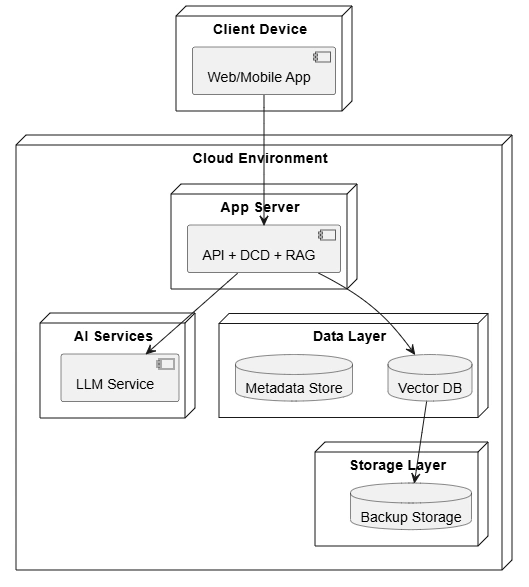
Deployment roles:
Client Device – User interaction interface.
App Server – Core AI orchestration layer.
AI Services – LLM compute cluster.
Data Layer – Embedding + metadata storage.
Storage Layer – Backup and recovery system.
Advantages
Improves factual accuracy through grounded retrieval.
Enables real-time knowledge updates without retraining LLM.
Supports secure enterprise knowledge integration.
Reduces hallucination risk significantly.
Scales efficiently with large document repositories.
Provides high availability via backup systems.
Optimizes token usage using Dynamic Context Discovery.
Enables fine-grained filtering using metadata.
Summary
A modern AI application combining Vector Database, Metadata, Backup Data, RAG Service, and Dynamic Context Discovery (DCD) creates a powerful, scalable, and reliable intelligent system. The Vector Database enables semantic retrieval, metadata enhances filtering precision, RAG grounds LLM outputs, DCD dynamically optimizes context, and backup systems ensure resilience. Together, these components transform a simple LLM-powered chatbot into a robust enterprise-grade AI platform capable of delivering accurate, contextual, and reliable responses at scale.
Join the conversation! Your thoughts help the community grow.