

Abstract / Overview
EIP-8141 is an Ethereum proposal that introduces a new transaction type called a Frame Transaction. It separates transaction validation, gas payment, and execution into individual frames.
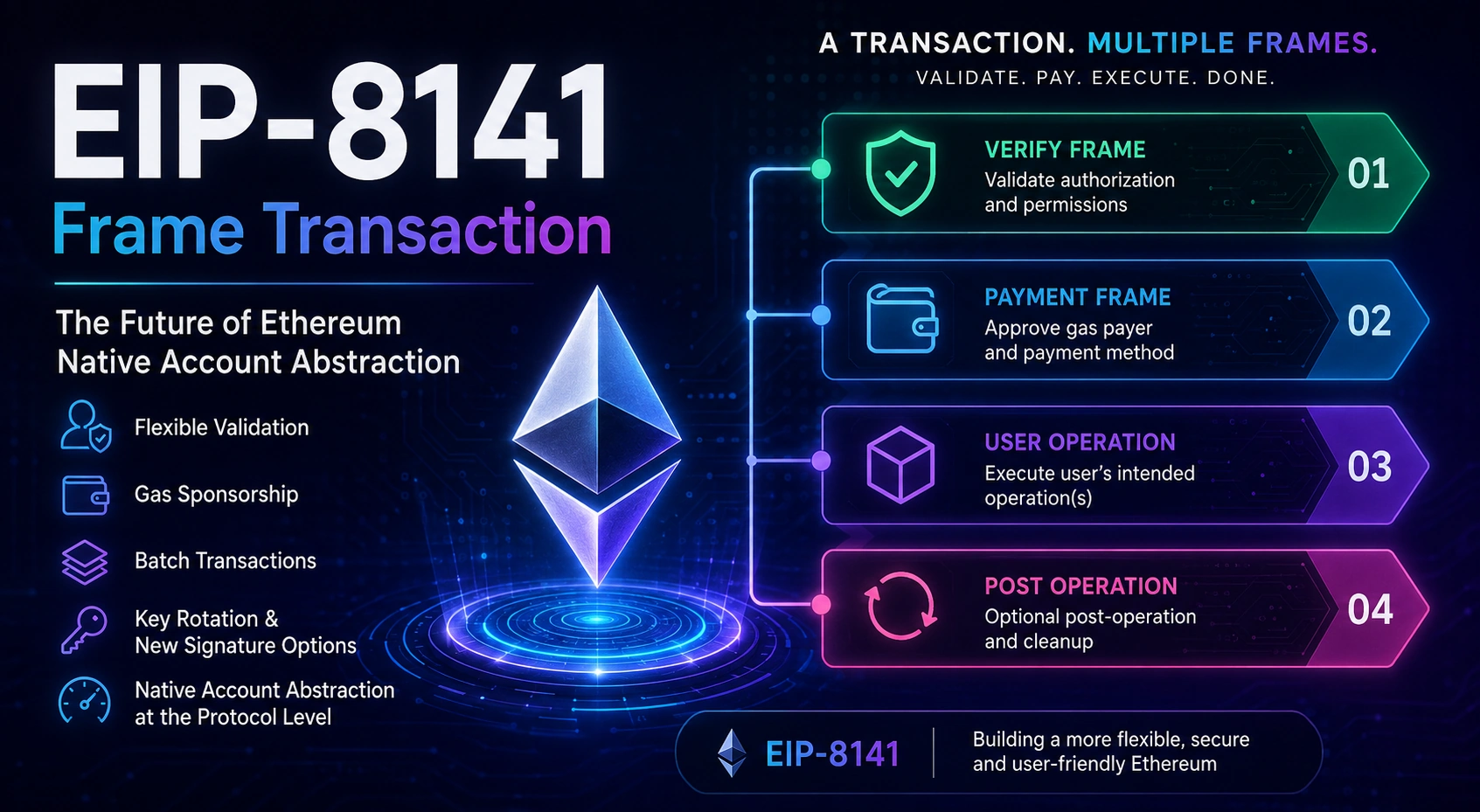
In simple terms, EIP-8141 aims to make an Ethereum account programmable at the protocol level. An account can define how a transaction is approved, who pays its gas, and which actions are executed.
The proposal is still a Draft, and Ethereum.org currently lists EIP-8141 as being considered for inclusion in the Hegotá upgrade. It is not a promise that the proposal will ship unchanged.
Last verified: August 30, 2026.
What Is EIP-8141?
EIP-8141, titled “Frame Transaction,” proposes a new Ethereum transaction format that breaks a transaction into a sequence of programmable frames.
Each frame can perform a specific job.
For example:
One frame can verify the user's authorization.
Another can approve gas payment.
Another can execute the user's transaction.
Another can perform a post-operation action.
A deployment frame can create a smart account.
This is designed to move Ethereum toward native account abstraction.
Account abstraction means that an account does not have to follow one fixed rule such as “an ECDSA signature from the private key must approve every transaction.” Instead, the account can define its own validation and payment logic.
EIP-8141 describes this goal as making an account essentially an address with code.
Why EIP-8141 Matters
Traditional Ethereum transactions combine several responsibilities into one transaction model:
Who is sending? → How is it authorized? → Who pays? → What should execute?
EIP-8141 separates these responsibilities.
The basic model becomes:
Authorization
     ↓
Gas Payment
     ↓
User Operation
     ↓
Optional Post Operation
This separation can support features such as:
Sponsored transactions
Gas payment using tokens
Batch transactions
Flexible signature systems
Native smart accounts
Key rotation
Passkey-style authentication
Future post-quantum migration
Account deployment and execution in one transaction
Ethereum.org describes EIP-8141 as a proposal that could allow smart accounts to define their own signature rules, gas payer, and execution without depending on the ERC-4337 EntryPoint, bundlers, or application-level relayers.
Conceptual Background: From EOAs to Programmable Accounts
Ethereum accounts have traditionally fallen into two broad categories.
Externally Owned Accounts
An EOA is controlled by a private key.
A simplified transaction flow looks like this:
Private Key
    ↓
Signature
    ↓
Ethereum Transaction
    ↓
EVM Execution
The transaction normally depends on the account's cryptographic signature and requires the transaction sender to handle gas payment.
Smart Contract Accounts
A smart account uses contract code to define its behavior.
This allows more flexible authorization rules, but historically developers have needed additional account-abstraction infrastructure to make smart-account experiences practical.
EIP-8141 attempts to move more of that functionality directly into the Ethereum transaction model.
The EIP-8141 Model
The proposed model looks more like this:

The important change is that validation and payment become programmable parts of the transaction.
How EIP-8141 Frame Transactions Work
EIP-8141 introduces a transaction type 0x06.
A frame transaction contains several major fields, including:
Chain ID
Nonce
Sender
Frames
Signatures
Fees
Optional blob versioned hashes
The current specification allows up to 64 frames in one transaction. It also defines an intrinsic transaction cost of 12,000 gas and a per-frame cost of 475 gas.
What Is a Frame?
A frame is a programmable part of the transaction.
A frame contains information such as:
Mode
Flags
Target
Execution and state limits
Value
Call data
Different modes give frames different roles.
The major modes in the current proposal include:
| Frame Type | Purpose |
|---|---|
| VERIFY | Validate authorization or approve payment |
| SENDER | Execute an operation as the sender |
| DEFAULT | Execute using the default account behavior |
| Deployment | Create a new smart account |
The specification also defines common patterns such as deploy, only_verify, pay, expiry_verify, user_op, and post_op.
Validation and Execution Are Separate
One of the most important ideas in EIP-8141 is the separation between validation and execution.
The transaction begins with a validation prefix.
The validation prefix is the shortest sequence of frames that successfully establishes who will pay for the transaction.
Once payment has been approved, later frames can perform the actual user operation.
This creates a boundary:
┌───────────────────────────────┐
│ Validation Prefix             │
│                               │
│ Verify sender                  │
│ Verify payment                 │
│ Approve payer                  │
└───────────────┬───────────────┘
                │
                ▼
┌───────────────────────────────┐
│ Execution                      │
│                               │
│ User operation                 │
│ Batch calls                    │
│ Optional post-operation       │
└───────────────────────────────┘
This boundary is important for Ethereum's public mempool because nodes need to determine whether a pending transaction is safe to propagate before putting it into the network.
What Is the Public Mempool Validation Prefix?
The public mempool is where pending transactions wait before inclusion in a block.
EIP-8141 does not allow arbitrary validation logic to enter the public mempool without restrictions.
Instead, the proposal defines recognized validation patterns.
The current specification identifies four public-mempool validation shapes:
Self relay
Deploy plus self-verification
Canonical paymaster
Deploy plus verification plus canonical payment
After the validation prefix establishes the payer, later execution frames are outside the public mempool validation rules.
This distinction helps Ethereum nodes understand which parts of a frame transaction need to be checked before propagation.
How Gas Payment Changes
Gas payment is one of the biggest practical changes introduced by the proposal.
In a traditional transaction, the sender generally needs to provide the asset used for transaction fees.
With EIP-8141, a frame can approve a different payer.
That opens the door to patterns such as:
User Account
     │
     │ authorizes transaction
     ▼
Verification
     │
     ▼
Paymaster / Gas Account
     │
     │ pays gas
     ▼
User Operation
This can make applications feel more like traditional Web2 services.
For example, an application could sponsor a user's first transaction instead of asking the user to acquire ETH before interacting with the application.
Gas Payment With Tokens
EIP-8141 can also support alternative fee-payment designs.
The EIP specification gives an example where a user transfers tokens to a sponsor as part of the transaction flow.
The transaction can then execute the user's intended action and optionally perform additional post-operation logic, such as handling refunds or converting tokens.
This could enable experiences such as:
“I only hold stablecoins. I do not need to keep ETH in this account just to pay transaction fees.”
That does not mean every token automatically becomes a gas token. Applications and account logic still need to implement the required payment mechanism.
EIP-8141 and Smart Accounts
Smart accounts are a central use case for EIP-8141.
A smart account can define its own authorization logic.
For example, an account could potentially support:
Multiple keys
Spending limits
Social recovery
Passkeys
Device-based authorization
Role-based permissions
Custom signature schemes
Transaction batching
Instead of forcing every application to build these features around a separate transaction abstraction, EIP-8141 makes the transaction itself capable of interacting with programmable validation logic.
EIP-8141 and EIP-7702
EIP-8141 and EIP-7702 address account abstraction from different directions.
EIP-7702 allows an EOA to temporarily or persistently use delegated code behavior through a delegation indicator.
EIP-8141 introduces a new transaction model where validation, payment, and execution are explicitly represented as frames.
Ethereum's 2026 documentation describes EIP-7702 plus ERC-4337 flows as an important practical account-UX path, while EIP-8141 remains under consideration.
A simple comparison is:
| Feature | EIP-7702 | EIP-8141 |
|---|---|---|
| Main idea | Give an EOA delegated code | Introduce frame-based transactions |
| Transaction type | Existing transaction types | New transaction type |
| Programmable validation | Through delegated account code | Native frame validation |
| Gas sponsorship | Possible with supporting infrastructure | Built into the transaction model |
| Batching | Possible through account code | Native transaction pattern |
| Status in 2026 | Deployed | Draft / under consideration |
EIP-8141 and ERC-4337
ERC-4337 introduced account abstraction without requiring a consensus-layer transaction-type change.
Its architecture uses concepts such as:
UserOperations
Bundlers
EntryPoint
Paymasters
Smart accounts
EIP-8141 takes a more protocol-native approach.
The key difference is where the abstraction lives.
ERC-4337

UserOperation
     ↓
Bundler
     ↓
EntryPoint
     ↓
Smart Account


EIP-8141

Frame Transaction
     ↓
Protocol-level Frames
     ↓
Smart Account Validation
     ↓
Execution
This does not make ERC-4337 obsolete today. The two approaches represent different architectural choices, and existing applications can continue using established account-abstraction infrastructure.
Native EOA Support
An important part of EIP-8141 is its treatment of existing EOAs.
The proposal defines default code behavior so that accounts without deployed contract code can still use frame transactions.
According to the EIP, this allows current EOA users to access features such as:
Sponsored transactions
ERC-20 gas payment
Batch transactions
without first needing to become conventional smart-contract accounts.
This is important because most Ethereum users cannot be expected to migrate accounts manually just to access better wallet experiences.
Key Rotation
Traditional EOAs are tightly connected to their private keys.
If a user wants to change the key controlling an EOA, the normal approach is to move assets to another account.
EIP-8141 aims to separate the account identity from a single ECDSA key.
The EIP specifically lists native key rotation as one of its goals.
This could make account recovery and security policies more flexible.
For example:
Ethereum Address
       │
       ├── Old Key
       │
       ├── New Key
       │
       ├── Recovery Key
       │
       └── Passkey
The address can remain stable while the authorization policy changes.
Post-Quantum Security
Another major motivation for EIP-8141 is long-term cryptographic flexibility.
Ethereum currently relies heavily on elliptic-curve cryptography for transaction authentication.
A post-quantum cryptographic system uses algorithms designed to resist attacks from sufficiently powerful quantum computers.
EIP-8141 aims to make it easier to move away from today's fixed ECDSA-based authentication model. The proposal explicitly lists a path toward post-quantum-secure systems among its motivations.
This does not mean EIP-8141 itself makes Ethereum post-quantum secure.
Instead, programmable validation can provide a framework for supporting different authorization schemes.
Batch Transactions
Batching is another practical benefit.
A user may want to perform several operations:
Approve Token
     ↓
Swap Token
     ↓
Deposit
     ↓
Update Position
With a traditional transaction model, applications often need additional smart-contract logic or wallet infrastructure to combine these actions.
With frame transactions, multiple execution frames can be included in one transaction.
This can reduce unnecessary user prompts and make complex application workflows easier to build.
Deployment and Execution in One Flow
EIP-8141 also supports a deployment frame.
A transaction can therefore be structured around:
Deploy Account
      ↓
Verify Account
      ↓
Approve Payment
      ↓
Execute User Operation
This is useful for users interacting with an account for the first time.
Instead of requiring a separate setup transaction before the account can perform useful work, deployment can become part of the transaction flow.
Transaction Expiry
EIP-8141 defines an expiry verifier mechanism.
A transaction can include an expiry verification frame that checks whether a specified timestamp has passed.
Nodes can reject a pending frame transaction when its expiry deadline is already in the past according to the node's current block timestamp.
This provides a native way to express time-sensitive transaction validity.
Data Efficiency
The EIP also considers transaction size.
The specification gives an example of a basic ETH transfer from a smart account using approximately 141 bytes under its stated encoding assumptions.
The EIP notes that this is not much larger than an EIP-1559 transaction, with the additional size mainly coming from explicitly describing the sender and frame structure.
This matters because account abstraction should not create unnecessary transaction overhead.
A Simple EIP-8141 Example
Consider Alice.
Alice has a wallet that does not hold ETH. She wants to interact with a decentralized application.
With a frame transaction, the flow could look like this:
Frame 1
VERIFY
│
├── Check Alice's authorization
│
▼

Frame 2
VERIFY
│
├── Approve gas payer
│
▼

Frame 3
SENDER
│
├── Execute Alice's application action
│
▼

Frame 4
DEFAULT
│
└── Optional payment or cleanup
From Alice's perspective, the experience could be as simple as:
Sign → Confirm → Done
The complexity happens inside the transaction architecture.
Why Developers Should Care
EIP-8141 could change how developers build wallet and Web3 applications.
Developers may be able to design applications around programmable accounts instead of treating accounts as fixed cryptographic identities.
Important areas include:
Wallets
Wallet developers can build more flexible authorization systems.
DeFi
DeFi applications can support batching, sponsored transactions, and alternative payment models.
Games
Games can hide much of the transaction complexity from users.
Consumer Applications
Consumer apps can sponsor transactions and reduce the need for users to understand ETH gas mechanics.
Enterprise Applications
Organizations can use programmable approval policies and account controls.
Identity
Authentication can become less dependent on one private key.
What Developers Need to Watch
EIP-8141 is technically ambitious, but it is still evolving.
The Ethereum Foundation reported in April 2026 that EIP-8141 had moved to Considered for Inclusion (CFI) for Hegotá as a non-headliner after client developers did not reach consensus on specific account-abstraction implementation choices.
Ethereum's roadmap currently lists Hegotá as targeted for 2027 and says EIP-8141 is being considered for inclusion as native account abstraction.
Developers should therefore avoid treating the current draft as a final protocol specification.
The exact transaction format, rules, and related EIPs may change.
What Could Change for Web3 UX?
The biggest potential impact may not be visible in the protocol itself.
It may be visible in the user experience.
Today, a new Ethereum user may encounter:
“Buy ETH first.”
“Approve this transaction.”
“Approve again.”
“You need ETH for gas.”
“Switch networks.”
“Sign another transaction.”
A native account-abstraction model could make these steps easier to combine.
The long-term experience could become:
User Intent
     ↓
Account Authorization
     ↓
Payment Selection
     ↓
Batch Execution
     ↓
Result
The blockchain still performs the required validation and accounting, but the wallet can hide much of the underlying complexity.
EIP-8141 Use Cases
Gas Sponsorship
An application can pay transaction fees for users.
Gas Accounts
One account can hold ETH while another account performs transactions using that account as a payer.
ERC-20 Fee Payment
Users can potentially use supported tokens to cover transaction costs.
Passkeys
Accounts can use authentication systems that are easier for mainstream users.
Key Rotation
Users can change authorization keys without necessarily abandoning their address.
Account Recovery
Programmable validation can support custom recovery policies.
Batch Operations
Several related actions can be executed in one transaction.
Smart Wallets
Wallets can provide richer account logic without relying entirely on external transaction infrastructure.
Post-Quantum Migration
Programmable signature validation creates a path toward new cryptographic schemes.
EIP-8141 vs Traditional Ethereum Transactions
| Area | Traditional Transaction | EIP-8141 |
|---|---|---|
| Authorization | Primarily fixed transaction signature model | Programmable validation |
| Gas payer | Sender | Can be separately approved |
| Execution | Transaction call | One or more frames |
| Batching | Requires additional logic | Native frame structure |
| Account behavior | More constrained | More programmable |
| Key flexibility | Limited | Designed for key rotation |
| Alternative signatures | More difficult | Designed to support flexible schemes |
| Sponsorship | External mechanisms often needed | Native payment model |
| Account deployment | Separate patterns | Deployment frame |
| Transaction structure | Single transaction execution | Sequence of frames |
Common Misunderstandings About EIP-8141
“EIP-8141 Is Already Live”
No.
The official EIP is currently marked as a draft. Ethereum's roadmap lists it as being considered for Hegotá.
“EIP-8141 Replaces ERC-4337 Immediately”
No.
ERC-4337 remains an important account-abstraction approach. EIP-8141 proposes a more native protocol-level transaction model.
“EIP-8141 Makes Every Token a Gas Token”
No.
It creates mechanisms that can support alternative payment schemes. A particular token-payment system still needs appropriate account, paymaster, and application logic.
“EIP-8141 Makes Ethereum Quantum-Proof”
No.
The proposal aims to make authentication more flexible and provides a path toward post-quantum systems. It does not by itself make the entire Ethereum protocol quantum-resistant.
“Frame Transactions Are Just Smart Contracts”
No.
A frame is a transaction-level component with defined execution and validation behavior. It is part of a new transaction model rather than simply another smart contract pattern.
How Businesses Can Prepare for EIP-8141
Organizations building Ethereum products should not wait for a final specification before thinking about account abstraction.
A practical approach is to:
Separate wallet logic from application logic.
Avoid assuming every user account holds ETH.
Support smart-account workflows.
Design APIs around user intent rather than raw transactions.
Prepare for sponsored transactions.
Keep authorization systems modular.
Track EIP-7702 and ERC-4337 developments.
Monitor the EIP-8141 specification for breaking changes.
For organizations that need help planning or building modern blockchain and software systems, C# Corner Consulting can help turn emerging technology changes into practical engineering plans.
How Developers Can Test the Idea Today
Because EIP-8141 is not finalized, developers should avoid building production systems around its exact current encoding.
Instead, developers can experiment with the concepts:
Smart accounts
Account abstraction
EIP-7702
ERC-4337
Paymasters
Batch execution
Flexible authorization
Modular account designs
The goal is to understand the architectural pattern first.
When the protocol specification stabilizes, those lessons will be easier to apply.
Future Enhancements to Watch
Several areas are worth following as EIP-8141 evolves:
Final frame semantics: The exact frame behavior may continue to change.
Mempool rules: Client implementations need safe and efficient validation rules.
Modular accounts: ERC-8286 is already exploring modular accounts built around EIP-8141.
Post-transaction behavior: Related proposals such as EIP-7906 explore additional transaction-frame capabilities.
Commit-reveal designs: EIP-8209 builds on the EIP-8141 frame format for commit-reveal transaction behavior.
These related proposals show that Frame Transactions are becoming part of a broader design space rather than being an isolated transaction-format change.
FAQs
What is EIP-8141?
EIP-8141 is an Ethereum proposal for a new Frame Transaction type. It separates transaction validation, gas payment, and execution into programmable frames.
What problem does EIP-8141 solve?
It aims to provide native account abstraction. This can make gas sponsorship, flexible authentication, batching, key rotation, and programmable account behavior easier to support.
Is EIP-8141 live on Ethereum mainnet?
No. The official proposal is currently a Draft and is being considered for a future Ethereum upgrade.
What transaction type does EIP-8141 introduce?
The proposal defines 0x06 as the frame transaction type.
How many frames can one transaction contain?
The current specification defines a maximum of 64 frames.
Can EIP-8141 support gas sponsorship?
Yes. Its frame model allows validation logic to approve a payer separate from the user executing the operation.
Can users pay gas with ERC-20 tokens?
EIP-8141 is designed to support alternative payment schemes, including token-based payment patterns. The actual implementation depends on the payment logic used by the account or paymaster.
Does EIP-8141 replace EIP-7702?
Not necessarily. EIP-7702 and EIP-8141 use different mechanisms and can be viewed as parts of Ethereum's broader move toward programmable accounts.
Does EIP-8141 replace ERC-4337?
No immediate replacement should be assumed. ERC-4337 provides account abstraction through an application-layer architecture, while EIP-8141 proposes native protocol support.
Why is EIP-8141 important for wallets?
It could let wallets offer better authentication, sponsorship, batching, recovery, and payment experiences without requiring users to understand every blockchain transaction detail.
References
Ethereum Improvement Proposals, EIP-8141: Frame Transaction, Vitalik Buterin, lightclient, Felix Lange, Yoav Weiss, Alex Forshtat, Dror Tirosh, Shahaf Nacson, Derek Chiang, Toni Wahrstätter, and Stavros Vlachakis. Created January 29, 2026.
Ethereum.org, Building on Ethereum in 2026: What Has Changed, updated May 28, 2026.
Ethereum Foundation, Checkpoint #9: Apr 2026, covering Hegotá and EIP-8141's Considered for Inclusion status.
Ethereum.org, Ethereum Roadmap: A More Secure Ethereum, current 2026 roadmap information on Hegotá and EIP-8141.
Ethereum Improvement Proposals, ERC-8286: Modular Accounts for Frame Transactions.
Ethereum Improvement Proposals, EIP-7906: Transaction Assertions via State Diff Opcode.
Ethereum Improvement Proposals, EIP-8209: Commit-Reveal Transaction Frames.
C# Corner, Generative Engine Optimization Guide, supplied reference material for GEO-oriented article structure and content practices.
Conclusion
EIP-8141 proposes a major change to how Ethereum transactions can work.
Instead of treating a transaction as one fixed operation controlled by one signing model and one gas payer, Frame Transactions divide the process into programmable stages.
That opens the door to:
Native account abstraction
Flexible authentication
Gas sponsorship
Alternative fee payment
Batch transactions
Key rotation
Smart accounts
Easier account deployment
A path toward new cryptographic schemes
The proposal is still evolving, so developers should treat the current specification as a design to study rather than a final production contract.
The larger direction is clear: Ethereum is moving toward accounts that can define how they authenticate, how they pay, and how they execute.
For developers and product teams, understanding EIP-8141 now can provide a useful head start on the next generation of Ethereum wallets and applications.
Join the conversation! Your thoughts help the community grow.