

Abstract / Overview
Druva64 Linux is the Linux operating system environment created and maintained to run on the DHRUV64 indigenous 64-bit microprocessor platform. It represents the software layer of India’s homegrown processor initiative, enabling developers, system integrators, and institutions to deploy a standards-compliant Linux stack on an indigenous RISC-V–based CPU.
In practical terms, Druva64 Linux is not a radically new Linux distribution. It is a curated Linux platform consisting of a RISC-V–enabled kernel, board support packages (BSPs), boot firmware integration, device trees, and user-space components validated specifically for the DHRUV64 hardware. Its value lies in hardware alignment, long-term maintainability, and strategic autonomy rather than novelty at the application layer.
This article explains what Druva64 Linux is, how it is structured, how it boots on DHRUV64 hardware, and how it is used in real systems.
Conceptual Background
Why is a dedicated Linux platform required?
Modern processors are only usable at scale when paired with a stable operating system ecosystem. For indigenous processors, this requirement is stronger because:
upstream support may lag behind new silicon
early silicon often requires custom firmware and kernel patches
long lifecycle programs need controlled, reproducible software stacks
security and sovereignty concerns favor transparent, auditable systems
Druva64 Linux exists to bridge the gap between generic upstream RISC-V Linux and the specific realities of the DHRUV64 processor and its reference platforms.
Relationship between Druva64 Linux and standard Linux
Druva64 Linux is best understood as:
Linux kernel (RISC-V 64-bit)
plus DHRUV64-specific kernel configuration
plus device tree sources for DHRUV64 boards
plus boot firmware integration (OpenSBI, U-Boot)
plus a validated root filesystem
Applications, libraries, shells, and development tools are largely identical to those found on other embedded Linux systems. This design choice reduces learning friction and improves portability.
Positioning in the Indian processor ecosystem
Druva64 Linux supports the goals of the Microprocessor Development Programme by:
enabling end-to-end indigenous compute stacks
reducing dependence on foreign BSPs
providing a reference software baseline for education, research, and deployment
accelerating adoption of RISC-V within national programs
It is a foundational software artifact rather than a consumer-facing product.
Architecture Overview
Layered view of Druva64 Linux
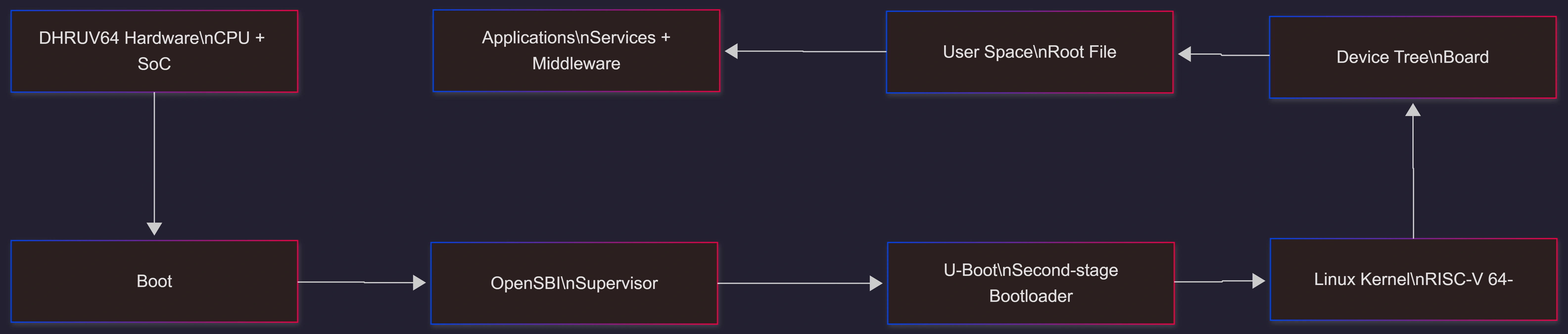
Key architectural components
Boot firmware
Boot ROM initializes minimal hardware and hands control to OpenSBI.
OpenSBI provides the RISC-V Supervisor Binary Interface required by Linux.
U-Boot loads the kernel, device tree, and initial ramdisk.
Linux kernel
64-bit RISC-V kernel
SMP enabled for dual-core operation
architecture-specific patches for timers, interrupts, and memory controllers
configuration tuned for DHRUV64 peripherals
Device tree
describes memory layout
enumerates SoC peripherals
defines clocks, interrupts, and pin multiplexing
acts as the contract between hardware and kernel
User space
typically built using BusyBox, Debian, Yocto, or Buildroot
includes standard GNU utilities and libraries
supports SSH, networking, storage, and system services
Step-by-Step Walkthrough
Booting Druva64 Linux on DHRUV64 hardware
This walkthrough reflects a typical embedded Linux boot flow.
Power on and reset
power rails stabilize
reset deasserts
CPU begins execution from the on-chip boot ROM
OpenSBI initialization
OpenSBI sets up privilege levels
initializes timers and basic interrupt handling
prepares the environment expected by the Linux kernel
OpenSBI is critical in RISC-V systems because Linux runs in supervisor mode and relies on SBI calls for low-level services.
U-Boot execution
initializes DRAM
configures clocks and peripherals
loads kernel image, device tree, and optional initramfs
passes control to the kernel
U-Boot is also used for recovery, diagnostics, and firmware updates.
Linux kernel startup
decompresses kernel
initializes MMU and caches
brings up secondary core (SMP)
probes devices defined in the device tree
mounts root filesystem
User space initialization
init system starts (e.g., SysV init, systemd, or BusyBox init)
network and storage services come online
application services start
At this point, Druva64 Linux behaves like any other embedded Linux system.
Code / JSON Snippets
Checking Druva64 Linux system identity
uname -a
uname -m
cat /proc/device-tree/model
Expected indicators:
riscv64architectureboard model referencing DHRUV64 or associated reference platform
Minimal device tree fragment example
This illustrates how hardware is described to the kernel.
/ {
  model = "DHRUV64 Reference Board";
  compatible = "cdac,dhruv64";

  cpus {
    #address-cells = <1>;
    #size-cells = <0>;

    cpu0: cpu@0 {
      device_type = "cpu";
      compatible = "riscv";
      reg = <0>;
    };

    cpu1: cpu@1 {
      device_type = "cpu";
      compatible = "riscv";
      reg = <1>;
    };
  };

  memory@80000000 {
    device_type = "memory";
    reg = <0x0 0x80000000 0x0 0x40000000>;
  };
};
Sample workflow JSON for Druva64 Linux deployment
{
  "workflow_name": "druva64_linux_deployment",
  "target_platform": "DHRUV64",
  "stages": [
    {
      "stage": "firmware_setup",
      "tasks": [
        "build_opensbi",
        "configure_u_boot",
        "flash_bootloader"
      ]
    },
    {
      "stage": "kernel_enablement",
      "tasks": [
        "configure_riscv_kernel",
        "apply_dhruv64_patches",
        "build_kernel_image"
      ]
    },
    {
      "stage": "rootfs_build",
      "tasks": [
        "select_build_system",
        "add_network_tools",
        "enable_ssh_access"
      ]
    },
    {
      "stage": "validation",
      "tasks": [
        "boot_test",
        "smp_verification",
        "peripheral_testing"
      ]
    },
    {
      "stage": "production",
      "tasks": [
        "lock_boot_settings",
        "sign_images",
        "prepare_update_mechanism"
      ]
    }
  ]
}
Use Cases / Scenarios
Strategic and government systems
Druva64 Linux is well-suited for long-lifecycle systems that require:
transparent source code
predictable update policies
alignment with indigenous hardware programs
security hardening and auditability
Education and research
Universities and research labs benefit from:
full-stack visibility from silicon to application
hands-on exposure to RISC-V Linux internals
opportunities to contribute upstream patches
Industrial and embedded products
Common deployments include:
control systems
secure gateways
storage and networking appliances
monitoring and telemetry nodes
Linux reduces time-to-market while preserving flexibility.
Limitations / Considerations
Ecosystem maturity
As with any new hardware platform:
some drivers may be early-stage
documentation may evolve over time
third-party middleware validation may be limited
Teams should plan for in-house enablement during early adoption.
Performance tuning
Out-of-the-box Linux configurations prioritize stability. For production systems:
kernel configuration should be trimmed
scheduler and memory parameters tuned
compiler flags aligned with supported RISC-V extensions
Long-term maintenance
A controlled Linux fork increases autonomy but also responsibility. Best practice is to:
track upstream Linux closely
upstream non-sensitive patches
maintain reproducible build pipelines
Fixes
Linux boots, but peripherals are missing
Likely cause:
incorrect or incomplete device tree
Fix:
audit device tree bindings
verify clock and interrupt assignments
compare against the reference board DTS files
Second core is not online
Likely cause:
OpenSBI or kernel SMP configuration issue
Fix:
Confirm OpenSBI version compatibility
verify kernel
CONFIG_SMPand RISC-V optionsInspect boot logs for secondary CPU bring-up messages
System instability under load
Likely cause:
memory timing issues
thermal throttling
aggressive power management defaults
Fix:
validate DRAM configuration
monitor temperatures
Simplify power management during initial validation
FAQs
1. Is Druva64 Linux a new Linux distribution?
No. It is a hardware-aligned Linux platform built around standard Linux components, tailored specifically for the DHRUV64 processor.
2. Can standard Linux applications run on Druva64 Linux?
Yes, provided they are compiled for 64-bit RISC-V and do not depend on unavailable hardware features.
3. Is Druva64 Linux open source?
It is built on open-source components. Availability of specific patches and BSPs depends on program policies and release practices.
4. Is Druva64 Linux suitable for production systems?
Yes, with proper validation, security hardening, and lifecycle planning, it can serve production-grade embedded systems.
References
Linux Kernel Documentation (RISC-V Architecture)
RISC-V Privileged Architecture Specification
OpenSBI Project Documentation
Embedded Linux development best practices
Government publications on indigenous microprocessor initiatives
Conclusion
Druva64 Linux is the software foundation that transforms the DHRUV64 processor from a silicon milestone into a usable computing platform. By combining standard Linux with hardware-specific enablement, it delivers familiarity, flexibility, and strategic independence.
Its success is measured not by novelty but by stability, transparency, and sustained ecosystem growth. For developers and organizations working with indigenous RISC-V hardware, Druva64 Linux provides a practical, extensible, and future-ready operating environment.
Join the conversation! Your thoughts help the community grow.