

- Diving Into Python: Chapter 1
- Diving Into Python: Chapter 2
- Diving Into Python: Chapter 3
- Diving Into Python: Chapter 4
- Diving Into Python: Chapter 5
- Diving Into Python: Chapter 6
- Diving Into Python: Chapter 7
- Diving Into Python: Chapter 8
- Diving Into Python: Chapter 9
- Diving Into Python: Chapter 10
A tuple can be defined as “A sequence of immutable Python objects.”
In simpler words, a Tuple can be defined as a sequence and it can be of any type (either homogeneous or heterogeneous) based on functionality and the requirements of the program, just like lists in Python.
Pin Points
As I said above in this article, tuples are similar to lists. So is there any difference between them?
Yes, there is a catch, let's have a look:
- Tuples are not dynamic like lists, here dynamic means tuples can't be changed, unlike lists.
- Tuples use small brackets, whereas lists use square brackets.
(For more info regarding lists, kindly visit my previous article.)
Creating a Simple Tuple
You can represent a tuple as:
tup1 = (‘.NET’, ‘HTML5’, ‘Python’);
or
tup1 = “.NET”, “HTML5”, “Python”;
or
tup1 = (1, 2, 3, 5, 8);
or
# An empty tuple
tup1 = ();
Special Case:
Assume you want to put only one element into a tuple. Be careful, because there is a catch. Let's have a look.
Tup1 = (1, );
As you can see, there is still a comma, in spite of being only one element in the list.
Accessing Tuples
To access the values in the tuple, we use square brackets. That square bracket will access the index to obtain the value available at that index.
Example
# Defining Tuples
tup1 = ('.NET', 'HTML5', 'Python');
tup2 = "C#", "CSS", "Django";
tup3 = (1, 2, 3);
# Accessing Tuples
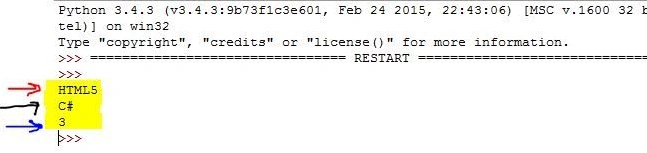
print (tup1[1])
print (tup2[0])
print (tup3[2])
Output
 Operations on Tuple
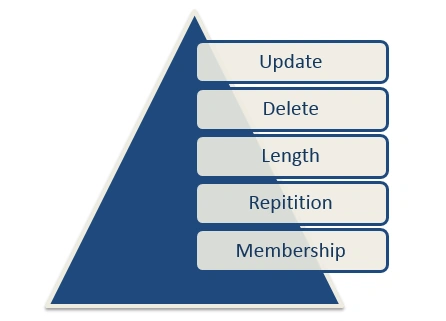
Now to explain some of the basic operations on tuples.
Operations on Tuple
Now to explain some of the basic operations on tuples.
- Tuples | Update
As I said earlier, tuples are not dynamic (we can't change tuple values). But there is always an alternate or different way to do a certain operation in any programming language and it is in Python.In Python, one can take portions of existing tuples to create new tuples. In simple words, you can call it the concatenation of two tuples. Let's have a look at how.Exampletup1 = ('.NET', 'HTML5', 'Python');
tup2 = "C#", "CSS", "Django";# Creating a new Tuple
tup3 = (tup1 + tup2);
print (tup3)Output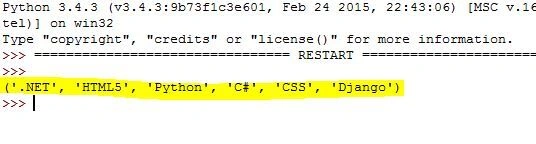
- Tuple | Delete
In Python you can never delete a single tuple, so you need to always delete a complete tuple. To delete a tuple in Python we use the del statement.Exampletup = ('.NET', 'HTML5', 'Python');
del (tup)
print (tup)Output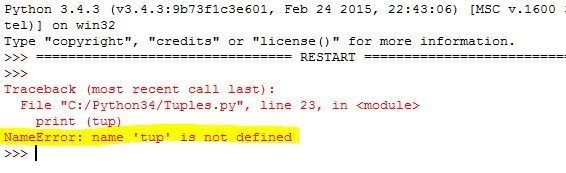 You will get an error message, like this:
- Tuple | Length
A tuple length can be defined using len, the same as we use to do for strings and in several other programming languages.Examplea = len ('C# Corner')print (a)Output: 9
- Tuple | Repitition
To repeat an entire tuple or a tuple value any number of times, we do use tuple repetition. This can be done by using "*".Example
- Repetitions of an entire tuple:
a = ("Goodbye World!")*2
print (a)OutputGoodbye World!Goodbye World! - Repetitions of a certain value of tuple:
a = ("Goodbye World!", "Hello World!" *2)
print (a)Output('Goodbye World!', 'Hello, World! Hello World!')
- Repetitions of an entire tuple:
- Tuple | Membership
This operation works somewhat like Boolean. It checks or verifies the values in a certain tuple then the result is either true or false.Example
- Condition- True
a = (1, 2, 3, 4)
b = 3 in a
print (b)Output: True - Condition- False
a = (1, 2, 3, 4)
b = 5 in a
print (b)Output: False
- Condition- True
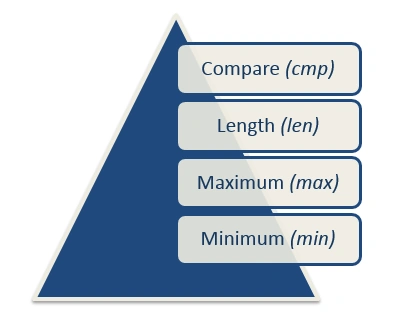
- Tuple | Compare
This built-in function is used for comparing the two tuples. It compares them in terms of there values.Exampletuple1 = ('CSK', 180)
tuple2 = ('MI', 175)
print (cmp(tuple1, tuple2))
print (cmp(tuple2, tuple1))Output-1, 1 - Tuple | Length
As the name of this built-in function suggests, it is used for getting the length of any tuple value from a tuple.Exampletup = len ('C# Corner')
print (a)Output: 9 - Tuple | Maximum
As the name of this built-in function suggests, it is used for fetching the max tuple value or max tuple from the given set of tuples and values.Exampletup1 = ('DOTNET', 'JAVA')
tup2 = ('PYTHON', 'C')
print ("Max value : ", max(tup1))
print ("Max value : ", max(tup2))
print ("Max value :", max(tup2, tup1))Output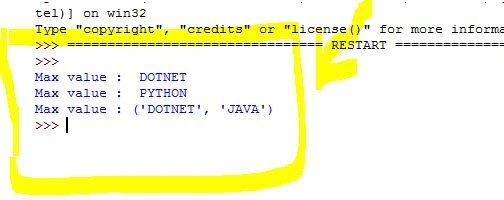
- Tuple | Minimum
As the name of this built-in function suggests, it is used for fetching the min tuple value or min tuple from the given set of tuples and values.Exampletup1 = ('DOTNET', 'JAVA')
tup2 = ('PYTHON', 'C')
print ("Min value : ", min(tup1))
print ("Min value : ", min(tup2))
print ("Min value :", min(tup2, tup1))Output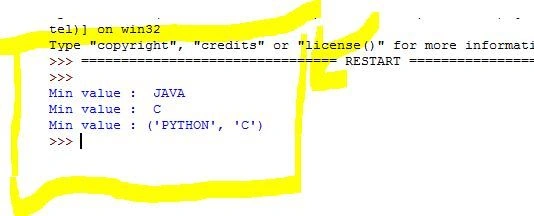
Guidelines from my Side
- Do as much as code you can
- Code anything you want, the best way to learn
- Don't just study things, try to learn them
- Work on your concepts
- Work on the fundamentals of any technology or stuff you want to learn
Moto
“Keep calm and code Python”.
I tried to make this an interesting and interactive article and wish you guys will like that, meanwhile if you have any suggestions then your welcome.
Until the next part, keep sharing!
Guest UserPosted May 21, 2015, 2:37 AM
dude I read all 12 articles. really cool
Abhishek JaiswalPosted May 20, 2015, 3:52 AM
Thank you guys!! :)
Gowtham RajamanickamPosted May 20, 2015, 1:13 AM
nice content
Gopi ChandPosted May 19, 2015, 4:59 PM
Nice content and explanation too.. :)