
Introduction
They are unable to remove the complex idea of the grey area because of their ignorance, and the blockchain concept (which overlaps with Web 3.0) is still in its infancy. It existed before the internet and computer revolutions. Even indirect users once believed fax was comparable to email. The distinction between computer science and computer applications continues to be a challenge. So once more, welcome to the new tech reformation. The majority of people not having a crystal clear understanding of the recently constructed system is like trying to catch lightning in a bottle, though!
If internet consumers are aware of the direction the internet is going, they are aware of the terms Metaverse and Web3. On social media websites like Facebook, YouTube, Twitter, and Instagram, these two terms were frequently utilized.
When the internet and IT world attempt to become familiar with Metaverse, discussions on Web3 are equally crucial. Furthermore, these ideas would have a big and lasting effect on connectivity in the future. Therefore, it is essential to consider the variations and implications for the end of the tech universe. It turns out that despite certain similarities between Meta and Web3, they both represent distinct methodologies.
Introduction to Web3?
As we all know, inventions are born out of necessity. Thus, the idea of Web3 or Web 3.0 seems to address the following issues,
- How would you feel if your computer could decipher data's meaning?
- What if it could identify individuals, companies, products, and data?
- Wouldn't it be better if they understood our areas of interest?
What is Web3?
In the web 3.0 revolution, decentralized protocols such as blockchain, the technology behind bitcoin transactions, will be used. It strives to address the critical concerns of data ownership and control in order to eliminate some of the fundamental shortcomings and flaws of the current internet era.
Let us look at the object from a different perspective.
Today, a considerable portion of the worldwide population relies heavily on internet-related services provided by major technology corporations. Contrary to Google, Apple, and Amazon, these businesses impose restrictions on the services that customers can use and serve as a conduit between consumers and their desired outcomes.
Web3 doesn't require authorization and runs on a decentralized network. In other words, internet service providers do not have the legal authority to control who utilizes their services. Furthermore, they do not operate as a go-between for users and their demands.
Are you prepared to enter the Metaverse? Everything you need to know about the Metaverse in 2023 is covered in our step-by-step beginner's guide.
Web3 Components
AI stands for Artificial Intelligence.
Because of advances in artificial intelligence, helpful forecasts and, in some cases, lifesaving acts can now be made. Despite the fact that Web 2.0 has seen some AI, it remains mostly human-driven as long as the big IT companies control the majority of internet traffic. As a result, corrupt behaviors such as biased product reviews, rigged ratings of some online services, and human errors are unavoidable. Most internet review platforms allow customers to submit feedback. Unfortunately, businesses frequently engage big groups of people to write good product or service ratings.
People may be paid to rate an app or service adversely and submit nasty reviews. The purpose of Web 3.0 is to limit the frequency of such manipulations. Artificial intelligence is an important component of the internet because it helps distinguish between legitimate and fraudulent operations, allowing users to receive more accurate information.
Blockchain System
Blockchain technology is a fundamental aspect of Web3. Decentralization is central to web3, which is based on blockchain technology. Data is decentralized, open, and may be distributed using blockchain technology. As a result, users control their data and can freely exchange it without fear of losing ownership, losing privacy, or relying on intermediaries. It also allows you to check in securely via the Internet without being tracked.
Furthermore, the utilization of blockchain-based tokens and cryptocurrencies in Web3 are critical features of the coming internet era. Users can receive rewards for their contributions to the platform's growth by publicly monetizing and donating to online upgrades, among other things.
VR and AR
Users collaborate, learn, play, entertain, and play games with other individuals in a metaverse. Based on a number of technologies, most of which are Virtual Reality (VR) and Augmented Reality (AR) (AR).
The company's blockchain projects use fungible (dividendable and exchangeable) tokens to purchase digital assets such as virtual land or avatar clothes. The Metaverse is still in its infancy and hasn't reached its full potential. Even at that level, Internet consumers and developers see immense potential in this technology.
Following is a list of several people's future metaverse expectations;
- Metaverse technology is a key component of Web3, and it will be constructed utilizing blockchain systems and open standards, and it will be administered by a global network of computers rather than a single company.
- Three technologies will be employed to create Web3 applications: augmented reality, virtual reality, and holographic projections.
- To facilitate virtual reality transactions, a non-fungible token (NFT) will be employed.
- Traditional gatekeepers would be powerless to limit access to the metaverse.
What are the distinguishing features of Web3?
Web3 is self-governing, stateful, resilient, and has native built-in payments. It possesses the following characteristics:
-
Decentralized
Because decentralized Web3 data is kept in the blockchain, no single system has complete access to it. It is spread across several platforms. This promotes decentralized access while increasing the likelihood of failure. - Permissionless
Users in Web3 can access the Internet without requiring specific permissions. Certain services will not require users to input personal information in order to access them. There will be no need to violate anyone's privacy or reveal any other information.
- Secure
Web 3.0 is more secure than Web 2.0 because decentralization makes it more difficult for hackers to target specific databases.
What Is The Use Of Web3?
In the context of Ethereum, decentralized apps operated on a blockchain are referred to as Web3. Participation in these apps is free, and your personal information is never sold.
Blockchain technology and cryptocurrencies are being utilized to encourage decentralization as part of the next generation of the internet. The Web 3.0 platform is intended to provide users with access to their personal data. As a result, people will be able to give services to one another and govern portions of the internet that they use without relying on large computer companies.
Examples of web3 applications include:
- Bitcoin
The world's most popular cryptocurrency is a prime example of a decentralized transaction.
- Apple Siri is a great example of Web3 technology ( Web 3.0). Since the 4s model's Siri, the AI assistant has extended its skills. Siri is a complex and individualized platform that employs speech recognition and AI technology.
- Opensea is a blockchain-based trading platform for NFTs.
- Google Cloud: The tech titan unveiled plans to transform Web3 into a cloud system.
What is Metaverse?
A metaverse is a network of three-dimensional virtual environments focused on social interaction. It is frequently portrayed in futuristic and science fiction as a hypothetical iteration of the Internet as a single, universal virtual environment made possible by the usage of virtual and augmented reality headgear.
The term "metaverse" is a combination of the words "meta" and "universe," and it first appeared in the 1992 science fiction novel Snow Crash.
The development of virtual world platforms such as Second Life has resulted in the creation of several metaverses for public usage. One characteristic of several metaverse iterations is the blending of virtual and physical spaces, as well as virtual economics. Virtual reality technology is frequently related to metaverse development in order to boost immersion.
It has exaggerated the progress of different technologies and undertakings as a public relations word. Privacy, addiction, and safety are concerns within metaverses, as they are in the social media and video gaming industry as a whole.
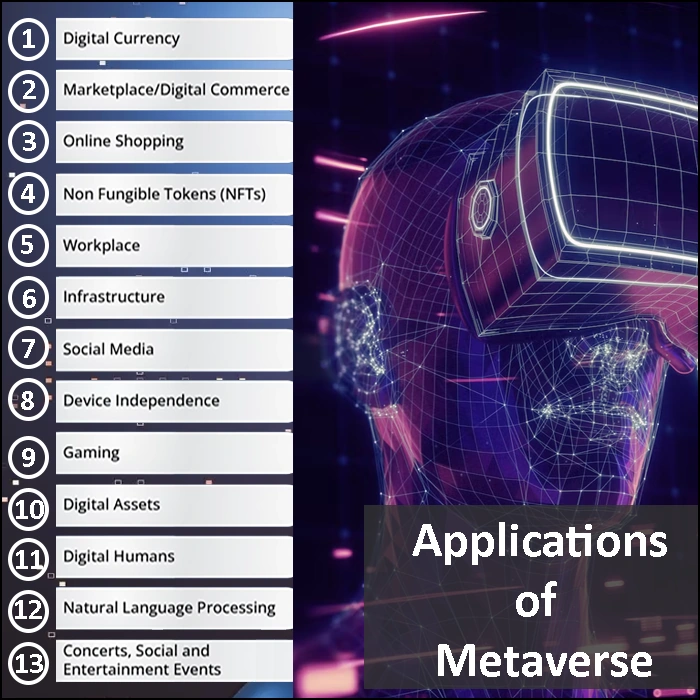
Applications of Metaverse
Virtual Reality
- In 2019, Facebook Horizon, a social VR realm, made its premiere in virtual reality.
- Mark Zuckerberg, Facebook's chairman, claimed that the business will create a metaverse in 2021.
- Meta Platforms has sponsored a number of virtual reality technologies that are still in the works.
- AltspaceVR, a virtual reality firm, was founded by Microsoft in 2017.
- Microsoft Teams now includes metaverse functionality in addition to virtual avatars and virtual reality meetings.
- Metaverse technology will be used in e-commerce, real estate, e-learning environments, job output optimization, and fashion.
Video Games
- Metaverse technologies have long been implemented into modern internet-enabled video games.
- Second Life combines numerous components of social networking into a three-dimensional reality with avatars that represent users.
- Social functions are important in many massively multiplayer online games.
- Minecraft's social gameplay is a novel parallel to a metaverse.
Hardware Engineering
- The metaverse can be accessed via smartphones and general-purpose computers.
- The list has been expanded to include augmented reality (AR), mixed reality (MR), virtual reality (VR), and virtual worlds.
- The necessity for VR technology has stifled large-scale metaverse expansion and acceptance.
- Limited mobile hardware and the need to balance cost and design have restricted mobility and high-quality graphics.
- The urge for retina display pixel density has increased with the emergence of lightweight wireless headsets.
- At the moment, hardware development is focused on overcoming the constraints of VR headsets, and sensors, and boosting immersion through haptic technology.
Software Development
- For metaverse applications, a standardized technical need has not been universally adopted.
- Currently, the majority of applications rely on proprietary technologies.
- Interoperability is a major concern in the construction of metaverses.
- A number of projects have standardized virtual environments.
- The Metaverse is a multidimensional Internet populated by real people.
- NVIDIA's metaverse development tools will be accepted in USD beginning in 2021, according to the company.
- The OpenXR open standard can be used to create virtual and augmented reality plans and involvements.
- Microsoft and Valve have approved it for HoloLens 2, Meta Platforms for Oculus Quest, and SteamVR.
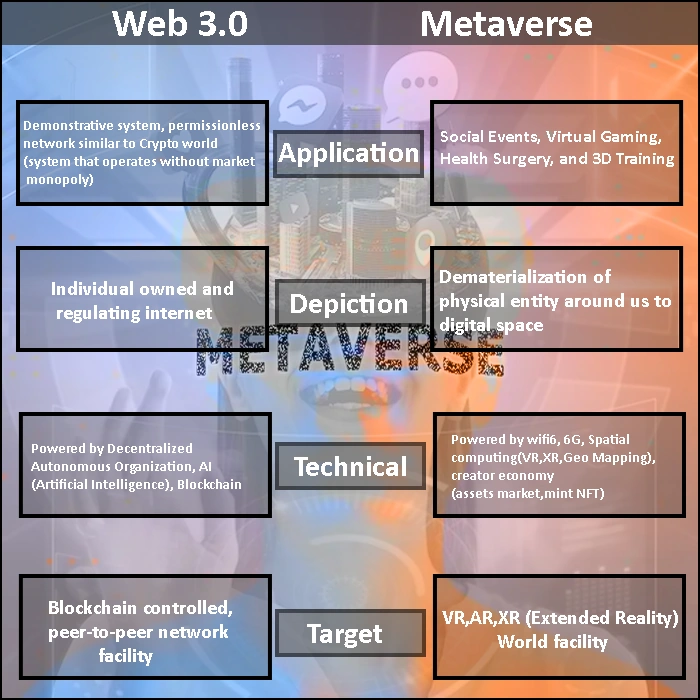
Difference between Web3 and Metaverse
Conclusion
We can conclude that the metaverse is a three-dimensional universe in which you can interact with three-dimensional companions, items, and locations. You can, for example, play games with your pals from the creator's ground.
Users of Web3 can nurture, own, sell, and acquire their material. Users can charge for their creations as well.
Because this system is still in its early phases, we must constantly study it to determine if it wants to widen the split or assimilate in the near future.
Join the conversation! Your thoughts help the community grow.