

🔎 Introduction
In machine learning, choosing the right approach is crucial. At its core, the choice often comes down to supervised vs. unsupervised learning. Both have strengths and weaknesses, but understanding their differences lets you pick the best tool for the job—and even combine them for powerful hybrid solutions.
📘 What Is Supervised Learning?
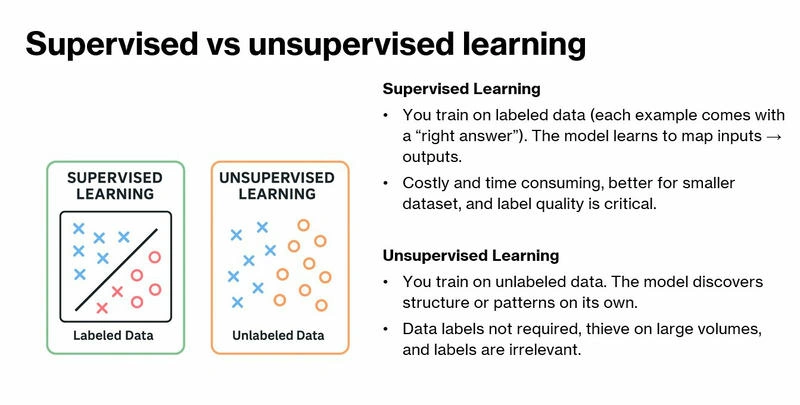
Supervised learning uses labeled data, meaning each training example comes with a known “correct answer.” The model’s job is to learn the mapping:
Input features → Target labels
Common tasks
- Classification: Predict a category (e.g., “spam” vs. “not spam”)
- Regression: Predict a continuous value (e.g., house price)
Pros
- Clear objective and easily measurable performance (accuracy, RMSE)
- Fast convergence when data quality is high
Cons
- Requires labeled data, which can be expensive to collect
- Risk of overfitting if dataset is small
🗂️ What Is Unsupervised Learning?
Unsupervised learning works with unlabeled data, letting the model discover hidden patterns on its own. There’s no ground truth—just raw data.
Primary goals
- Clustering: Group similar items (customer segments)
- Dimensionality Reduction: Simplify data (PCA, t‑SNE)
- Anomaly Detection: Find outliers (fraud, faults)
Pros
- No labeling cost—vast amounts of data available
- Can uncover unexpected structures
Cons
- Harder to evaluate (no “right answer”)
- May find patterns that aren’t useful
⚖️Supervised Learning vs Unsupervised Learning
| Aspect | Supervised Learning | Unsupervised Learning |
|---|---|---|
| Data | Labeled | Unlabeled |
| Goal | Predict known outputs | Discover hidden structure |
| Examples | Classification, Regression | Clustering, Dimensionality Reduction |
| Evaluation | Accuracy, Precision, MSE | Silhouette score, Reconstruction error |
| Use Cases | Spam filters, Price prediction | Market segmentation, Anomaly detection |
| Cost | High (labeling effort) | Low (no labels needed) |
🌐 Real‑World Use Cases
🔍 Supervised Learning
- Email Spam Detection: Models trained on millions of labeled spam/non‑spam emails.
- Credit Scoring: Predict default risk using historical loan data.
- Image Recognition: Tagging photos with objects or people.
🧩 Unsupervised Learning
- Customer Segmentation: Group shoppers by buying behavior for targeted marketing.
- Fraud Detection: Spot unusual transactions without predefined fraud labels.
- Feature Engineering: Compress thousands of sensor readings into a handful of key indicators.
🛠️ Choosing the Right Approach
-
Data Availability
-
Lots of labeled data → go supervised.
-
Only raw data or labeling is too costly → start unsupervised.
-
-
Project Goal
-
Need specific predictions → supervised.
-
Exploring data patterns or outliers → unsupervised.
-
-
Hybrid Options
-
Semi‑Supervised Learning: Pair a small labeled set with a larger unlabeled set.
-
Self‑Supervised Learning: Pretrain on unsupervised tasks (e.g., mask‑prediction) then fine‑tune on supervised objectives.
-
🔮 Future Trends
- Self‑Supervised Pretraining: Language models like BERT learn from raw text by masking words, then fine‑tune on labeled tasks.
- Automated Machine Learning (AutoML): Platforms that automatically choose between supervised/unsupervised methods and tune hyperparameters.
- Explainable AI (XAI): Tools to interpret both supervised and unsupervised models, making their decisions transparent.
✅ Conclusion
Supervised and unsupervised learning each serve distinct roles. Never ignore one for the other—start by exploring your data unsupervised, then apply supervised methods for targeted predictions. Embrace hybrid and self‑supervised strategies to reduce labeling costs and boost performance. With the right mindset, you’ll leverage both to build smarter, more resilient AI systems.
Join the conversation! Your thoughts help the community grow.