

Introduction

Choosing the right framework for a new JavaScript system, application, or website is the top priority nowadays. It can have a direct effect on a project’s durability, ability to fit in deadlines, further code maintainability, and scalability of your future app. Angular and React are two new web technologies on the rise. Many business owners, technical decision-makers, and project managers are having difficulties in making a choice between these two. The amount of JavaScript tools is steadily increasing, turning the selection of appropriate technology into a challenge. While among the top discussions is AngularJS vs. ReactJS, both are highly-performing, advanced, and widely used worldwide.
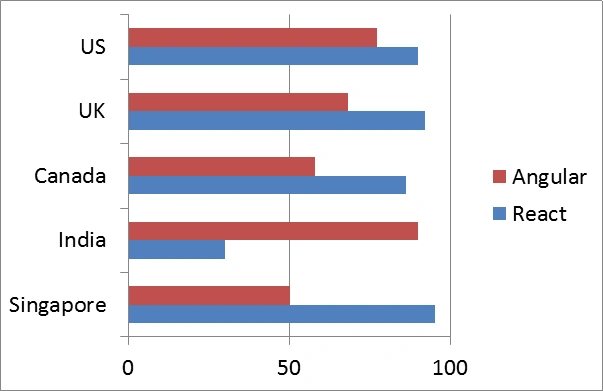
Let us take a close look at the world-wide popularities of both, Angular and React.
 Attributes
AngularJS
Disadvantages of AngularJS
React JS
Disadvantages of React JS
Let us have a quick overview of the attributes in both the frameworks.
| Technology | AngularJS | ReactJS |
| Developer / Creator | ||
| Language | Java Script, HTML | JSX |
| Packaging | Medium | Strong |
| DOM | Regular DOM | Virtual DOM |
| Native Support | Native Script | React Native |
| Rendering | Server Side | Server Side |
| Size | 766k | 151k |
| Performance | Above Avg. | Faster |
AngularJS is developed with the primary purpose of addressing single page application development. AngularJS works with the MVC platform, where it simplifies development by providing a reliable solution. AngularJS follows some guidelines, like Angular data binding. In Angular, the Model and the View are linked to allow automatic data synchronization between the two.
Let us see some advantages of AngularJS.
- Complete Framework
AngularJS is a complete framework that can run in any browser or platform. Angular is consistent, overwhelmed with ready-made tools, ng components are robust and quite mature, as contrasted with React.
- Two-Way Data Binding
This property is probably the top feature of AngularJS, as it diffuses the impact after every minor data change and does away with the need for further effort with data sync in View and Model.
- Architecture
AngularJS has a component-based architecture. Components have deep binding and each of them comprises elements with only relevant functionality. They are loosely coupled and properly encapsulated. Such an approach makes components easily re-usable, enhances their testability, and further maintainability.
Steep learning curve and complexity are the main weak points of AngularJS. Like any other client-side rendering technology in the JavaScript framework comparison list, programmers should place special emphasis on security to make apps reliable and safe.
ReactJS provides us a high-performance client and server-side rendering with a one-way flow for data binding. ReactJS is based on building reusable components of the code base which make an app very lightweight, more of a library that makes it quite easy to work with.
React is more of a library than a framework. It can best be described as an application view that allows the programmer to utilize reusable components again and again. It is composed of its own React libraries, tools, and solutions that developers can use to build their own JS framework.
Let us see the advantages of React JS.
- JSX Syntax
JSX is a JS syntax that allows the developer to use HTML quotes and usage of HTML tag syntax for subcomponents rendering. It promotes the building of machine-readable code and provides the ability to compound components in one compile-time verified file.
- Rendering
Rendering is the best feature of React that gives a significant edge over Angular. The technology comprises smart methods to mitigate the amount of DOM operations, optimize and accelerate the updates process. Virtual DOM is of great use while handling vast databases.
ReactJS is not a full-scale framework and for this very reason integration of the UI library into a common MVC framework requires good programming knowledge.
So, after this complete discussion, we can’t say which is better - ReactJS or AngularJS. Both technologies are the best at their prospective purpose. Depending upon the custom app goal, we can use anyone. Angular usually assumes the creation of a core skeleton for a front-end app, whereas React.js can be applied to improve its specific parts.
I hope you have enjoyed this article. Stay tuned for the next article in which we will study about components of ReactJS.
Former memberPosted Jul 27, 2021, 5:32 AM
I really like reading through a post that can make people think. Also, many thanks for permitting me to comment!
Mahesh ChandPosted Jun 5, 2017, 7:29 AM
Good feedback, DJ. Will ask Author to review and correct. Unfortunately, Editors can't be expert in all technologies. Their job is to check the correctness of grammar, spellings etc. It is up to Authors responsibility and readers to point out if any issues.
Former memberPosted Jun 5, 2017, 7:18 AM
Since I am not very known of REACT so cant comment on REACT side but for Angular, editor should check some of the technical correctness and terms being used
Former memberPosted Jun 5, 2017, 7:17 AM
Author is using the word "deep binding" for Angular architecture . I never heard the word DEEP BINDING and any official doc of Angular. Another misleading point.
Former memberPosted Jun 5, 2017, 7:16 AM
The language of article says that is deep copied from some articles written on Angular in 2015. I am sorry and do not want to be rude but everything almost about Angular in this article is misleading.
Former memberPosted Jun 5, 2017, 7:14 AM
Angular does not have in built two way data binding. It is combination of property and event binding and known as banana in the box syntax to achieve [(ngModel)]. However, this article says - "this feature is TOP feature of Angular". This line is completely wrong
Former memberPosted Jun 5, 2017, 7:13 AM
There are many think need to be edited. For example, logo of Angular is wrong. Chart has just country name and some number. It does not have any information about unit of number such that thousand or hundred ? Spelling of JavaScript is wrong in many places. For Packaging it says Angular has medium and React has strong. This information is gross misleading. I would like to see source from where author has taken this point.
Former memberPosted Jun 5, 2017, 3:59 AM
Hi editor, can we change title of this article ? this article talks about difference between Angular and ReactJS instead of AngularJS and ReactJS. Keep in mind that AngularJS name is for 1.x versions, whereas for >2.x naming is only Angular . As Igor said in his talk "It is Angular, not AngularJS " ; Happy to help editor team, if you need mentoring in editing and verifying technically correctness of an article . Cheers - DJ
Former memberPosted Jun 1, 2017, 5:34 AM
Angular does not have server side rendering, angular supports only native script , angular performance is just above average etc etc. If author has any real data to show that angular performance is that bad please show it otherwise delete that point.
Chukiat BPosted May 31, 2017, 5:03 PM
Any idea, why only India is higher on Angular?