

In .NET development, errors can occur at two different stages of application development: compilation and runtime. It is important to understand the difference between these two types of errors to debug effectively and write good, error free code. Let’s look at the differences between compilation and runtime errors, with some examples.

What is a Compilation Error?
Compilation errors occur when the source code cannot be successfully compiled into an executable program. These errors are detected during the build process, before the application is run. Compilation errors typically result from syntax errors, missing references, or type mismatches.
Common Causes of Compilation Errors
- Syntax Errors: These are Mistakes in the structure or rules of the programming language.
- Missing References: Required libraries or namespaces not included.
- Type Mismatches: Assigning incompatible data types.
Example
using System;

class Program
{
    static void Main()
    {
        int number = "abc"; // Error: Cannot implicitly convert type 'string' to 'int'.
        Console.WriteLine(number);
    }
}
Output
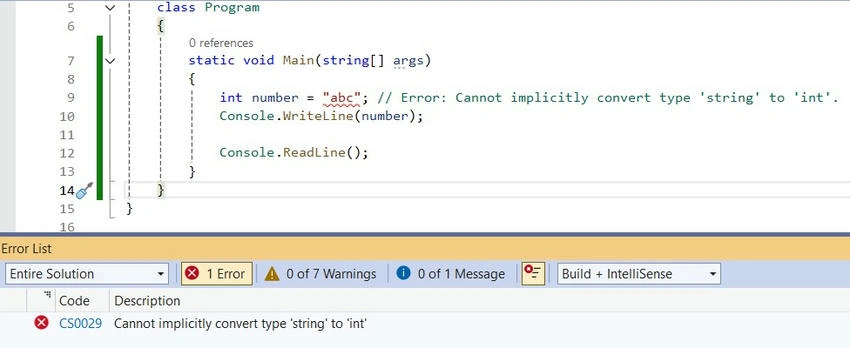
Explanation: In this example, a string is being assigned to an int variable, causing a type mismatch. This error will be flagged during compilation, and the program will not execute until it is resolved.
What is a Runtime Error?
Runtime errors occur after the application has been successfully compiled and is being executed. These errors are often due to unforeseen scenarios during program execution, such as invalid user input, unavailable resources, or logical errors.
Common Causes of Runtime Errors
- Null Reference Exceptions: Attempting to access a member of a null object.
- Index Out of Range Exceptions: Accessing elements outside the bounds of an array or list.
- Division by Zero: Performing division with a denominator of zero.
Example
using System;

class Program
{
    static void Main()
    {
        int[] numbers = { 1, 2, 3 };
        Console.WriteLine(numbers[5]); // Error: Index was outside the bounds of the array.
    }
}
Output
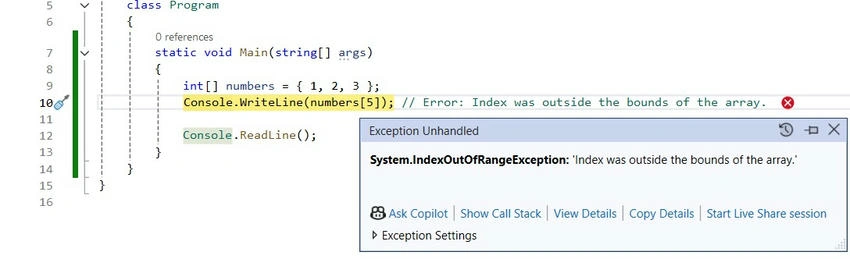
Explanation: In this example, the code tries to access an element at index 5 in an array of size 3. This will compile successfully, but during execution, it will throw an IndexOutOfRangeException because the index does not exist.
Differences Between Compilation and Runtime Errors
| Aspect | Compilation Errors | Runtime Errors |
|---|---|---|
| Occurrence | During the compilation phase | During program execution |
| Detection | Caught by the compiler | Caught by runtime exceptions |
| Impact | Prevents the program from running | Halts or disrupts the program's execution |
| Examples | Syntax errors, type mismatches | Null references, division by zero |
| Resolution | Requires fixing the code and recompiling | Requires debugging and handling exceptions |
Handling Errors in .NET
Compilation Errors
To handle compilation errors.
- Use an IDE like Visual Studio, which provides real-time syntax checking and IntelliSense.
- Use code analysis tools to catch potential issues early.
- Regularly build the project to catch errors early.
Runtime Errors
To handle runtime errors.
- Implement exception handling using try-catch blocks.
- Validate user input to ensure correctness.
- Use logging to monitor application behavior.
- Test thoroughly, including edge cases.
Example
using System;

class Program
{
    static void Main()
    {
        try
        {
            int denominator = 0;
            int result = 10 / denominator; // Will throw DivideByZeroException
        }
        catch (DivideByZeroException ex)
        {
            Console.WriteLine("Error: Division by zero is not allowed.");
        }
    }
}
Output
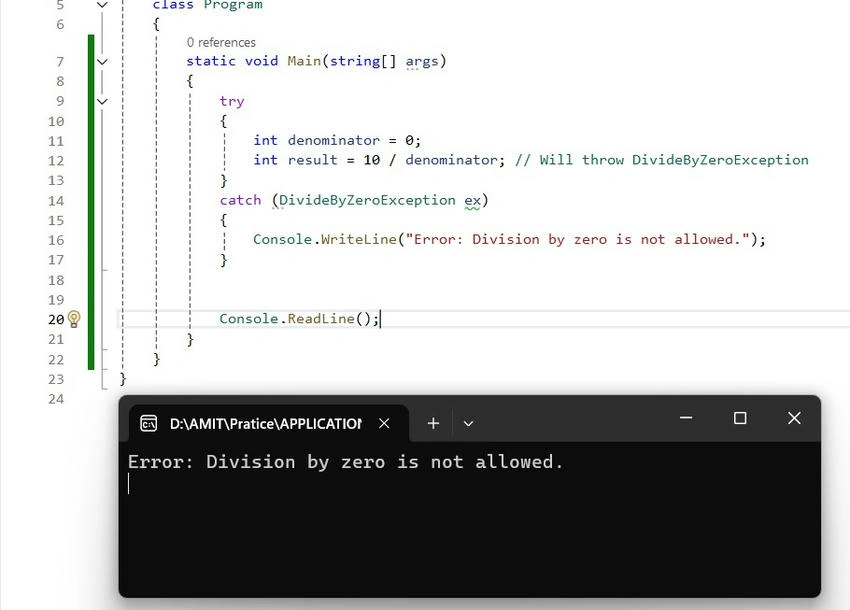
Explanation: The try-catch block ensures the program handles the division by zero gracefully instead of crashing.
Conclusion
Compilation errors and runtime errors are both important parts of software development in .NET. Compilation errors are easier to find and fix while writing code, but runtime errors need proper testing and good error handling. By understanding and fixing these errors correctly, developers can build more stable and reliable applications.
Join the conversation! Your thoughts help the community grow.