

As .NET developers, we love the simplicity of async and await – they make asynchronous code read like synchronous code, keeping our applications responsive without the nightmare of callbacks. But have you ever wondered what really happens under the hood when the C# compiler sees an async method?
The magic lies in a compiler-generated state machine. Let's take a straightforward, non-complex look at this mechanism, based entirely on official Microsoft documentation.
What Does async/await Solve?
Traditional synchronous I/O operations (such as reading from a file or calling a web API) block the calling thread until they complete. In UI apps, this freezes the interface; in server apps, it wastes threads.
async / await enables non-blocking asynchronous operations while keeping code linear and readable.
The Compiler's Transformation: From Method to State Machine
When you mark a method with async , the C# compiler doesn't execute your code as-is. Instead, it rewrites the method into a state machine .
The compiler generates a struct that implements
IAsyncStateMachine.This struct holds:
The current state (an integer indicating where execution paused).
Captured local variables and parameters (lifted into fields so they survive across awaits).
The method builder (e.g.,
AsyncTaskMethodBuilderforTaskreturns).
The original method becomes a stub : it creates the state machine on the stack, initializes it, and starts it.
The bulk of your code moves into the state machine's
MoveNext()method, which uses aswitchstatement on the state to jump to the right point after resumption.
Importantly: If the async method completes synchronously (all awaited operations are already done), the state machine stays on the stack – no heap allocation occurs . Only when a true await pauses execution does it box the struct to the heap.
A view of async program navigation and tracing:
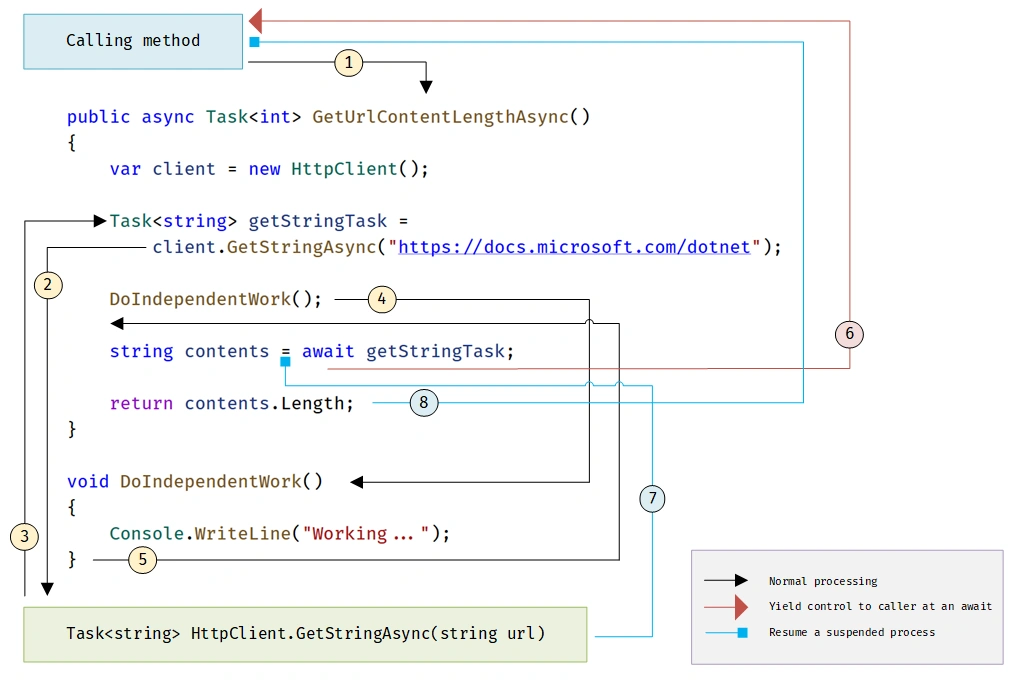
A Simple Example
Consider this method:
    public async Task<int> DownloadDataAsync(string url)
{
    using var client = new HttpClient();
    string data = await client.GetStringAsync(url);
    return data.Length;
}
At compile time :
The compiler rewrites the async method into a state machine struct (see below).
It generates a tiny stub method that replaces your original method signature (see below).
Your method body is moved into the state machine's
MoveNext()method, split by state.
At runtime (when the method is called):
The generated stub creates an instance of the state machine struct (on the stack initially).
It initializes the state machine (sets state to -1, captures parameters/locals if needed).
The stub calls
MoveNext()to begin execution.
Inside MoveNext() (where your original code lives):
Execution runs from the current state until an await is reached.
If the awaited task (e.g., GetStringAsync) is already complete → continues synchronously (fast path, no heap allocation).
If the task is incomplete → registers a continuation, returns control immediately (non-blocking), and pauses.
When the task completes later → the continuation calls
MoveNext()again, resuming exactly after the await using the saved state and captured values.
"The compiler transforms your program into a state machine. This construct tracks various operations and state in your code, such as yielding execution when the code reaches an await expression, and resuming execution when a background job completes."
Compiler-generated state machine (simplified pseudo-code – approximate view from decompilers like SharpLab or ILSpy in Release mode):
    // Roughly what the compiler generates (struct in Release builds)
private struct <DownloadDataAsync>d__1 : IAsyncStateMachine
{
    public int <>1__state;                      // State: -1 = start, 0 = awaiting, -2 = done
    public AsyncTaskMethodBuilder<int> <>t__builder;
    public string url;                          // Captured parameter
    private string <data>5__2;                  // Lifted local variable
    private HttpClient <client>5__3;            // Using variable also lifted

    private void MoveNext()
    {
        int num = this.<>1__state;
        try
        {
            if (num == -1)                          // Initial execution
            {
                this.<client>5__3 = new HttpClient();
                Task<string> getTask = this.<client>5__3.GetStringAsync(this.url);

                var awaiter = getTask.GetAwaiter();
                if (!awaiter.IsCompleted)
                {
                    this.<>1__state = 0;            // Mark as awaiting
                    this.<>t__builder.AwaitUnsafeOnCompleted(ref awaiter, ref this);
                    return;                         // Pause here – continuation calls MoveNext later
                }

                // Fast path if already complete
                this.<data>5__2 = awaiter.GetResult();
            }
            else                                    // num == 0 → resumption after await
            {
                // Awaiter is already captured from previous call
                // (In real code, awaiter is stored in a field during pause)
                this.<data>5__2 = /* awaiter.GetResult() logic */;
            }

            // Code after await
            int result = this.<data>5__2.Length;

            // Cleanup
            this.<client>5__3?.Dispose();

            // Set final result
            this.<>1__state = -2;
            this.<>t__builder.SetResult(result);
        }
        catch (Exception exception)
        {
            this.<>1__state = -2;
            this.<>t__builder.SetException(exception);
        }
    }

    // IAsyncStateMachine interface methods
    void IAsyncStateMachine.MoveNext() => MoveNext();
    // SetStateMachine(...) omitted for brevity
}
The original method becomes a stub like this (Roughly):
    public Task<int> DownloadDataAsync(string url)
{
    var stateMachine = new <DownloadDataAsync>d__1();
    stateMachine.<>t__builder = AsyncTaskMethodBuilder<int>.Create();
    stateMachine.url = url;
    stateMachine.<>1__state = -1;
    stateMachine.<>t__builder.Start(ref stateMachine);
    return stateMachine.<>t__builder.Task;
}
Why This Matters
Understanding the state machine helps explain:
Zero-allocation fast path for synchronous completion.
Why locals are captured (they become fields on the struct because they are needed for pausing and resuming states).
Performance characteristics (minimal overhead when done right).
Next time you write async / await , remember: you're not just writing cleaner code – you're leveraging sophisticated compiler magic that turns sequential logic into an efficient state machine!
#CSharp #DotNet #AsyncAwait #ProgrammingTips
(References: All explanations and concepts drawn from devblogs.microsoft.com/dotnet and learn.microsoft.com/dotnet/csharp)
Mohsin AzamPosted Jan 28, 2026, 8:00 AM
Good article!
Safwan MasarikPosted Jan 28, 2026, 5:12 AM
Amazing explanation. I understood it. Thanks.