

Apache Airflow has become the de facto standard for orchestrating data engineering pipelines, offering flexibility, scalability, and observability. For back-end developers, data engineers, and project managers, mastering Airflow’s advanced features ensures reliable, secure, and efficient pipeline execution. Below are key techniques to elevate your pipeline management skills.
Apache Airflow pipeline architecture diagram
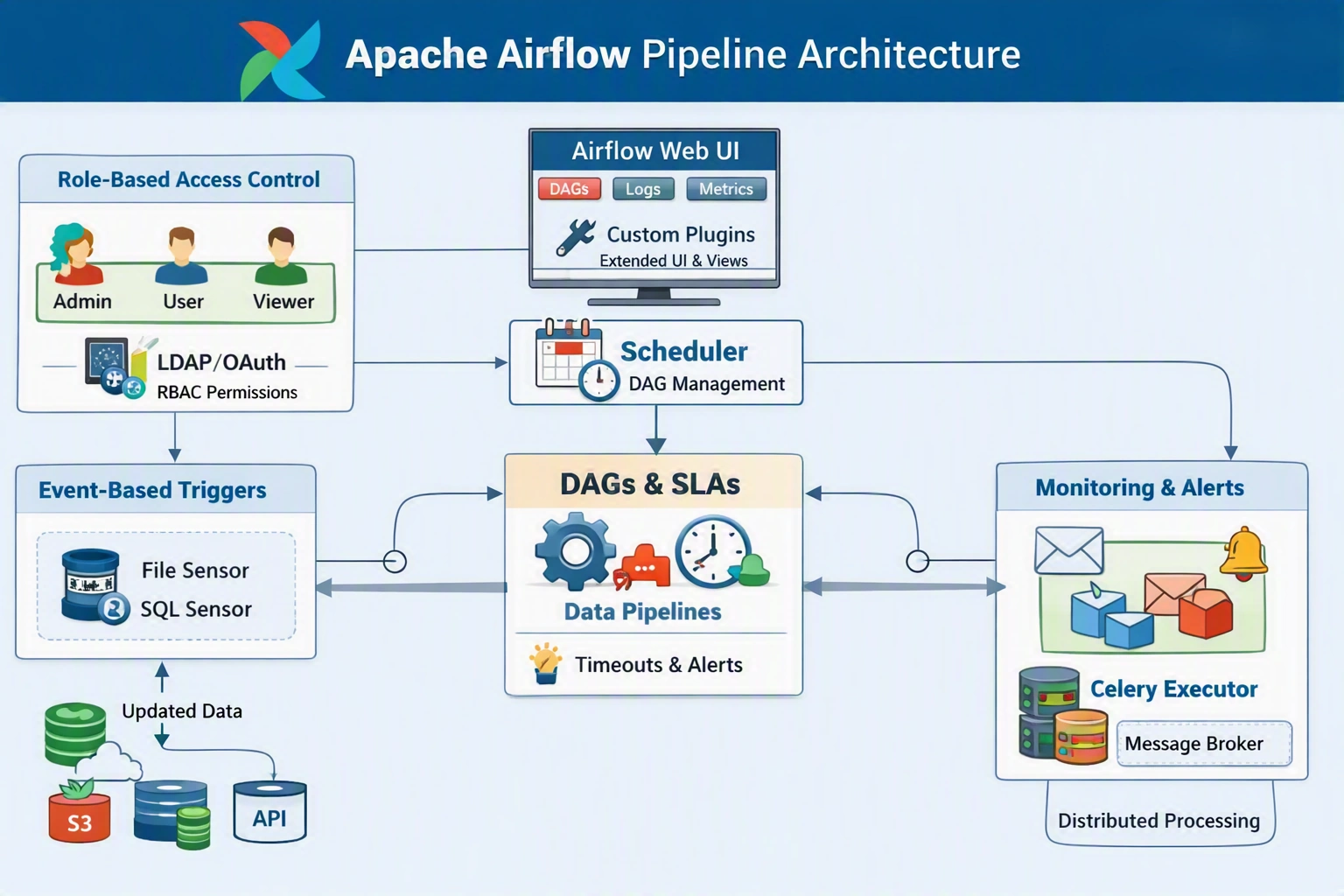
This diagram shows the flow from data sources, through event-based triggers, DAGs with SLAs, monitoring, and distributed execution.
Role-Based Access Control with Simple and FAB Auth Managers
Objective
Ensure secure and controlled access to Airflow resources.
Implementation
In
airflow.cfg, set:
auth_backend = airflow.contrib.auth.backends.fab_authSimple Auth Manager: Ideal for development environments with minimal user roles.
FAB (Flask App Builder) Auth Manager: Provides enterprise-level RBAC with granular permissions and LDAP/OAuth integration.
Best Practices:
Assign roles such as Admin, User, and Viewer.
Enforce least-privilege access.
Audit user actions regularly through Airflow’s built-in logging.
Outcome
A secure environment where only authorized personnel can trigger, modify, or monitor workflows.
Managing Execution Timeouts and Deadlines
Objective
Prevent long-running tasks and ensure SLA compliance.
Implementation
Task-level timeouts: Use
execution_timeoutto cap runtime.
PythonOperator(
    task_id='transform_data',
    python_callable=transform,
    execution_timeout=timedelta(minutes=30)
)
DAG-level SLAs: Define
sla_miss_callbackfor missed deadlines.
dag = DAG(
    'data_pipeline',
    sla_miss_callback=notify_sla_miss,
    schedule_interval='@daily'
)
Retries and Alerts: Configure email or Slack notifications for failures.
Best Practices
Set realistic timeouts based on historical task performance.
Combine SLAs with monitoring dashboards for proactive management.
Outcome
Reliable pipelines that maintain performance and prevent resource exhaustion.
Scheduling DAGs Based on Data Asset Updates
Objective
Trigger workflows dynamically when data changes.
Implementation
Sensors: Use
FileSensororSqlSensorto detect updates in files or tables.
file_sensor = FileSensor(
    task_id='check_file',
    filepath='/data/input.csv',
    poke_interval=300,
    timeout=3600
)
Event-driven DAGs: Replace static cron schedules with conditional triggers.
sql_sensor = SqlSensor(
    task_id='check_table_update',
    sql='SELECT COUNT(*) FROM updates WHERE date = CURDATE()',
    conn_id='mysql_conn'
)
Dynamic Scheduling: Automate downstream tasks based on data freshness.
Best Practices
Implement backoff intervals to avoid excessive polling.
Use external triggers for large-scale data ingestion workflows.
Outcome
Data pipelines that respond intelligently to real-time data availability.
Customizing the Airflow UI with Plugins
Objective
Enhance usability and visibility for engineering and business teams.
Implementation
Create custom views and dashboards using Flask-based plugins.
Extend operator functionality for domain-specific tasks.
Integrate company branding and shortcuts for frequent actions.
Best Practices
Keep plugin logic modular and version-controlled.
Test UI extensions in staging before production deployment.
Outcome
A tailored Airflow interface that improves monitoring and collaboration.
Scaling Airflow with the Celery Executor
Objective
Enable distributed task execution for high-volume pipelines.
Implementation
Configure
CeleryExecutorinairflow.cfg.
executor = CeleryExecutorUse Redis or RabbitMQ as message brokers.
broker_url = redis://localhost:6379/0
result_backend = db+mysql://airflow:password@localhost/airflow
Deploy multiple worker nodes for parallel processing.
airflow celery workerBest Practices
Monitor worker health using Celery Flower.
Balance workloads across nodes to prevent bottlenecks.
Use autoscaling for dynamic resource allocation.
Outcome
A horizontally scalable Airflow environment capable of handling enterprise workloads efficiently.
Enterprise Considerations
High Availability: Deploy Airflow with redundant schedulers and workers.
Monitoring: Integrate with Prometheus or Grafana for metrics visualization.
Version Control: Store DAGs in Git for traceability and rollback.
Compliance: Align RBAC and audit trails with organizational security policies.
Conclusion
Effective pipeline management in Apache Airflow requires more than just writing DAGs. By implementing RBAC for security, timeouts for reliability, event-driven scheduling for freshness, UI customization for usability, and Celery for scalability, you can build robust, production-ready data engineering workflows.
Join the conversation! Your thoughts help the community grow.