

Introduction
Android is one of the most popular operating systems for mobile. The User can access the internet through the Browser. Each Browser has the Web view module. The web view is the most important thing in Android and Web development. Thus, I will show you how to create a Web view Android Application, using Android Studio. Android is a kernel-based operating system. It allows the user to modify the GUI components and the source code.
Requirements
- Android Studio.
- Little bit XML and Java knowledge.
- Android emulator (or) an Android mobile.
- Stable internet connection during the execution.
- Download link (Android Studio)
Steps to be followed are given below
Carefully follow my steps to create Web view Android Application, using Android Studio and I have included the source code given below.
Step 1
Open Android Studio. Start the new project.
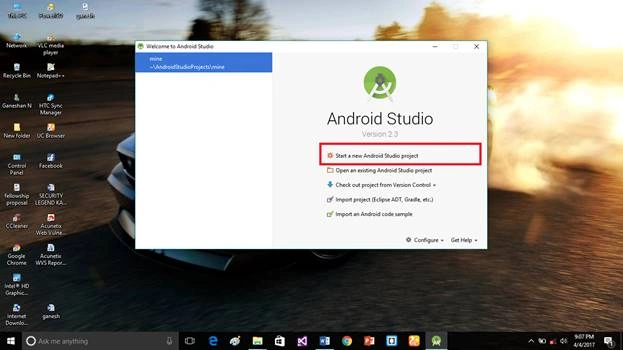
Step 2
Put the Application name and the company domain. If you wish to use C++ to code the project, mark Include C++ support, followed by clicking Next.
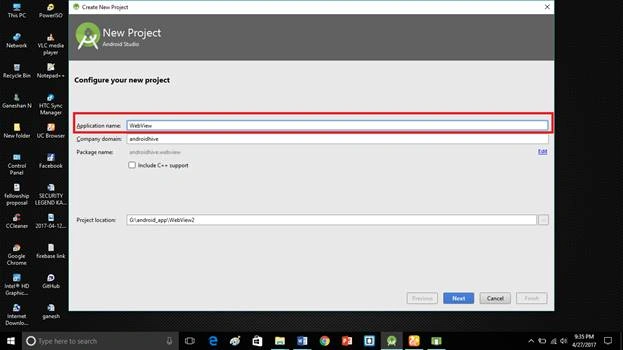
Step 3
Select Android minimum SDK. Afterward, you chose the minimum SDK. It will show an approximate percentage of the people using the SDK, followed by clicking Next.
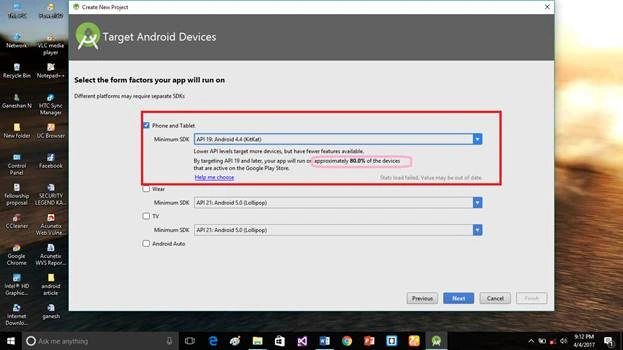
Step 4
Choose the basic activity, followed by clicking Next.
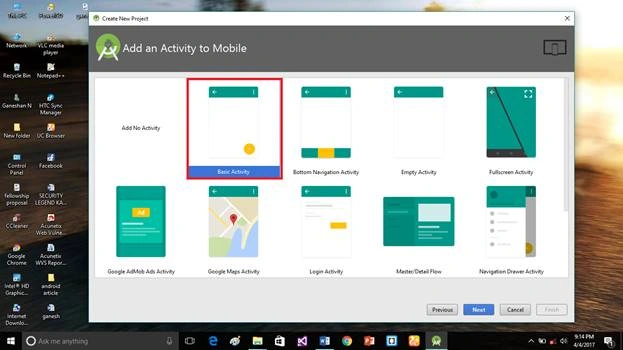
Step 5
Put the activity name and the layout name. Android Studio basically takes a Java class name, which provides the activity name and click Finish.
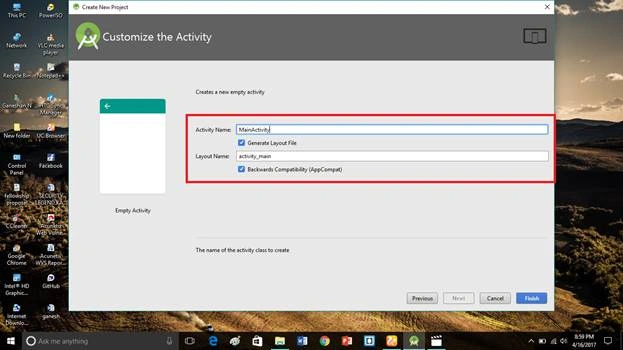
Step 6
Go to activity_main.xml, followed by clicking the text bottom. This XML file contains the designing code for an Android app. Into the activity_main.xml, copy and paste the code given below.
Activity_main.xml code
- <?xml version="1.0" encoding="utf-8"?>
- <android.support.design.widget.CoordinatorLayout xmlns:android="http://schemas.android.com/apk/res/android"
- xmlns:app="http://schemas.android.com/apk/res-auto"
- android:id="@+id/main_content"
- android:layout_width="match_parent"
- android:layout_height="match_parent"
- android:background="@android:color/white"
- android:fitsSystemWindows="true">
- <android.support.design.widget.AppBarLayout
- android:id="@+id/appbar"
- android:layout_width="match_parent"
- android:layout_height="@dimen/detail_backdrop_height"
- android:fitsSystemWindows="true"
- android:theme="@style/ThemeOverlay.AppCompat.Dark.ActionBar">
- <android.support.design.widget.CollapsingToolbarLayout
- android:id="@+id/collapsing_toolbar"
- android:layout_width="match_parent"
- android:layout_height="match_parent"
- android:fitsSystemWindows="true"
- app:contentScrim="?attr/colorPrimary"
- app:expandedTitleMarginEnd="64dp"
- app:expandedTitleMarginStart="48dp"
- app:expandedTitleTextAppearance="@android:color/transparent"
- app:layout_scrollFlags="scroll|exitUntilCollapsed">
- <RelativeLayout
- android:layout_width="wrap_content"
- android:layout_height="wrap_content">
- <ImageView
- android:id="@+id/backdrop"
- android:layout_width="match_parent"
- android:layout_height="match_parent"
- android:fitsSystemWindows="true"
- android:scaleType="centerCrop"
- app:layout_collapseMode="parallax" />
- </RelativeLayout>
- <android.support.v7.widget.Toolbar
- android:id="@+id/toolbar"
- android:layout_width="match_parent"
- android:layout_height="?attr/actionBarSize"
- app:layout_collapseMode="pin"
- app:popupTheme="@style/ThemeOverlay.AppCompat.Light" />
- </android.support.design.widget.CollapsingToolbarLayout>
- </android.support.design.widget.AppBarLayout>
- <include layout="@layout/content_main" />
- <ProgressBar
- android:id="@+id/progressBar"
- style="@style/Widget.AppCompat.ProgressBar.Horizontal"
- android:layout_width="match_parent"
- android:layout_height="wrap_content"
- android:layout_marginTop="-7dp"
- android:indeterminate="true"
- app:layout_behavior="@string/appbar_scrolling_view_behavior" />
- </android.support.design.widget.CoordinatorLayout>
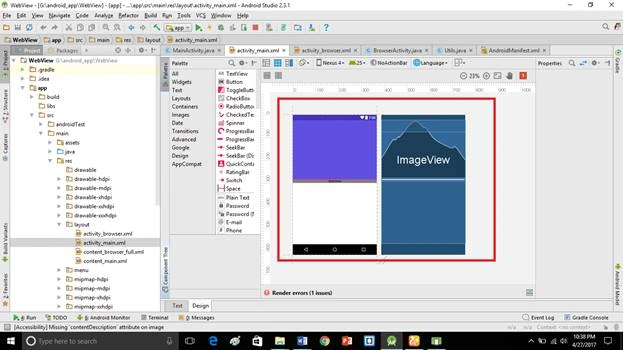
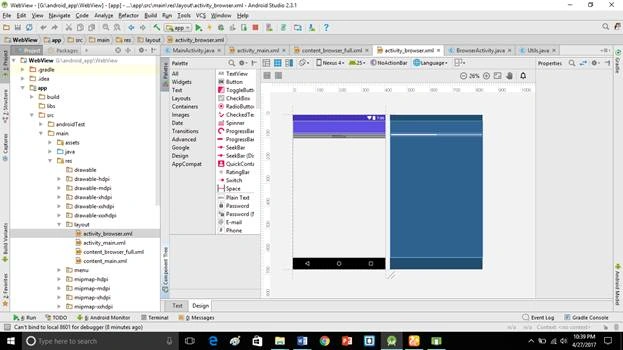
Create a new activity_browser.xml file (File ⇒ New ⇒Activity⇒Empty_activity).
Go to activity_browser.xml, followed by clicking the text bottom. This XML file contains the designing code for an Android app. In activity_browser.xml, copy and paste the code given below.
activity_browser.xml code
- <?xml version="1.0" encoding="utf-8"?>
- <android.support.design.widget.CoordinatorLayout xmlns:android="http://schemas.android.com/apk/res/android"
- xmlns:app="http://schemas.android.com/apk/res-auto"
- xmlns:tools="http://schemas.android.com/tools"
- android:id="@+id/main_content"
- android:layout_width="match_parent"
- android:layout_height="match_parent"
- android:background="@android:color/white"
- android:fitsSystemWindows="true"
- tools:context=".BrowserActivity">
- <android.support.design.widget.AppBarLayout
- android:layout_width="match_parent"
- android:layout_height="wrap_content"
- android:theme="@style/AppTheme.AppBarOverlay">
- <android.support.v7.widget.Toolbar
- android:id="@+id/toolbar"
- android:layout_width="match_parent"
- android:layout_height="?attr/actionBarSize"
- android:background="?attr/colorPrimary"
- app:popupTheme="@style/AppTheme.PopupOverlay" />
- </android.support.design.widget.AppBarLayout>
- <include layout="@layout/content_browser_full" />
- <ProgressBar
- android:id="@+id/progressBar"
- style="@style/Widget.AppCompat.ProgressBar.Horizontal"
- android:layout_width="match_parent"
- android:layout_height="wrap_content"
- android:layout_marginTop="-7dp"
- android:indeterminate="true"
- android:visibility="gone"
- app:layout_behavior="@string/appbar_scrolling_view_behavior" />
- </android.support.design.widget.CoordinatorLayout>
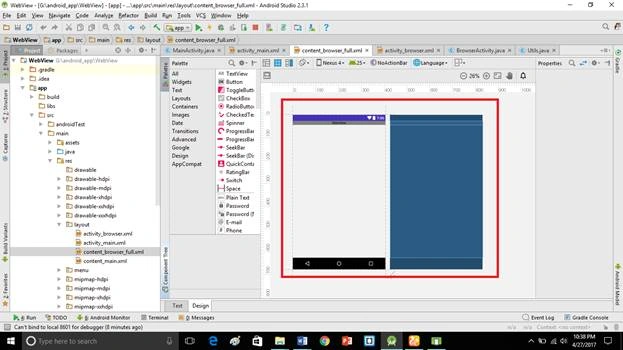
Create a new content_browser_full.xml file (File ⇒ New ⇒Activity⇒Empty_activity).
Go to content_browser_full.xml then click the text bottom. This XML file contains the designing code for android app. In content_browser_full.xml, copy and paste the code given below.
content_browser_full.xml code
- <?xml version="1.0" encoding="utf-8"?>
- <android.support.v4.widget.NestedScrollView xmlns:android="http://schemas.android.com/apk/res/android"
- xmlns:app="http://schemas.android.com/apk/res-auto"
- android:layout_width="match_parent"
- android:layout_height="match_parent"
- android:fadeScrollbars="false"
- android:scrollbarFadeDuration="0"
- app:layout_behavior="@string/appbar_scrolling_view_behavior">
- <WebView
- android:id="@+id/webView"
- android:layout_width="match_parent"
- android:layout_height="wrap_content" />
- </android.support.v4.widget.NestedScrollView>
MainActivity.java code
- import android.content.Context;
- import android.content.Intent;
- import android.os.Bundle;
- import android.support.design.widget.AppBarLayout;
- import android.support.design.widget.CollapsingToolbarLayout;
- import android.support.v7.app.AppCompatActivity;
- import android.support.v7.widget.Toolbar;
- import android.text.TextUtils;
- import android.view.MotionEvent;
- import android.view.View;
- import android.webkit.WebChromeClient;
- import android.webkit.WebView;
- import android.webkit.WebViewClient;
- import android.widget.ImageView;
- import android.widget.ProgressBar;
- import com.bumptech.glide.Glide;
- import com.bumptech.glide.load.engine.DiskCacheStrategy;
- public class MainActivity extends AppCompatActivity {
- private String postUrl = "/members/ganeshan-n";
- private WebView webView;
- private ProgressBar progressBar;
- private float m_downX;
- private ImageView imgHeader;
- @Override
- protected void onCreate(Bundle savedInstanceState) {
- super.onCreate(savedInstanceState);
- setContentView(R.layout.activity_main);
- Toolbar toolbar = (Toolbar) findViewById(R.id.toolbar);
- setSupportActionBar(toolbar);
- getSupportActionBar().setDisplayHomeAsUpEnabled(true);
- webView = (WebView) findViewById(R.id.webView);
- progressBar = (ProgressBar) findViewById(R.id.progressBar);
- imgHeader = (ImageView) findViewById(R.id.backdrop);
- if (!TextUtils.isEmpty(getIntent().getStringExtra("postUrl"))) {
- postUrl = getIntent().getStringExtra("postUrl");
- }
- initWebView();
- initCollapsingToolbar();
- renderPost();
- }
- private void initWebView() {
- webView.setWebChromeClient(new MyWebChromeClient(this));
- webView.setWebViewClient(new WebViewClient() {
- @Override
- public boolean shouldOverrideUrlLoading(WebView view, String url) {
- if (Utils.isSameDomain(postUrl, url)) {
- Intent intent = new Intent(MainActivity.this, MainActivity.class);
- intent.putExtra("postUrl", url);
- startActivity(intent);
- } else {
- // launch in-app browser i.e BrowserActivity
- openInAppBrowser(url);
- }
- return true;
- }
- @Override
- public void onPageFinished(WebView view, String url) {
- super.onPageFinished(view, url);
- progressBar.setVisibility(View.GONE);
- }
- });
- webView.clearCache(true);
- webView.clearHistory();
- webView.getSettings().setJavaScriptEnabled(true);
- webView.setHorizontalScrollBarEnabled(false);
- webView.setOnTouchListener(new View.OnTouchListener() {
- public boolean onTouch(View v, MotionEvent event) {
- if (event.getPointerCount() > 1) {
- //Multi touch detected
- return true;
- }
- switch (event.getAction()) {
- case MotionEvent.ACTION_DOWN: {
- // save the x
- m_downX = event.getX();
- }
- break;
- case MotionEvent.ACTION_MOVE:
- case MotionEvent.ACTION_CANCEL:
- case MotionEvent.ACTION_UP: {
- // set x so that it doesn't move
- event.setLocation(m_downX, event.getY());
- }
- break;
- }
- return false;
- }
- });
- }
- private void renderPost() {
- webView.loadUrl(postUrl);
- }
- private void openInAppBrowser(String url) {
- Intent intent = new Intent(MainActivity.this, BrowserActivity.class);
- intent.putExtra("url", url);
- startActivity(intent);
- }
- private void initCollapsingToolbar() {
- final CollapsingToolbarLayout collapsingToolbar =
- (CollapsingToolbarLayout) findViewById(R.id.collapsing_toolbar);
- collapsingToolbar.setTitle(" ");
- AppBarLayout appBarLayout = (AppBarLayout) findViewById(R.id.appbar);
- appBarLayout.setExpanded(true);
- // hiding & showing the txtPostTitle when toolbar expanded & collapsed
- appBarLayout.addOnOffsetChangedListener(new AppBarLayout.OnOffsetChangedListener() {
- boolean isShow = false;
- int scrollRange = -1;
- @Override
- public void onOffsetChanged(AppBarLayout appBarLayout, int verticalOffset) {
- if (scrollRange == -1) {
- scrollRange = appBarLayout.getTotalScrollRange();
- }
- if (scrollRange + verticalOffset == 0) {
- collapsingToolbar.setTitle("Web View");
- isShow = true;
- } else if (isShow) {
- collapsingToolbar.setTitle(" ");
- isShow = false;
- }
- }
- });
- // loading toolbar header image
- Glide.with(getApplicationContext()).load("http://www.ourlonelyuniverse.com/wp-content/uploads/2016/01/google-dont-be-evil.png")
- .thumbnail(0.5f)
- .crossFade()
- .diskCacheStrategy(DiskCacheStrategy.ALL)
- .into(imgHeader);
- }
- private class MyWebChromeClient extends WebChromeClient {
- Context context;
- public MyWebChromeClient(Context context) {
- super();
- this.context = context;
- }
- }
- }
Step 10
Create a new BrowserActivity.java file (File ⇒ New ⇒Java class).
In the BrowserActivity.java, copy and paste the code given below. Java programming is the backend language for Android. Do not replace your package name, otherwise, the app will not run.
BrowserActivity.java code
- import android.content.Context;
- import android.graphics.Bitmap;
- import android.os.Bundle;
- import android.support.design.widget.CoordinatorLayout;
- import android.support.design.widget.Snackbar;
- import android.support.v7.app.AppCompatActivity;
- import android.support.v7.widget.Toolbar;
- import android.text.TextUtils;
- import android.view.Menu;
- import android.view.MenuItem;
- import android.view.MotionEvent;
- import android.view.View;
- import android.webkit.WebChromeClient;
- import android.webkit.WebResourceError;
- import android.webkit.WebResourceRequest;
- import android.webkit.WebView;
- import android.webkit.WebViewClient;
- import android.widget.ProgressBar;
- public class BrowserActivity extends AppCompatActivity {
- private String url;
- private WebView webView;
- private ProgressBar progressBar;
- private float m_downX;
- CoordinatorLayout coordinatorLayout;
- @Override
- protected void onCreate(Bundle savedInstanceState) {
- super.onCreate(savedInstanceState);
- setContentView(R.layout.activity_browser);
- Toolbar toolbar = (Toolbar) findViewById(R.id.toolbar);
- setSupportActionBar(toolbar);
- getSupportActionBar().setDisplayHomeAsUpEnabled(true);
- getSupportActionBar().setTitle("");
- url = getIntent().getStringExtra("url");
- // if no url is passed, close the activity
- if (TextUtils.isEmpty(url)) {
- finish();
- }
- webView = (WebView) findViewById(R.id.webView);
- progressBar = (ProgressBar) findViewById(R.id.progressBar);
- coordinatorLayout = (CoordinatorLayout) findViewById(R.id.main_content);
- initWebView();
- webView.loadUrl(url);
- }
- private void initWebView() {
- webView.setWebChromeClient(new MyWebChromeClient(this));
- webView.setWebViewClient(new WebViewClient() {
- @Override
- public void onPageStarted(WebView view, String url, Bitmap favicon) {
- super.onPageStarted(view, url, favicon);
- progressBar.setVisibility(View.VISIBLE);
- invalidateOptionsMenu();
- }
- @Override
- public boolean shouldOverrideUrlLoading(WebView view, String url) {
- webView.loadUrl(url);
- return true;
- }
- @Override
- public void onPageFinished(WebView view, String url) {
- super.onPageFinished(view, url);
- progressBar.setVisibility(View.GONE);
- invalidateOptionsMenu();
- }
- @Override
- public void onReceivedError(WebView view, WebResourceRequest request, WebResourceError error) {
- super.onReceivedError(view, request, error);
- progressBar.setVisibility(View.GONE);
- invalidateOptionsMenu();
- }
- });
- webView.clearCache(true);
- webView.clearHistory();
- webView.getSettings().setJavaScriptEnabled(true);
- webView.setHorizontalScrollBarEnabled(false);
- webView.setOnTouchListener(new View.OnTouchListener() {
- public boolean onTouch(View v, MotionEvent event) {
- if (event.getPointerCount() > 1) {
- //Multi touch detected
- return true;
- }
- switch (event.getAction()) {
- case MotionEvent.ACTION_DOWN: {
- // save the x
- m_downX = event.getX();
- }
- break;
- case MotionEvent.ACTION_MOVE:
- case MotionEvent.ACTION_CANCEL:
- case MotionEvent.ACTION_UP: {
- // set x so that it doesn't move
- event.setLocation(m_downX, event.getY());
- }
- break;
- }
- return false;
- }
- });
- }
- @Override
- public boolean onCreateOptionsMenu(Menu menu) {
- // Inflate the menu; this adds items to the action bar if it is present.
- getMenuInflater().inflate(R.menu.browser, menu);
- if (Utils.isBookmarked(this, webView.getUrl())) {
- // change icon color
- Utils.tintMenuIcon(getApplicationContext(), menu.getItem(0), R.color.colorAccent);
- } else {
- Utils.tintMenuIcon(getApplicationContext(), menu.getItem(0), android.R.color.white);
- }
- return true;
- }
- @Override
- public boolean onPrepareOptionsMenu(Menu menu) {
- if (!webView.canGoBack()) {
- menu.getItem(1).setEnabled(false);
- menu.getItem(1).getIcon().setAlpha(130);
- } else {
- menu.getItem(1).setEnabled(true);
- menu.getItem(1).getIcon().setAlpha(255);
- }
- if (!webView.canGoForward()) {
- menu.getItem(2).setEnabled(false);
- menu.getItem(2).getIcon().setAlpha(130);
- } else {
- menu.getItem(2).setEnabled(true);
- menu.getItem(2).getIcon().setAlpha(255);
- }
- return true;
- }
- @Override
- public boolean onOptionsItemSelected(MenuItem item) {
- if (item.getItemId() == android.R.id.home) {
- finish();
- }
- if (item.getItemId() == R.id.action_bookmark) {
- // bookmark / unbookmark the url
- Utils.bookmarkUrl(this, webView.getUrl());
- String msg = Utils.isBookmarked(this, webView.getUrl()) ?
- webView.getTitle() + "is Bookmarked!" :
- webView.getTitle() + " removed!";
- Snackbar snackbar = Snackbar
- .make(coordinatorLayout, msg, Snackbar.LENGTH_LONG);
- snackbar.show();
- invalidateOptionsMenu();
- }
- if (item.getItemId() == R.id.action_back) {
- back();
- }
- if (item.getItemId() == R.id.action_forward) {
- forward();
- }
- return super.onOptionsItemSelected(item);
- }
- private void back() {
- if (webView.canGoBack()) {
- webView.goBack();
- }
- }
- private void forward() {
- if (webView.canGoForward()) {
- webView.goForward();
- }
- }
- private class MyWebChromeClient extends WebChromeClient {
- Context context;
- public MyWebChromeClient(Context context) {
- super();
- this.context = context;
- }
- }
- }
Step 11
Create a new Utils.java file (File ⇒ New ⇒Java class).
In Utils.java, copy and paste the code given below. Java programming is the backend language for Android. Do not replace your package name, otherwise, the app will not run.
Utils.java code
- import android.content.Context;
- import android.content.SharedPreferences;
- import android.graphics.PorterDuff;
- import android.graphics.drawable.Drawable;
- import android.support.v4.content.ContextCompat;
- import android.view.MenuItem;
- public class Utils {
- public static boolean isSameDomain(String url, String url1) {
- return getRootDomainUrl(url.toLowerCase()).equals(getRootDomainUrl(url1.toLowerCase()));
- }
- private static String getRootDomainUrl(String url) {
- String[] domainKeys = url.split("/")[2].split("\\.");
- int length = domainKeys.length;
- int dummy = domainKeys[0].equals("www") ? 1 : 0;
- if (length - dummy == 2)
- return domainKeys[length - 2] + "." + domainKeys[length - 1];
- else {
- if (domainKeys[length - 1].length() == 2) {
- return domainKeys[length - 3] + "." + domainKeys[length - 2] + "." + domainKeys[length - 1];
- } else {
- return domainKeys[length - 2] + "." + domainKeys[length - 1];
- }
- }
- }
- public static void tintMenuIcon(Context context, MenuItem item, int color) {
- Drawable drawable = item.getIcon();
- if (drawable != null) {
- // If we don't mutate the drawable, then all drawable's with this id will have a color
- // filter applied to it.
- drawable.mutate();
- drawable.setColorFilter(ContextCompat.getColor(context, color), PorterDuff.Mode.SRC_ATOP);
- }
- }
- public static void bookmarkUrl(Context context, String url) {
- SharedPreferences pref = context.getSharedPreferences("androidhive", 0); // 0 - for private mode
- SharedPreferences.Editor editor = pref.edit();
- // if url is already bookmarked, unbookmark it
- if (pref.getBoolean(url, false)) {
- editor.putBoolean(url, false);
- } else {
- editor.putBoolean(url, true);
- }
- editor.commit();
- }
- public static boolean isBookmarked(Context context, String url) {
- SharedPreferences pref = context.getSharedPreferences("androidhive", 0);
- return pref.getBoolean(url, false);
- }
- }
- <?xml version="1.0" encoding="utf-8"?>
- <manifest xmlns:android="http://schemas.android.com/apk/res/android"
- package="info.androidhive.webview" >
- <uses-permission android:name="android.permission.INTERNET"/>
- <application
- android:allowBackup="true"
- android:icon="@mipmap/ic_launcher"
- android:label="@string/app_name"
- android:supportsRtl="true"
- android:theme="@style/AppTheme.NoActionBar" >
- <activity android:name=".MainActivity" >
- <intent-filter>
- <action android:name="android.intent.action.MAIN" />
- <category android:name="android.intent.category.LAUNCHER" />
- </intent-filter>
- </activity>
- <activity android:name=".BrowserActivity"
- android:theme="@style/AppTheme.NoActionBar"></activity>
- </application>
- </manifest>
Step 13
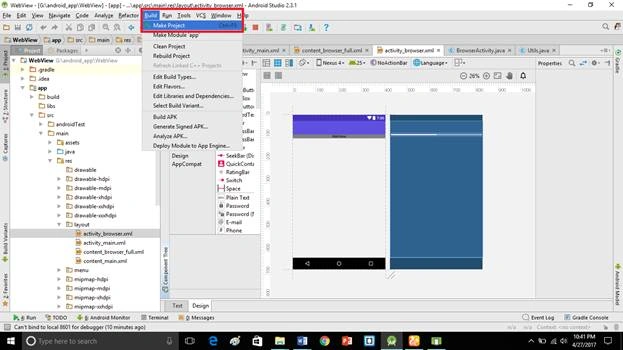
This is our user interface of the Application. Click Make project option.
Step 14
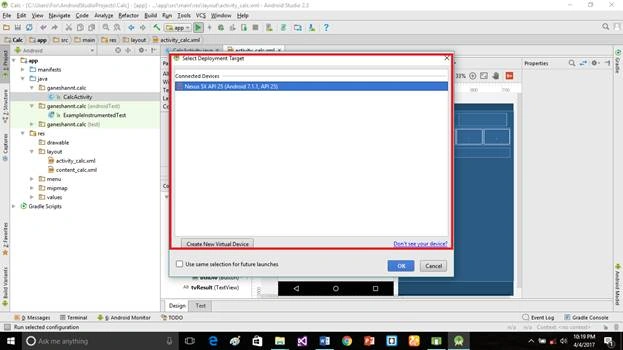
Run the Application, followed by choosing a virtual machine. Click OK.
Deliverables
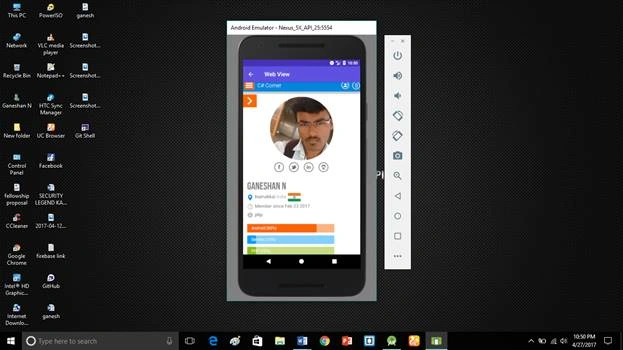
“Google-Don’t be evil” image is the default. If you want to replace the image, I will change the image link.
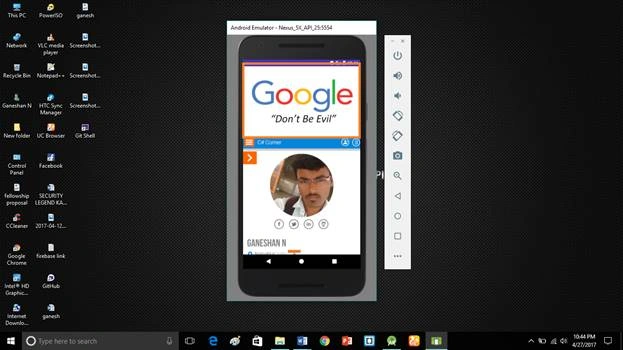
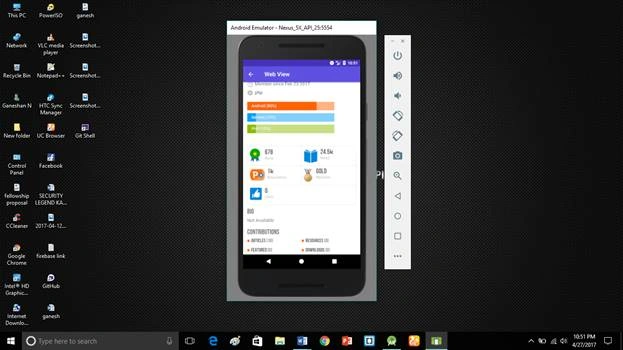
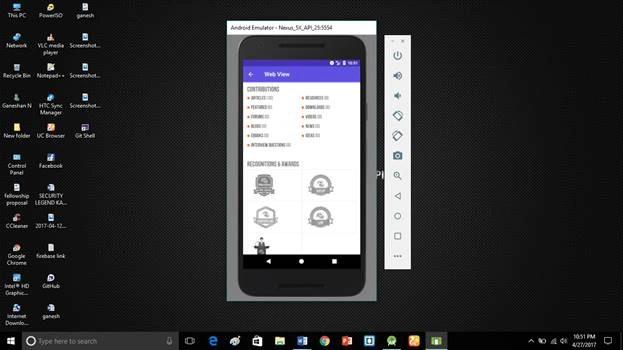
Below this image is the Web view part. I set the default link, which is my C# Corner profile link. Due to this, it shows my C# Corner profile. link.
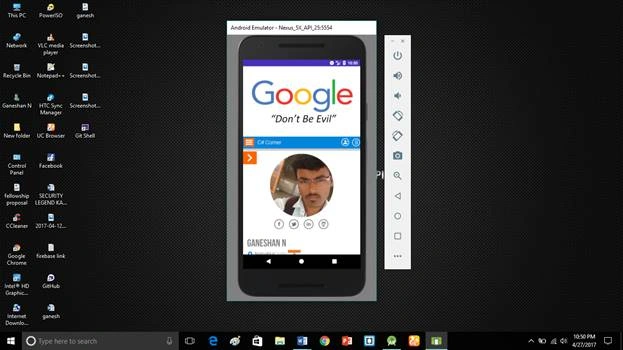
Just scroll up the page.
Don’t forget to like and follow me. If you have any doubts, just comment below.
Source code
https://github.com/GaneshanNT/WebView
Muhammad FawadPosted Mar 24, 2019, 3:48 AM
Where i change the code when i touch contact number and it is open in dial up of mobile. I already change the code BrowserActivity as @Overridepublic boolean shouldOverrideUrlLoading(WebView view, String url) { if (url.startsWith("tel:")) { Intent intent = new Intent(Intent.ACTION_DIAL, Uri.parse(url)); startActivity(intent); }else if(url.startsWith("http:") || url.startsWith("https:")) { webView.loadUrl(url); } return true;
Ganeshan NPosted Apr 30, 2017, 12:23 PM
Thanks Mr.Hanif Hefaz . I will try to make video soon :)
Hanif HefazPosted Apr 30, 2017, 5:14 AM
Great! sharing a video will be more significant!