

Introduction
This is a simple application for beginners that shows how to create a harmonic oscillator on canvas using HTML5. We know that HTML 5 is the advanced version of HTML. Basically HTML 5 can be used to develop 3D applications. This article is intended to help with the use of HTML5 tools to create a harmonic oscillator on a canvas application. The <canvas> tag is an HTML element which can be used to draw graphics using scripting. It can be used to draw graphs to make photo compositions or do simple animations. The <canvas> element is a bitmap drawing API and once you have committed to a set of pixels you are stuck with them. Canvas is an important tag of an HTML 5 that is used to show the image and text in an HTML 5 application. I hope this article helps to create a harmonic oscillator on canvas using HTML5 tools.
Step 1: First open an HTML editor such as Notepad.
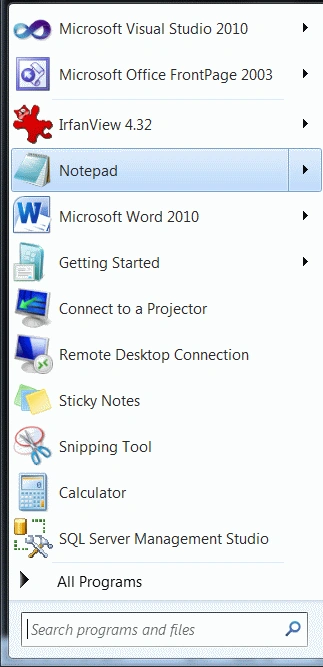
- Open start->Notepad.
- The name of the editor is "canvas".
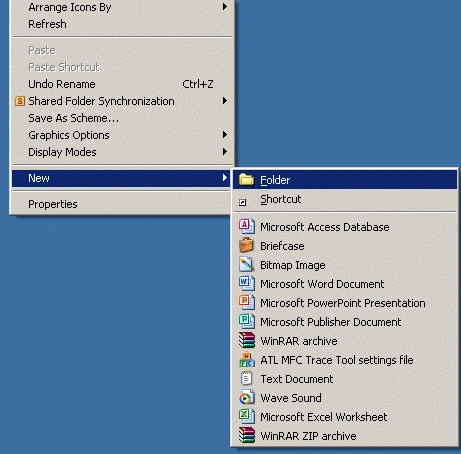
- Right-click on desktop->new->Folder.
- The name of the folder is "Tom".
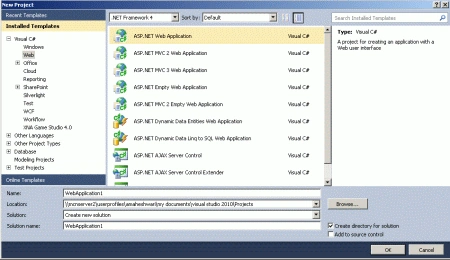
- Go to file -> New->Projects.
- Create an ASP. NET Web Application.
- Name of "Harmonic.aspx".

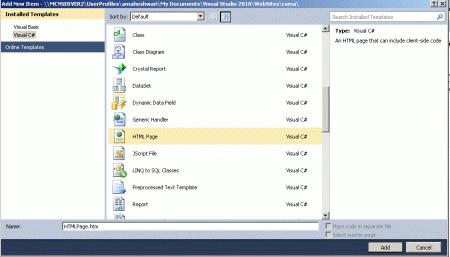
- Right-click on Solution Explorer.
- Add->add new item->HTML form.
- The Name of the HTML form is "Oscillator.html".
Code
- <style type="text/css">
- body {
- margin: 0px;
- padding: 0px;
- }
- #myCanvas {
- border: 1px solid #00ff99;
- background-color: Green;
- }
- </style>
Step 6 : Now in this step we set a callback time on windows.
Code
- window.requestAnimFrame = (function(callback) {
- return window.requestAnimationFrame ||
- window.webkitRequestAnimationFrame ||
- window.mozRequestAnimationFrame ||
- window.oRequestAnimationFrame ||
- window.msRequestAnimationFrame ||
- function(callback) {
- window.setTimeout(callback, 1000 / 60);
- };
- })();
Step 7: Now in this step we create a function named drawWeight that is used to set all the properties of a rectangle.
Code
- function drawWeight(canvas, pxt) {
- var size = 200;
- pxt.save();
- pxt.fillStyle = "red";
- pxt.fillRect(-size / 2, 0, size, size);
- pxt.restore();
- }
Step 8: In this step, we create an onload function that is used to assign an id for the canvas.
Code
- window.onload = function() {
- var canvas = document.getElementById("myCanvas");
- var theta = 0;
- var d = new d();
- var time = d.getTime();
- animate(canvas, theta, time);
- };
Step 9: The demonstration of complete application code is given below.
Code
- <html>
- <head>
- <title>Tom application</title>
- <style type="text/css">
- body
- {
- margin: 0px;
- padding: 0px;
- }
- #myCanvas
- {
- border: 1px solid #00ff99;
- background-color:Green;
- }
- </style>
- window.requestAnimFrame = (function (callback)
- {
- return window.requestAnimationFrame ||
- window.webkitRequestAnimationFrame ||
- window.mozRequestAnimationFrame ||
- window.oRequestAnimationFrame ||
- window.msRequestAnimationFrame ||
- function (callback) {
- window.setTimeout(callback, 1000 / 60);
- };
- })();
- function drawWeight(canvas, pxt)
- {
- var size = 200;
- pxt.save();
- pxt.fillStyle = "red";
- pxt.fillRect(-size / 2, 0, size, size);
- pxt.restore();
- }
- pxt.save();
- pxt.translate(canvas.width / 2, 0);
- pxt.save();
- pxt.scale(1, scale);
- drawSpring(canvas, pxt);
- pxt.restore();
- pxt.lineWidth = 6;
- pxt.strokeStyle = "#ff0066"; // blue-ish color
- pxt.stroke();
- pxt.translate(0, 200 * scale);
- drawWeight(canvas, pxt);
- pxt.restore();
- wndow.onload = function ()
- {
- var canvas = document.getElementById("myCanvas");
- var theta = 0;
- var d = new d();
- var time = d.getTime();
- animate(canvas, theta, time);
- };
- };
- </script>
- </head>
- <body onmousedown="return false;" bgcolor="#ff99cc">
- <canvas id="myCanvas" width="578" height="500">
- </canvas>
- </body>
- </html>
Step 10: Press Ctrl+ F5 to run code in a browser.
Output
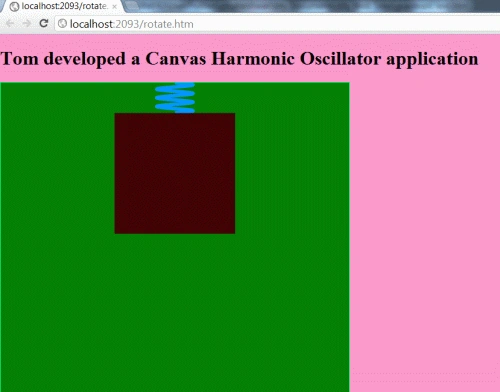
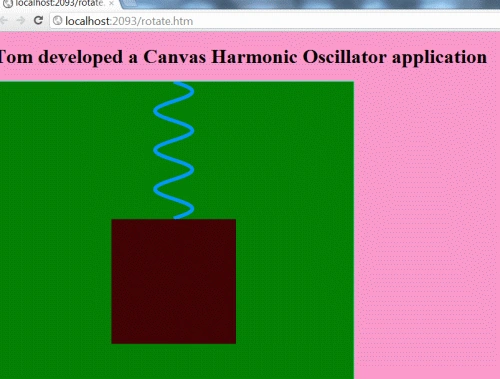
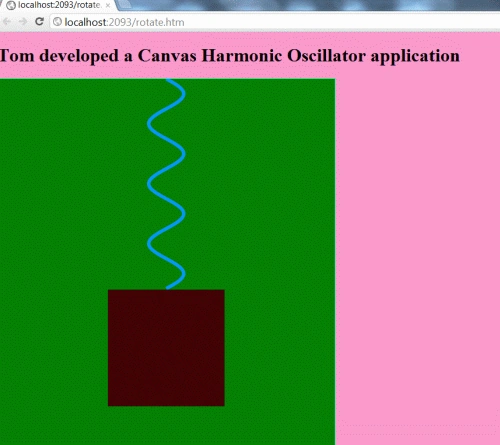
Resources
Here are some useful resources:
Join the conversation! Your thoughts help the community grow.