

Pre-requisite to understand this
Machine Learning basics – Models learn patterns from numerical data
Neural Networks – Systems that transform inputs into learned representations
Vectors & Dimensions – Numbers arranged in arrays to represent meaning
Similarity Search – Finding items that are “close” mathematically
APIs & Services – External services used to generate embeddings
Databases – Storage systems for vectors and metadata
Introduction
Modern AI systems cannot directly understand raw text, images, or structured data in their original form. To enable machines to reason, compare, search, and retrieve meaning, all inputs must be transformed into vector representations, also called embeddings. These vectors capture semantic meaning in numerical space, allowing AI models to perform similarity search, clustering, classification, and retrieval-augmented generation (RAG). This conversion process is foundational to recommendation systems, semantic search, chatbots, and multimodal AI.
What problem we can solve with this?
Converting text, images, and structured data into vectors allows AI systems to understand meaning rather than keywords or pixels. Traditional systems fail when phrasing changes, synonyms appear, or images vary slightly. Vector representations solve this by encoding semantic similarity into mathematical distance. This enables intelligent retrieval, personalization, anomaly detection, and cross-modal understanding. It also allows massive datasets to be searched efficiently and accurately. Without vectors, AI systems would be brittle, literal, and slow.
Problems solved include:
Semantic search beyond keyword matching
Question answering over private documents
Image similarity and visual search
Recommendation engines
Chatbots with long-term memory
Multimodal AI (text + image + data)
How to implement / use this?
To implement vectorization, raw input data is first preprocessed (cleaning, resizing, tokenization). This data is then passed to a pre-trained embedding model suitable for its type (text, image, or tabular). The model outputs high-dimensional vectors that numerically represent meaning. These vectors are stored in a vector database optimized for similarity search. At query time, new input is converted into a vector and compared against stored vectors using distance metrics like cosine similarity. The closest matches are retrieved and used by downstream AI systems.
High-level steps:
Collect and preprocess raw data
Choose embedding model (text/image/multimodal)
Generate vectors using AI model
Store vectors in vector database
Perform similarity search during queries
Sequence Diagram
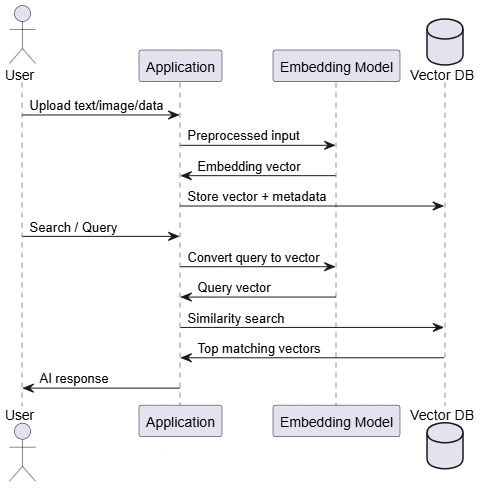
This sequence diagram shows the end-to-end lifecycle of vector creation and usage. The user provides raw data, which is preprocessed and sent to an embedding model. The model transforms the input into a numerical vector capturing semantic meaning. This vector is stored in a vector database alongside metadata. During a query, the same embedding process occurs, and the system retrieves the closest vectors using similarity search. The application then uses these results to generate accurate AI responses.
Key points:
Same model used for data and queries
Vector DB enables fast similarity search
Metadata helps filter and contextualize results
Component Diagram
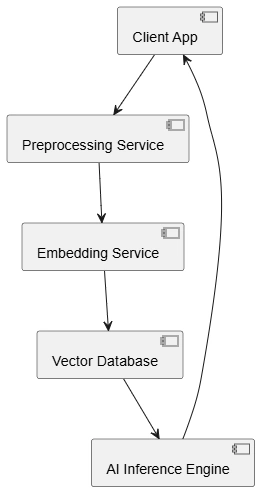
This component diagram illustrates the logical architecture of a vector-based AI system. The client interacts with preprocessing services that normalize input data. The embedding service converts processed data into vectors using ML models. These vectors are persisted in a vector database designed for high-performance similarity operations. The AI inference engine consumes retrieved vectors to generate intelligent responses. Each component can scale independently.
Key points:
Clear separation of responsibilities
Embedding service can be reused across apps
Vector DB is optimized for distance search
Deployment Diagram
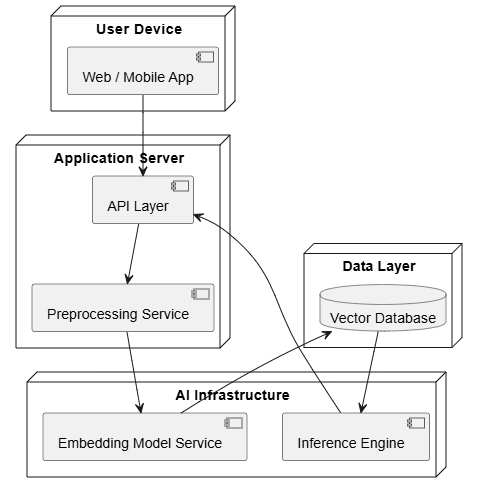
This deployment diagram shows how vector systems are deployed across infrastructure. User applications communicate with an API layer hosted on application servers. Preprocessing and embedding services run in AI-optimized environments (often GPU-backed). Vector databases are deployed separately for scalability and low latency. The inference engine consumes retrieved vectors to produce final outputs. This architecture supports cloud-native scaling and fault isolation.
Key points:
GPU nodes for embedding models
Vector DB optimized for ANN search
Scalable and cloud-ready design
Advantages
Semantic understanding – Captures meaning, not keywords
Scalability – Handles millions of vectors efficiently
Flexibility – Works for text, images, and structured data
Speed – Fast approximate nearest-neighbor search
Accuracy – Robust to wording and visual variations
Reusability – Same vectors power multiple AI features
Summary
Converting text, images, and data into vector representations is a foundational technique in modern AI systems. Embeddings allow machines to understand semantic meaning, perform similarity search, and power advanced applications like chatbots, recommendation engines, and multimodal AI. By using embedding models, vector databases, and scalable architectures, organizations can build intelligent systems that are accurate, flexible, and efficient. Vectorization transforms raw data into actionable intelligence, making it one of the most important building blocks in today’s AI stack.
Nancy DelgadoPosted Jan 30, 2026, 6:07 AM
Really nice breakdown ?? This explains vectors and embeddings in a very practical way, especially for people who are new to RAG and semantic search. I like how you tied the concepts to real use cases and architecture, it makes it much easier to see why vectors are such a core building block in modern AI systems. Great resource for beginners and practitioners alike.