

Introduction
Blockchain technology is the most well-known distributed ledger technology. They can be used in any industry and present less risk of fraud or theft than traditional centralized databases because they are decentralized and reliable. A few issues still need to be resolved before blockchain technology is extensively deployed. Among these are scalability, compatibility, and performance limits. The adoption of decentralized networks will still take some time.
A blockchain network is a network of computers called nodes. These nodes on a blockchain participate in some decision-making. This process is called the consensus mechanism. Different widely known algorithms can be used to implement a consensus protocol. In this article, we will learn some of these popular consensus algorithms and various famous blockchain use cases of these algorithms. If you are new to blockchain, please read What Is Blockchain (c-sharpcorner.com).
What Is A Consensus Mechanism?
A consensus mechanism is a protocol in a blockchain network that ensures agreement among all participants on the state of the network and the validity of transactions. It is used to achieve consensus on the single version of the truth in a decentralized network, ensuring that all nodes have the same information and the network operates smoothly. Some popular consensus mechanisms include Proof of Work (PoW), Proof of Stake (PoS), and Delegated Proof of Stake (DPoS).
Quorum mining is an alternative where decisions may be made with the approval of just 51% of miners. However, because there aren't enough nodes that are disconnected from one another or have been taken over by attackers who wish to have control over the full mining power itself, this also contributes to centralization.

Proof Of Work (PoW)
Proof of Work (PoW) is a consensus algorithm used in a blockchain network to validate transactions and secure the network. In PoW, nodes, also known as miners, compete to solve a complex mathematical puzzle, and the first node to solve it is granted the right to create a new block and validate transactions. Once a block is added to the blockchain, the other nodes in the network verify the solution, and if it's correct, the block is accepted and added to the blockchain. This process consumes a large amount of computational power, making it difficult for an attacker to manipulate the network by creating false blocks. PoW is used by some of the earliest blockchain networks, such as Bitcoin and Ethereum.

How does PoW is used in the Bitcoin network?
Proof of Work (PoW) is used in the Bitcoin network to secure the blockchain by verifying transactions and adding new blocks to the chain. Miners in the network compete to solve a complex mathematical puzzle known as a hash puzzle, and the first miner to solve it is granted the right to create a new block. Then, the miner adds the block to the blockchain and broadcasts it to the network.
The hash puzzle requires a significant amount of computational power to solve, which makes it difficult for an attacker to manipulate the network by creating false blocks. In return for solving the puzzle and adding a block to the blockchain, the miner is rewarded with newly minted bitcoins.
PoW helps maintain the security and integrity of the Bitcoin network by making it expensive and resource-intensive to attack the network. In addition, poW helps prevent double-spending and ensures the chronological order of transactions in the blockchain.
What are the benefits of the PoW algorithm?
Proof of Work (PoW) is a widespread consensus algorithm used in blockchain networks to secure and validate transactions. The following are some of the benefits of using PoW:
- Security: PoW makes it difficult for an attacker to manipulate the network by creating false blocks, as it requires significant computational power to solve the hash puzzle.
- Decentralization: PoW allows for a decentralized network where nodes or miners compete to validate transactions and add blocks to the blockchain without relying on a central authority.
- Transparency: PoW ensures that the state of the network and the validity of transactions are publicly verifiable, making it easier to maintain transparency and trust in the network.
- Resistance to Sybil attacks: PoW makes it difficult for an attacker to manipulate the network by creating multiple fake identities, as it requires a significant investment in computational power.
- Energy Efficiency: Although PoW consumes a large amount of energy, it provides strong security guarantees for the network. Its energy consumption can be seen as proof of the network's security.
Overall, PoW provides a robust and secure way of reaching consensus in a decentralized network, making it a popular choice for many blockchain projects.
What are the drawbacks of the PoW algorithm?
Proof of Work (PoW) is a widely used consensus algorithm in blockchain networks, but it also has some drawbacks:
- Energy consumption: PoW requires a large amount of computational power and energy to solve the hash puzzle, leading to high energy consumption and a large carbon footprint.
- Centralization: Over time, mining can become centralized, with a small number of large mining pools controlling a significant portion of the network's hash rate, potentially leading to a reduced level of decentralization.
- Scalability: As the network grows, the computational requirements for mining can increase, leading to scalability challenges and slower transaction times.
- Complexity: PoW can be complex to implement and understand, making it less accessible to non-technical users.
- 51% Attack: If a single miner or a group of miners control more than 50% of the network's computational power, they can carry out a 51% attack, potentially leading to double-spending and other security concerns.
These drawbacks have led to the development of alternative consensus algorithms, such as Proof of Stake (PoS), which aim to address some of these issues. However, PoW remains a widely used and secure consensus algorithm for many blockchain networks.
Proof Of Stake (PoS)
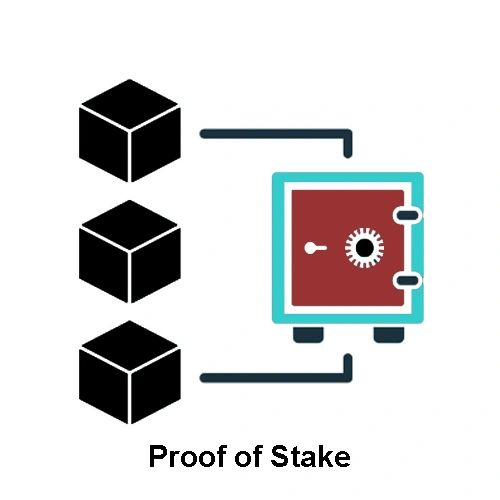
Proof of Stake (PoS) is a consensus algorithm used in blockchain networks to validate transactions and secure the network. In PoS, instead of using computational power to solve a mathematical puzzle, as in Proof of Work (PoW), nodes, known as validators, are selected to validate transactions and add new blocks to the blockchain based on the amount of stake they hold.
The stake, typically in the form of cryptocurrency, serves as a financial incentive for validators to act honestly and maintain the network's security. If a validator is found to be acting maliciously, their stake can be forfeited, providing a deterrent against malicious behavior.
PoS is designed to be more energy-efficient and scalable than PoW, as it does not require a large amount of computational power to validate transactions. It also has the potential to reduce centralization, as validators are selected based on the amount of stake they hold rather than the computational power they control.
Overall, PoS is a promising alternative to PoW for consensus in blockchain networks, offering improved energy efficiency, scalability, and reduced centralization.
What are the benefits of the PoS algorithm in blockchain?
- Proof of Stake (PoS) is a consensus algorithm used in blockchain networks that offers several benefits compared to Proof of Work (PoW):
- Energy efficiency: PoS does not require a large amount of computational power and energy to validate transactions, making it more energy-efficient than PoW.
- Scalability: PoS can handle a higher volume of transactions compared to PoW, making it more scalable for large and growing networks.
- Reduced centralization: In PoS, validators are selected based on the amount of stake they hold, reducing the potential for centralization compared to PoW, where mining pools with a large amount of computational power control a significant portion of the network.
- Increased security: PoS provides financial incentives for validators to act honestly and maintain the network's security, reducing the risk of malicious behavior.
- More accessible: PoS is simpler to implement and understand than PoW, making it more accessible to non-technical users.
Overall, PoS offers a more energy-efficient, scalable, and secure alternative to PoW for consensus in blockchain networks, making it a promising option for many blockchain projects.
What are the drawbacks of the PoS algorithm?
- Proof of Stake (PoS) is a widely used consensus algorithm in blockchain networks, but it also has some drawbacks:
- Initial centralization: The initial distribution of stake can be centralized, potentially leading to a reduced level of decentralization.
- Lack of ASIC resistance: Unlike PoW, PoS is not ASIC-resistant, which means that specialized hardware can be developed and used to validate transactions, reducing the level of decentralization.
- Stake grinding: PoS is vulnerable to stake grinding attacks, where an attacker creates multiple fake identities to control a significant portion of the network's stake and manipulate the network.
- Nothing at Stake problem: In PoS, validators are incentivized to validate multiple versions of the same block, potentially leading to multiple conflicting versions of the blockchain, known as the Nothing at Stake problem.
- Long Range Attack: PoS is vulnerable to a Long Range Attack, where an attacker creates a new version of the blockchain from an earlier point in time, potentially leading to a split in the network.
Despite these drawbacks, PoS remains a widely used and secure consensus algorithm for many blockchain networks, offering improved energy efficiency, scalability, and reduced centralization compared to PoW. When selecting a consensus algorithm for a blockchain network, carefully considers the trade-offs between PoS and PoW.
Several blockchain networks use the Proof of Stake (PoS) consensus algorithm, including:
- Ethereum (plans to move from Proof of Work to Proof of Stake)
- Cosmos
- Algorand
- Tezos
- EOS
- TRON
- Cardano
- Polkadot
- Harmony
- NEAR
- Stratis
- Solana uses Proof of History (PoH) based on PoS
- Polygon
Proof of Stake vs. Proof of Work
Large computer networks are needed for calculations in proof-of-work systems that verify blockchain transactions. This operation consumes much more energy than proof-of-stake systems and requires a lot of electricity. But PoW also has certain negative aspects: It can be expensive to maintain since each transaction necessitates the use of computer resources that might not be sufficient for the demands of the majority of users; occasionally, internal security weaknesses may result in problems; and finally, it loads slowly.

Delegated Proof Of Stake (DPoS)
Delegated Proof of Stake (DPoS) is a consensus algorithm used in blockchain networks that combines elements of both Proof of Stake (PoS) and a voting system. In DPoS, token holders vote to elect a limited number of delegates responsible for validating transactions and adding new blocks to the blockchain.
The delegates, known as witnesses or block producers, are incentivized to act honestly and maintain the network's security, as their reputation and ability to generate revenue as a block producer depend on it. If a delegate is found to be acting maliciously, they can be voted out by token holders and replaced with a more trustworthy delegate.
DPoS is designed to be more scalable and efficient than traditional PoS, as the number of delegates is limited, reducing the computational requirements for validation. It also provides a more democratic way of reaching consensus, as token holders have a direct say in who represents them as block producers.
DPoS is a promising alternative to traditional PoS for consensus in blockchain networks, offering improved scalability, efficiency, and decentralization.
EOS utilizes the Delegated Proof of Stake (DPoS) consensus algorithm.

What are the benefits of the DPoS algorithm?
Delegated Proof of Stake (DPoS) is a consensus algorithm used in blockchain networks that offers several benefits compared to other consensus algorithms, including:
- Scalability: DPoS reduces the computational requirements for validation, allowing for faster and more scalable transactions compared to traditional Proof of Stake (PoS) or Proof of Work (PoW) algorithms.
- Efficiency: DPoS is designed to be more efficient than traditional PoS, as the number of delegates is limited, reducing the computational requirements for validation.
- Decentralization: DPoS provides a more democratic way of reaching consensus, as token holders have a direct say in who represents them as block producers, reducing the risk of centralization.
- Improved security: DPoS incentivizes delegates to act honestly and maintain the network's security, as their reputation and ability to generate revenue as a block producer depend on it.
- Faster block production: The limited number of delegates in DPoS allows for faster block production, reducing the time required to confirm transactions.
DPoS offers a promising alternative to traditional PoS and PoW for consensus in blockchain networks, offering improved scalability, efficiency, decentralization, and security.
What are the drawbacks of the DPoS algorithm?
Delegated Proof of Stake (DPoS) is a consensus algorithm used in blockchain networks that has several drawbacks, including:
- Centralization risk: Although DPoS is designed to be more democratic than traditional Proof of Stake (PoS), the risk of centralization remains, as a small number of token holders may control the majority of the voting power, potentially leading to the election of delegates who serve their own interests.
- Voting manipulation: DPoS is vulnerable to voting manipulation, where a small number of token holders may coordinate to control the election of delegates, potentially leading to a reduced level of decentralization.
- Dependence on delegates: The network's security depends on the elected delegates' reliability and honesty, which can be a concern in the event of a security breach or malicious behavior by a delegate.
- Limited participation: Only token holders who participate in the voting process have a say in who represents them as a delegate, potentially leading to a reduced level of decentralization for those who do not participate.
- Complexity: DPoS can be complex for new users, as it requires an understanding of the voting process and the election of delegates, potentially leading to reduced user adoption.
Despite these drawbacks, DPoS remains a widely used consensus algorithm in blockchain networks, offering improved scalability, efficiency, and decentralization compared to traditional PoS and PoW algorithms. It is important to carefully consider the trade-offs between DPoS and other consensus algorithms when selecting a consensus mechanism for a blockchain network.
Practical Byzantine Fault Tolerance (PBFT)
Practical Byzantine Fault Tolerance (PBFT) is a consensus algorithm used in blockchain networks to ensure that the network remains operational, even in the presence of malicious actors. The algorithm is designed to ensure that most nodes in the network agree on the current state of the blockchain, despite faulty or malicious nodes.
PBFT works by having nodes in the network communicate with each other in a specific sequence, which allows for detecting any malicious or faulty nodes and excluding these nodes from the consensus process. The algorithm also includes mechanisms for preventing double-spending and ensuring that all nodes have the same view of the current state of the blockchain.
What are the benefits of Practical Byzantine Fault Tolerance (PBFT)?
The Practical Byzantine Fault Tolerance (PBFT) algorithm offers several benefits for blockchain networks, including:
- Fast and efficient consensus: PBFT allows for fast and efficient consensus, making it well-suited for use in high-throughput blockchain networks.
- Robust against malicious actors: PBFT is designed to be robust against malicious actors, even in the presence of network partitions or other types of faults, ensuring the security and integrity of the network.
- Low latency: PBFT provides low latency, as consensus is achieved quickly and efficiently, reducing the time required to confirm transactions.
- Suitable for permissioned networks: PBFT is particularly well-suited for use in permissioned blockchain networks where the number of nodes is limited and well-known, as the algorithm requires fewer nodes to reach consensus compared to other consensus algorithms.
- A high degree of security: PBFT provides a high degree of security, as the algorithm is designed to ensure that most nodes in the network agree on the current state of the blockchain, despite faulty or malicious nodes.
PBFT offers a promising alternative to other consensus algorithms for use in blockchain networks, offering improved efficiency, security, and scalability, particularly in permissioned networks.
What are the drawbacks of Practical Byzantine Fault Tolerance (PBFT)?
The Practical Byzantine Fault Tolerance (PBFT) algorithm has some drawbacks, including:
Limited scalability: PBFT is limited in terms of scalability, as the number of nodes in the network must be limited to ensure fast and efficient consensus.
High resource requirements: PBFT requires high computational resources and network bandwidth, making it less suitable for use in resource-constrained environments.
- Not suitable for public networks: PBFT is not well-suited for use in public blockchain networks, as the algorithm is designed for use in permissioned networks where the number of nodes is limited and well-known.
- Complexity: PBFT can be complex for new users, as it requires a deep understanding of the consensus process and the communication between nodes, potentially leading to reduced user adoption.
- Centralization risk: PBFT can be vulnerable to centralization, as the algorithm depends on the reliability and honesty of the nodes in the network, potentially leading to a reduced level of decentralization.
Despite these drawbacks, PBFT remains a widely used consensus algorithm in blockchain networks, offering improved security and efficiency compared to other consensus algorithms, particularly in permissioned networks. It is important to carefully consider the trade-offs between PBFT and other consensus algorithms when selecting a consensus mechanism for a blockchain network.
Proof Of Importance (POI)
Proof of Importance (POI) is a consensus approach that uses the amount of cryptocurrency you hold to determine your influence on the network because it combines Proof of Stake and Proof of Work so that POI may be used with PoS and PoW systems.
POI was created by Ethereum's founder and CEO, Vitalik Buterin. He detailed how it might operate as a substitute for proof-of-work systems like Bitcoin or Ethereum itself in a paper he released on the subject in 2017. It is also known as "Proof of Devotion" since it compensates users who invest more time in a project than others by granting them more voting power over their tokens compared to users who haven't put in as much effort to boosting the value of their holdings.
If a person has a basic understanding of cryptocurrencies, they can use any Blockchain techniques. Although most cryptocurrency exchanges are prohibited in the USA, you can access them using a VPN because a rapid VPN server will quickly complete the task in your limited region.
As a result, there are multiple distinct blockchain network varieties, each with distinctive characteristics and benefits for certain applications: permissioned and public; private; hybrid; permission/private hybrids; etc.

Decision-Making On Blockchains Utilizes Consensus
The innovative manner of blockchain makes it possible to use various consensus techniques for making decisions. Many computers comprise the global network of nodes (computers) where transactions are verified and stored. This indicates that no one computer can affect how another computer functions or how stores data.
Conclusion
A consensus mechanism is an important component of a decentralized network. It impacts the system's security, efficiency, and scalability. When evaluating a consensus process, it is critical to evaluate three aspects: degree of decentralization, security, and scalability. Unfortunately, most consensus techniques can only optimize on two of the three factors: security comes at the expense of scalability and the risk of centralization. At the same time, scalable networks may be more vulnerable to attacks. As a result, multiple consensus techniques must be examined based on the needs of the specific network.
Aravind GovindarajPosted Feb 4, 2023, 6:50 AM
Nice article