

Today I am here to talk about Concurrent Collections in .NET. First we will discuss Concurrent Collections in general then go through ConcurrentDictionary in detail and cover what, when and how to use it.
To begin with, let’s put out some questions to understand the concept related to Concurrent Collections.
 What are the Concurrent collections and when to use them?
Concurrent collections (Namespace: System.Collections.Concurrent) are basically thread safe collections and are designed to be used in multithreading environment. They also provide type safety due to the generic implementation.
These collections should be used when they are getting changed or data is added/updated/deleted by multiple threads. If the requirement is only read in multithreaded environment then generic collections can be used.
If locking is needed at a few places, manual locking or synchronization techniques can also be used however if it is required at several places, using concurrent collection is a good choice.
Concurrent collections are designed to be used in cases when excessive thread safety is required, overly using manual locking can lead to deadlock and other issues.
Under the hood, concurrent collections use several algorithms to minimize the thread blocking.
What are the commonly used concurrent collections we have? Does concurrent collections addresses race conditions?
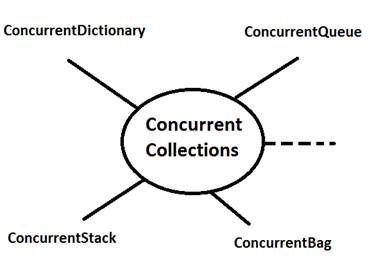
There are several types of concurrent collections but commonly used are as follows.
What are the Concurrent collections and when to use them?
Concurrent collections (Namespace: System.Collections.Concurrent) are basically thread safe collections and are designed to be used in multithreading environment. They also provide type safety due to the generic implementation.
These collections should be used when they are getting changed or data is added/updated/deleted by multiple threads. If the requirement is only read in multithreaded environment then generic collections can be used.
If locking is needed at a few places, manual locking or synchronization techniques can also be used however if it is required at several places, using concurrent collection is a good choice.
Concurrent collections are designed to be used in cases when excessive thread safety is required, overly using manual locking can lead to deadlock and other issues.
Under the hood, concurrent collections use several algorithms to minimize the thread blocking.
What are the commonly used concurrent collections we have? Does concurrent collections addresses race conditions?
There are several types of concurrent collections but commonly used are as follows.
- ConcurrentDictionary<TKey, TValue> -> Thread safe version of Dictionary
- ConcurrentBag<T> -> New thread safe unordered collection
- ConcurrentQueue<T> -> Thread safe version of generic queue (FIFO structure)
- ConcurrentStack<T> -> Thread safe version of generic stack (LIFO structure)
Out of the above list, ConcurrentDictionary can be used as a general purpose collection whereas others are mostly used in producer-consumer (i.e. dedicated threads for add-delete) scenarios.
Concurrent collections address the race condition and thread safety inside their implementation (e.g. inside AddOrUpdate method of ConcurrentDictionary) however it doesn’t guarantee the race conditions among threads between custom method calls.
Hope at this point, you understand what concurrent collections are and when to use them.
Now let’s see how to use them.
We will begin with concurrent dictionary as it’s the most commonly used.
 As mentioned earlier, Concurrent Dictionary is the general purpose collection and can be used in most of the cases. It has exposed several methods and properties and commonly used methods are as follows.
- TryAdd
TryAdd returns true if it’s successfully added else the key/value pair returns false primarily due to duplicate key.Let’s have a look at the code below to understand how to use it.Now let’s call the method and see the output.
- private static void DoTryAdd(string key, int value)
- {
- Console.WriteLine("Is {0} Successfully added? {1}", key, phoneOrders.TryAdd(key, value));
- }
Output- Console.WriteLine("********************TryAdd********************");
- //TryAdd returns true, if it successfully added.
- string key1 = "Prakash";
- int value1 = 5;
- DoTryAdd(key1, value1);
- string key2 = "Aradhana";
- int value2 = 7;
- DoTryAdd(key2, value2);
- string key3 = "DEF";
- int value3 = 6;
- DoTryAdd(key3, value3);
- ////TryAdd returns false, if it failed to add due to duplicate key.
- DoTryAdd(key2, value2);
- PrintOrders();

- TryGetValue (Also present in generic dictionary)
If key is present, TryGetValue fetches the value and returns true and if key isn’t present, it simply returns false without throwing any exception. Let’s have a look at the code below to understand how to use it.Now let’s call the method and see the output.
- private static void DoTryGetValue(string key)
- {
- int value;
- if (phoneOrders.TryGetValue(key, out value))
- {
- Console.WriteLine("The phone stock is with {0} is: {1}", key, value);
- }
- else
- {
- Console.WriteLine("Key {0} is invalid to fetch.", key);
- }
- }
Output- Console.WriteLine("\n********************TryGetValue********************");
- //TryGetValue returns true and fetches the value, if key exist else returns false
- //but doesn't throw exception in case of key not present.
- DoTryGetValue(key2);
- string key4 = "Satna";
- DoTryGetValue(key4);

- TryUpdate
TryUpdate returns true and updates the value if key exists and passes current value if the third parameter matches with the one in collection, else it returns false. Let’s have a look at thr code below to understand how to use it.Now let’s call the method and see the output.
- private static void DoTryUpdate(string key, int newValue, int currentValue)
- {
- if (phoneOrders.TryUpdate(key, newValue, currentValue))
- {
- Console.WriteLine("Key {0} is successfully updated with new value {1}", key, newValue);
- }
- else
- {
- Console.WriteLine("Key {0} is failed to update with new value {1}", key, newValue);
- }
- }
Output- Console.WriteLine("\n********************TryUpdate********************");
- //Traditional or single threaded way to update the dictionary.
- phoneOrders["Prakash"] = 7;
- //Multi-threaded way to update.
- //If key exists and current value matches, new value is updated.
- DoTryUpdate(key2, value2 + 1, value2);
- DoTryUpdate(key4, 1, 1);

- TryRemove
If key is present, TryRemove deletes the element and returns true else it simply returns false without throwing any exception. Let’s have a look at the code below to understand how to use it.Now let’s call the method and see the output.
- private static void DoTryRemove(string key)
- {
- int value;
- if (phoneOrders.TryRemove(key, out value))
- {
- Console.WriteLine("Key {0} and Value {1} pair removed", key, value);
- }
- else
- {
- Console.WriteLine("Key {0} is invalid to delete.", key);
- }
- }
Output- Console.WriteLine("\n********************TryRemove********************");
- //Try Remove
- Console.WriteLine("Elements count before removing: {0}", phoneOrders.Count);
- DoTryRemove(key3);
- DoTryRemove(key4);
- Console.WriteLine("Elements count after removing: {0}", phoneOrders.Count);
- PrintOrders();

- AddOrUpdate
If key is present, AddOrUpdate updates the existing value with a new one and returns the new value else it adds the key with the value passed in the second parameter and returns the same. It is designed not to fail irrespective if key is present or not as it handles both the possible cases. Let’s have a look at the code below to understand how to use it.Now let’s call the method and see the output.
- private static void DoAddOrUpdate(string key, int newValue)
- {
- //2nd param is the value to be added for an absent key.
- int newValue2 = phoneOrders.AddOrUpdate(key, 1, (key2, currentValue2) => newValue);
- Console.WriteLine("Key {0} is successfully added/updated with new value {1}", key, newValue2);
- }
Output- Console.WriteLine("\n********************AddOrUpdate********************");
- //If key exists, new value is updated else key is added with value passed in 2nd param.
- DoAddOrUpdate(key2, value2 + 2);
- DoAddOrUpdate(key4, 1);

- GetOrAdd
If key is present, GetOrAdd fetches the value else it adds the key with the value passed in the second parameter and returns the same. Similar to AddOrUpdate,iIt is also designed not to fail irrespective if key is present or not as it handles both the possible cases. Let’s have a look at code below to understand how to use it.Now let’s call the method and see the output.
- private static void DoGetOrAdd(string key)
- {
- //2nd param is the value to be added for an absent key.
- int newValue2 = phoneOrders.GetOrAdd(key, 1);
- Console.WriteLine("Key {0} is successfully retrieved/added with key {1}", key, newValue2);
- }
Output- Console.WriteLine("\n********************GetOrAdd********************");
- //If key exists, corresponding value is returned else key is added with value passed in 2nd param.
- DoGetOrAdd(key2);
- string key5 = "Rewa";
- DoGetOrAdd(key5);
- PrintOrders();

As you can see in the above output Key ‘Rewa’ is added with value 1 using GetOrAdd method as the key was not present in the collection.
FireMystPosted Feb 14, 2018, 12:58 AM
According to these benchmarks: http://cc.davelozinski.com/c-sharp/dictionary-vs-concurrentdictionary it's actually faster to add items to a Dictionary with locking than a ConcurrentDictionary in a multi-threaded environment.
Prakash TripathiPosted Jul 14, 2016, 7:26 AM
Thnx Kalu singh.
kalu singh raoPosted Jul 14, 2016, 6:19 AM
Nice...
Prakash TripathiPosted Jul 13, 2016, 9:39 PM
Thnx Gowtham for reading.
Gowtham KPosted Jul 13, 2016, 9:36 PM
Good One, Thanks for sharing:)
Prakash TripathiPosted Jul 13, 2016, 9:33 PM
Thnx Vignesh.
Vignesh ManiPosted Jul 13, 2016, 5:42 PM
Nice