

OpenAI Codex Goals let developers give Codex a persistent objective instead of a one-shot prompt. This changes Codex from a simple coding assistant into a long-running coding agent that can plan, execute, verify, and continue working until the goal is complete.
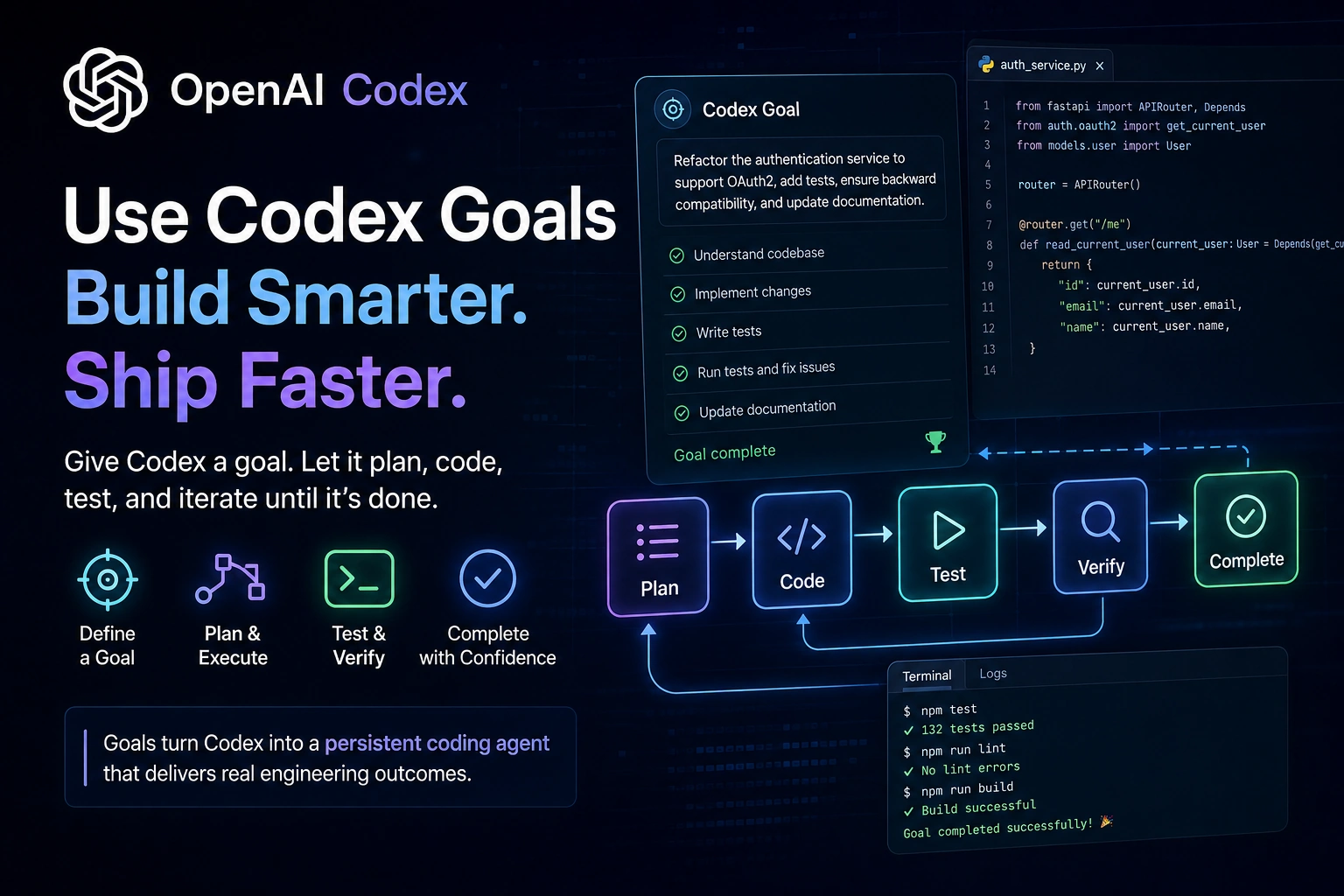
For developers building large features, migrations, refactors, test automation, or DevOps workflows, Goals are one of the most important upgrades in AI-assisted software engineering today.
Abstract / Overview
OpenAI recently published guidance on using Goals in Codex through its developer cookbook. The feature is designed for durable coding objectives that require multiple iterations, verification loops, and long-running execution.
Traditional prompts work well for small coding tasks:
Generate a function
Fix a bug
Explain an error
But modern engineering tasks are rarely that small.
Real developer work usually involves:
Multiple files
Test execution
Validation
Refactoring
Dependency management
Documentation updates
Continuous verification
Goals solve this problem by allowing Codex to maintain an active objective across many turns and continue working until success conditions are met.
This article explains:
What Codex Goals are
How Goal mode works internally
How developers should write effective goals
Common failure modes
Real-world engineering use cases
Best practices for production workflows
This article reflects publicly available OpenAI documentation and ecosystem discussions as of May 2026.
What Is OpenAI Codex?
OpenAI created Codex as a coding-focused AI system designed for software engineering workflows. Modern Codex products act more like autonomous coding agents than autocomplete tools.
Codex can:
Read repositories
Modify files
Run tests
Execute commands
Validate outputs
Generate patches
Review codebases
Unlike early copilots, Codex now operates inside isolated execution environments and can work on larger engineering objectives independently.
What Are Goals in Codex?
A Goal is a persistent engineering objective.
Instead of:
“Write this function.”
You define:
“Refactor the authentication system to support OAuth2, add tests, ensure backward compatibility, and verify all CI checks pass.”
Goal mode allows Codex to:
Continue across many steps
Track progress
Re-evaluate work
Run validation loops
Stop only when completion criteria are satisfied
OpenAI describes this as durable objective execution rather than a normal single-turn interaction.
Why Goals Matter
Most software work is iterative.
Developers rarely finish tasks in one action.
A typical feature implementation looks like this:
Understand requirements
→ inspect codebase
→ modify files
→ run tests
→ discover failures
→ fix failures
→ rerun validation
→ update docs
→ verify deployment readiness
Goal mode mirrors this real engineering loop.
How Goal Mode Works
Codex Goals operate like an autonomous execution loop.

According to OpenAI ecosystem discussions, Goal mode repeatedly evaluates whether the defined objective has truly been completed before stopping.
What Changes When a Goal Is Active?
When Goal mode is enabled, Codex behavior changes significantly.
Normal Prompt Mode
Single-turn focused
Minimal persistence
Limited verification
Stops quickly
Goal Mode
Persistent objective memory
Long-running execution
Verification loops
Multi-step reasoning
Self-evaluation
Retry behavior
This makes Goal mode much better for:
Large refactors
Infrastructure work
Test remediation
CI/CD fixes
Migrations
Multi-file feature implementation
Step-by-Step Walkthrough
Step 1: Define a Clear Goal
Weak goals create weak results.
Bad example:
Improve authentication.Good example:
Migrate the authentication system from session-based auth to OAuth2.
Maintain backward compatibility for existing API clients.
Add integration tests.
Ensure all CI tests pass.
Update API documentation.
The second version gives:
Scope
Constraints
Validation rules
Success criteria
This is critical.
According to developers using Goal mode internally and externally, vague goals are a major failure mode. (LinkedIn)
Step 2: Add Verification Criteria
Verification is one of the most important parts of Goals.
Without it, Codex may stop early.
Good examples:
Goal is complete only if:
- all unit tests pass
- TypeScript build succeeds
- no linting errors exist
- authentication integration tests pass
- documentation is updated
This creates measurable completion conditions.
Step 3: Add Constraints
Constraints reduce dangerous or unnecessary changes.
Example:
Constraints:
- do not modify database schema
- avoid breaking public APIs
- maintain backward compatibility
- use existing logging framework
Constraints are especially important in enterprise systems.
Step 4: Let Codex Execute
Once active, Codex may:
Inspect repositories
Open files
Modify code
Execute tests
Analyze failures
Retry fixes
Generate reports
Modern Codex systems can operate for many minutes during execution.
Step 5: Review Results
Developers still remain responsible for:
Security review
Architecture validation
Production readiness
Compliance checks
Business correctness
AI agents accelerate engineering work, but they do not replace engineering ownership.
Example Goal for a Real Project
Here is a strong Goal example.
Refactor the payment service to support Stripe subscription webhooks.

Requirements:
- add webhook signature validation
- support subscription.created and subscription.updated events
- preserve existing payment flows
- add unit and integration tests
- update API documentation

Verification:
- all tests pass
- no TypeScript errors
- lint checks pass
- webhook replay attack tests succeed

Constraints:
- do not modify checkout flow
- do not remove legacy API endpoints
This is much more effective than:
Add Stripe webhooks.Use Cases / Scenarios
1. Large Refactoring
Goals work extremely well for:
Monolith decomposition
Dependency upgrades
Framework migrations
Naming standardization
Type safety improvements
Example:
Migrate React class components to hooks across the dashboard module.2. CI/CD Remediation
Codex can:
Detect failing tests
Retry fixes
Re-run pipelines
Repair build issues
This is useful for broken pull requests and dependency updates.
3. Test Coverage Expansion
Example Goal:
Increase unit test coverage for the auth module from 45% to 80%.This works well because the success condition is measurable.
4. Documentation Automation
Codex can update:
READMEs
API docs
Architecture docs
Changelogs
Developer documentation is becoming increasingly important in AI retrieval systems and Generative Engine Optimization (GEO).
Teams looking to improve developer-facing AI visibility can work with C# Corner Consulting to modernize documentation pipelines and AI-ready engineering workflows.
5. Security Hardening
Goal mode is useful for:
Dependency vulnerability fixes
Secret scanning remediation
Static analysis cleanup
Permission hardening
Modern Codex systems are increasingly used in enterprise engineering workflows.
Best Practices for Developers
1. Use Quantifiable Goals
Weak:
Improve performance.Strong:
Reduce API response latency below 200ms for the product search endpoint.Measurable goals create better execution loops.
2. Always Add Verification
This is mandatory.
Without verification:
Codex may stop too early
False positives increase
Partial completion becomes common
3. Keep Goals Focused
Avoid:
Rewrite the whole platform.Prefer:
Migrate authentication to OAuth2.Smaller bounded objectives perform better.
4. Define Constraints Explicitly
AI agents optimize aggressively.
If constraints are missing, unintended changes may happen.
Always define:
Protected systems
Forbidden modifications
Stability requirements
Security expectations
5. Require Evidence
Ask Codex to provide:
Test logs
Build outputs
Coverage reports
Diff summaries
Example:
Return a summary of all modified files and test results.Common Failure Modes
Premature Completion
One known issue discussed in the Codex ecosystem is premature task closure after context compaction or partial verification. (GitHub)
This usually happens when:
Goals are vague
Validation is weak
Completion conditions are missing
Fix:
Add explicit success conditions
Require evidence
Demand full validation
Oversized Goals
Very large objectives can reduce accuracy.
Fix:
Break large initiatives into phases.
Example:
Phase 1: authentication migration
Phase 2: authorization updates
Phase 3: admin dashboard integration
Missing Constraints
Without constraints, Codex may:
Refactor unrelated systems
Introduce breaking changes
Modify infrastructure unexpectedly
Always define boundaries.
Goals vs Plans
Many developers confuse Goals with Plans.
The difference is important.
| Feature | Plan Mode | Goal Mode |
|---|---|---|
| Purpose | Strategy | Execution |
| Duration | Short | Long |
| Persistence | Low | High |
| Verification | Limited | Continuous |
| Best For | Design | Delivery |
A simple way to think about it:
Plan = pre-flight
Goal = autopilot
This description is consistent with community explanations around Codex workflows. (J.D. Hodges)
Architecture-Level Thinking
Goal systems are important because they move AI coding tools from:
prompt → outputto:
objective → execution loop → validation → completionThis is a major architectural shift in AI engineering systems.
Future of Goal-Based Coding Agents
Goal-based execution is likely to become standard in AI software engineering.
Expected future capabilities include:
Multi-agent coordination
Persistent memory systems
CI-native agents
Autonomous pull requests
Self-healing pipelines
Deployment-aware coding agents
Industry competition around coding agents is rapidly increasing across OpenAI, Anthropic, GitHub, and others.
Future Enhancements Developers Should Expect
Native GitHub Actions integration
Long-term repository memory
Better architecture reasoning
Automatic rollback support
Multi-environment testing
FAQs
1. What is a Goal in OpenAI Codex?
A Goal is a persistent coding objective that allows Codex to continue working across multiple execution cycles until success conditions are satisfied.
2. How is Goal mode different from normal prompting?
Normal prompts are short-lived. Goal mode supports long-running execution with verification loops and persistent objectives.
3. Are Codex Goals autonomous?
Partially. Codex can independently execute coding workflows, but developers still need to review and approve results.
4. What makes a good Goal?
A good Goal includes:
Clear objective
Constraints
Verification criteria
Measurable outcomes
5. Can Codex run tests during Goal execution?
Yes. Modern Codex systems can execute tests, inspect failures, retry fixes, and validate outputs.
6. Are Goals good for enterprise development?
Yes. They are especially useful for:
Refactoring
CI remediation
Security patching
Documentation updates
Migration projects
Conclusion
OpenAI Codex Goals represent a major evolution in AI-assisted software engineering.
Instead of treating AI as a one-shot autocomplete tool, Goals turn Codex into a persistent engineering agent capable of:
Planning
Executing
Verifying
Retrying
Completing durable software objectives
For developers, this changes the workflow completely.
The best engineers will not simply “prompt AI.”
They will learn how to define measurable engineering objectives, verification systems, and execution constraints that allow coding agents to operate safely and effectively at scale.
Teams building AI-native engineering workflows today are already gaining major productivity advantages.
Organizations looking to modernize AI engineering workflows, developer platforms, and AI-ready documentation systems can explore services from C# Corner Consulting.
References
OpenAI Developer Cookbook — Using Goals in Codex
OpenAI Codex ecosystem discussions and engineering notes
OpenAI Codex architecture and workflow documentation
Reuters coverage on AI coding agents
OpenAI Codex product discussions and developer examples
GEO Guide PDF by C# Corner
Web sources used for verification:
(digg.com)
Join the conversation! Your thoughts help the community grow.