

Background
Today, cloud computing plays a key role in delivering and managing highly scalable and reliable applications, and there are many types of delivery and deployment models of cloud computing by using the services that are made available to the end customer to integrate or use.
I have written this article considering the newcomers, so let's start from the basic steps and concepts so everyone gets to know these terms. Let's start with the deployment models.
What is Cloud Deployment Model?
The cloud deployment model is the strategy that decides on which type of network the set of cloud services can be accessed. The idea behind this type of deployment is to fully fulfill the needs of every business use case. Some industries, such as banking and government, require high levels of data and network security, and some businesses may need to use multiple network services because their operations are spread across geography or an application must be made available outside the organization's network boundaries.
Taking into account previously mentioned scenarios and requirements, the cloud has the following deployment models.
- Private Cloud
- Public Cloud
- Hybrid Cloud
What is a Private Cloud?
The term "private cloud" refers to a cloud platform developed for an organisation whose services are only used within that organisation over a private network. Private cloud services are only used within the organisation or its dedicated customer behind the firewall, but services are never exposed over the public network. The private cloud has organization-specific data centers and is mostly considered for confidential applications where customers or organisations don't want to exchange the data over the public network.
The following diagram demonstrates the private cloud
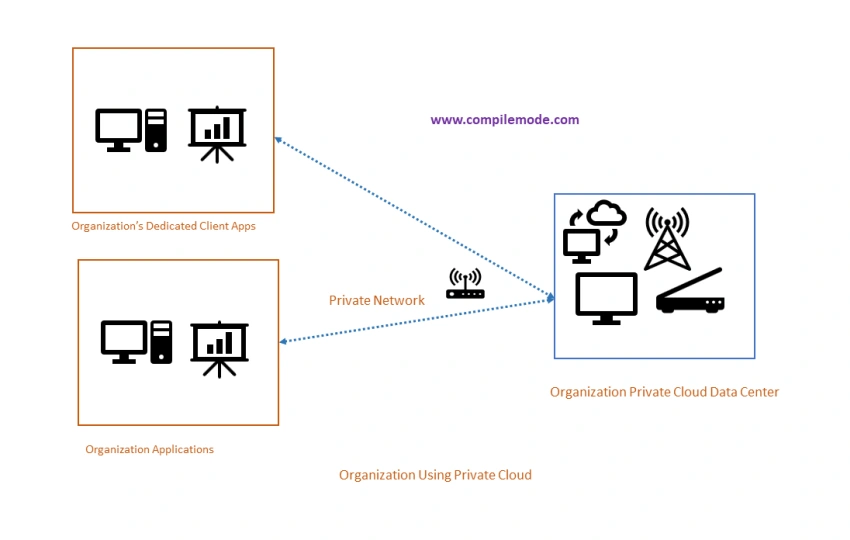
Private Cloud Key Points
- Services are accessed only within the organisation over a private network and LAN behind a firewall.
- Services are not exposed to other organisations or other customers, which means they can't be shared among multiple customers.
- A data center resides within the organization.
- Best suited for secure data exchange since it's not involving the public network.
- The organisation is responsible for the maintenance and management of the private cloud.
- Private clouds are expensive since they require the cost of setup, maintenance, and management.
Private clouds are mostly used in banking, defense, and medical domain applications where confidentiality of data and information has priority.
What is Public Cloud?
Public cloud services are exposed over the public network, and anyone can subscribe to and use the public cloud services. These services are available for multiple organisations and data centers spread across geographical regions. The public cloud has ready-to-use and quick-setup services which help application development without worrying about the underlying infrastructure setup.
The following diagram demonstrates the public cloud
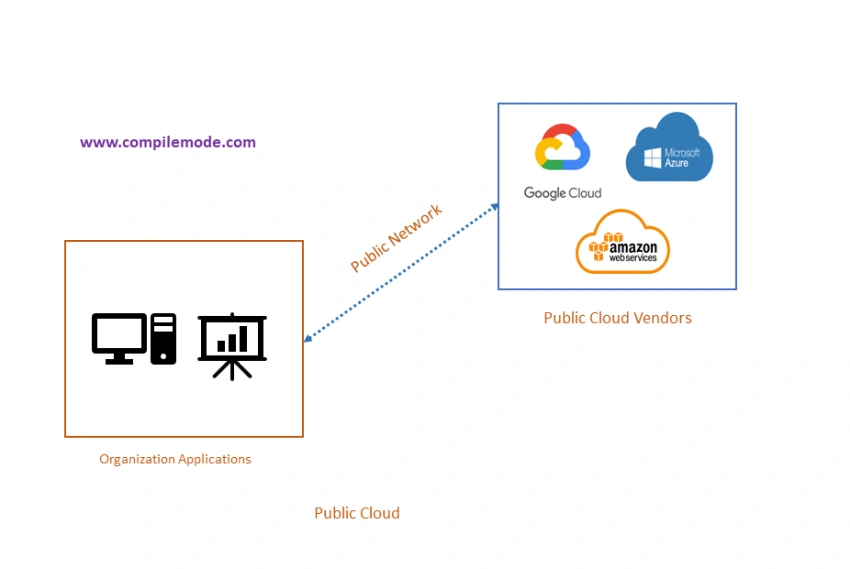
An Example of Public Clouds
- Microsoft Azure
- Amazon Web Services (AWS)
- Google Cloud
- IBM Cloud
- Alibaba Cloud etc.
Public Cloud Key Points
- Services can be used by multiple organisations over a public network
- The applications or services can also be secured for access within the organization's network by utilising a VNET in Azure or a VPC in AWS etc.
- The data center resides at the cloud provider's premises.
- The public cloud is considered less secure to share confidential information since it involves the public network.
- Cloud providers are responsible for the maintenance and management of the public cloud, so users don't have to worry about it.
- The public cloud is less expensive compared to the private cloud since it does not require the cost of setup, maintenance, and management.
What is Hybrid Cloud?
When the combination of private and public cloud services is used by an organisation, it is termed a hybrid cloud. It's often that either of the clouds does not provide the capability to deliver a certain application requirement, then an organisation chooses to use both the cloud services to build the applications. The following diagram demonstrates the hybrid cloud
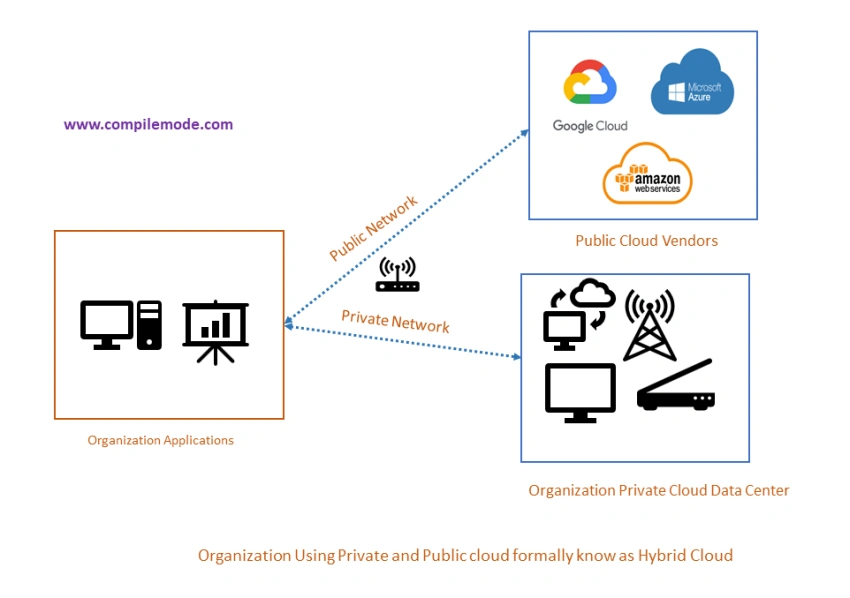
Hybrid Cloud Key Points
- Data coming from the public cloud will be kept on public cloud databases, but private cloud data resides in a private database
- A private cloud datacenter resides within an organisation and a public cloud datacenter resides over the cloud provider premises.
- Confidential information is shared using the private cloud and other information can be shared using the public cloud.
- A hybrid cloud is a little expensive since it uses private and public cloud services together.
I hope the preceding explanation helped to understand the public, private, and hybrid cloud deployment models. Now let's learn about the cloud services delivery model.
What is the cloud service delivery model?
The cloud provider groups or categories the services based on the type of business requirement fulfilled by the services. The following are the three types of services delivery models typically used by any cloud provider, such as Microsoft, Google, and Amazon.
- IaaS (Infrastructure as a service)
- PaaS (Platform as a Service)
- SaaS (Software as a Service)
The following diagram demonstrates the service delivery model layers.
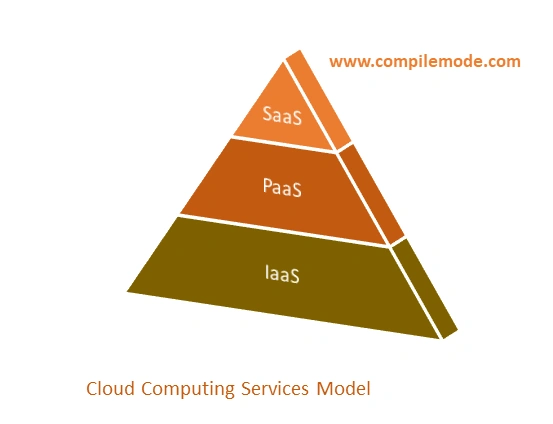
Now let's visualise the following tree diagram to make it easier to understand the service delivery models.
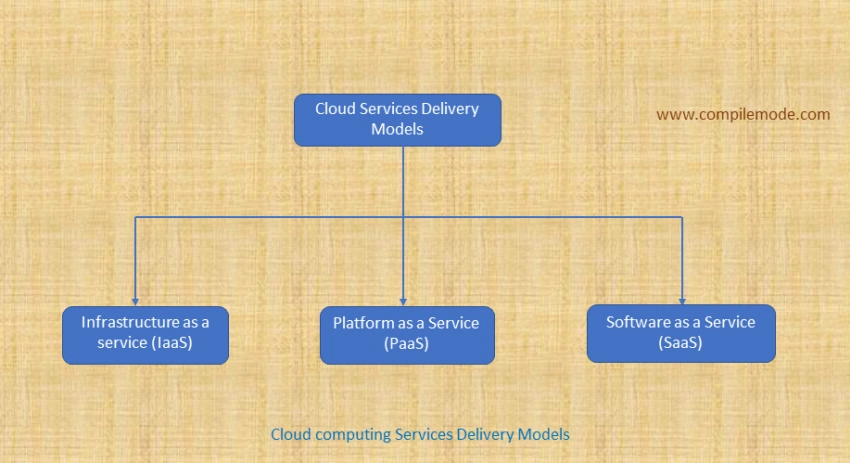
Let's take a look at each service delivery model.
What is Infrastructure as a Service (IaaS)?
In the IaaS cloud computing service delivery model, cloud providers offer the compute resources that are required for application development, such as virtual machines, storage, virtualization, networking, etc. The IaaS model provides the flexibility to use the infrastructure as a service based on a pay as you go or fixed rate model without worrying about the underlaying setup complexity and without purchasing the high-cost physical servers and hardware.
IaaS ensures the faster setup of infrastructure without worrying about the maintenance, security, scalability, and installation process. The end user has only the responsibility to manage the infrastructure in terms of access restrictions to users etc. The Infrastructure-as-a-service (IaaS) model saves the huge amount of money that is required to setup, maintain, and manage the resources.
Examples
- Virtualization
- Azure Virtual Machines
- Azure Networking
- Azure Storage
- Amazon EC2 etc.
What is Platform as a Service (PaaS)?
Platform-as-a-Service (PaaS) provides the environment to build, test, and manage an application without worrying about the underlaying infrastructure. Platform as a service lets organisations focus on their application or product development without worrying about the environment required to run, scale, and secure their applications. Cloud users can use the services on a pay as-go or fixed pay model.
The cloud user's only responsibility is to manage the data and create resources. The rest of the process is managed by the cloud provider. Platform-as-a-Service (PaaS) provides a variety of services as given in tthe following example
- Development tools
- Middleware
- Operating systems
- Database management
- Infrastructure
Examples
- Azure App Service
- Amazon Web Service
- Google App Engine etc.
What is Software as a Service (SaaS)?
Software-as-a-Service (SaaS) delivers complete application software as a service via a pay-as-you-go or fixed-fee model, eliminating the need to build, deploy, and manage the application. The software building, testing , deployment, database server management, etc. are taken care of by the cloud provider, and the end user is allowed to access services via a web browser.
Examples
- Microsoft Office 365
- CRM
- SalesForce
- Google Docs
- Google Drive etc.
Summary
I hope you found this article helpful in understanding Cloud Deployment and Service Delivery Models. If you have any questions, then let me know using the comment box.
Related articles
Join the conversation! Your thoughts help the community grow.