

Cloud Computing
Cloud computing provides quick services to the customer in the form of Public, Private, and Hybrid cloud models, like Microsoft Azure, which gives features for online storage, Visual Studio Access, Virtual Devices, and many more.

This image is taken from Google Cloud Data Center where all types of Data are managed.
History of Cloud Computing
- Many early mainframes offered similar capabilities but were not connected via a large network such as the internet.
- com was one of the early pioneers with Software as a Service (SaaS) in 1999.
- com launched some of the early Infrastructure as a Service (IaaS) services in 2006.
- Microsoft started offering Azure Services in 2010.
- Cloud computing market is projected to reach $127 billion by 2017.
Advantages of Cloud Computing
- Computing as a Utility
- Pay for what you use
- Elasticity - easily scale up or down dynamically.
- Multiple services offered in a single location (Web-Based Access)
- Speed of operations
- Sever Provisioning
- Server Cloning
- Cost sharing of data centers
- Built-in services for disaster recovery and failover
- Data center security and certifications
Limitation of Cloud Computing
- We do not have physical control over the data
- Our data center is remote and we may not control the connectivity of the data center
- Limited control of physical resources
- Security is provided by a third party to a certain extent
- Possibility of unwanted shutdown
IaaS – Infrastructure as a Service
- Provides virtualized resources over the internet
- Can provision
- Servers
- Desktops
- Network resource including routers and local balancers
- Can provide a high level of automation for most tasks
- Can provide advanced services such as dynamic scaling
PaaS – Platform as a Service
- Allows customers to build and deploy applications without the complexity of building physical infrastructure
- Provides a set of services that make deploying software much simpler
- Allows IT organizations to concentrate on delivering software solutions and not infrastructure
- Does limit the amount of control that IT organizations have over the application
- Existing applications may need rework to be compliant with these services
SaaS- Software as a Service
- Subscription based software
- Typically delivered on browser
- Backups and upgrades provided as a service
- Office 365, Gmail, and Google Docs
- com (CRM)
- NetSuite (ERP)
- ServiceNow (IT Service Management)
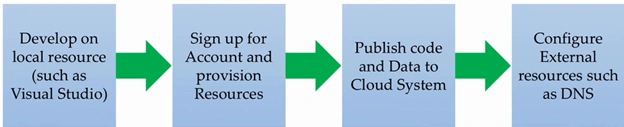
Life Cycle of Cloud Computing
Typically, the cloud-computing life cycle is broken into four important steps.
- Develops on a local resource (such as Visual Studio)
- Sign up for account provision resources
- Publish code and data to a cloud system
- Configure external resources, such as DNS
Join the conversation! Your thoughts help the community grow.