

Pre-requisite to understand this
HTTP/HTTPS – Protocol used by browsers to fetch content from servers.
DNS – Resolves domain names to IP addresses.
Caching – Temporarily storing content to reduce repeated backend calls.
Load Balancer – Distributes traffic across multiple servers.
Latency – Time taken for a request to travel from client to server.
Edge Computing – Processing data closer to the end user.
Cloud Infrastructure – Distributed compute, storage, and networking.
Web Application Firewall (WAF) - WAF is a security layer that protects web applications by monitoring, filtering, and blocking malicious HTTP/HTTPS traffic.
DDoS layer - Refers to the OSI layer at which a Distributed Denial of Service (DDoS) attack operates and is mitigated.
Introduction
A Content Delivery Network (CDN) is a globally distributed system of edge servers designed to deliver web content to users with high performance, availability, and security. Instead of serving content from a single centralized data center, a CDN caches and serves content from geographically closer edge locations. At an enterprise level, CDNs are not limited to static content delivery but also handle dynamic content acceleration, API caching, DDoS protection, Web Application Firewall (WAF), and observability. Large-scale enterprises such as e-commerce platforms, OTT streaming services, SaaS providers, and financial institutions rely heavily on CDNs to ensure consistent user experience across the globe.
What problem we can solve with this?
Without a CDN, enterprise applications face multiple scalability and performance challenges. Users located far from the origin server experience high latency, leading to slow page loads and poor user experience. Sudden traffic spikes (e.g., flash sales or product launches) can overload backend systems, causing downtime. Security threats like DDoS attacks can cripple centralized infrastructures. CDNs mitigate these risks by distributing content closer to users, offloading traffic from origin servers, and absorbing malicious traffic at the edge. They also reduce bandwidth costs and improve global reach while maintaining compliance and reliability.
Problems solved:
High latency for geographically distributed users
Backend overload during traffic spikes
Poor availability and single point of failure
Inefficient bandwidth usage
Increased vulnerability to DDoS attacks
Slow delivery of static and media content
How to implement/use this?
In an enterprise setup, a CDN is placed in front of application load balancers and origin servers. DNS is configured to route user requests to the nearest CDN edge location. Static assets are cached at edge nodes, while dynamic requests are intelligently forwarded to the origin. Enterprises define cache policies, TTLs, and invalidation strategies. Security services such as WAF, rate limiting, and bot protection are enabled at the CDN layer. Monitoring and logging are integrated with enterprise observability tools to track performance and anomalies.
Implementation steps:
Configure CDN provider and edge locations
Update DNS to route traffic via CDN
Define caching and invalidation policies
Integrate security features (WAF, DDoS)
Monitor performance and logs
Optimize cache hit ratios
Sequence Diagram
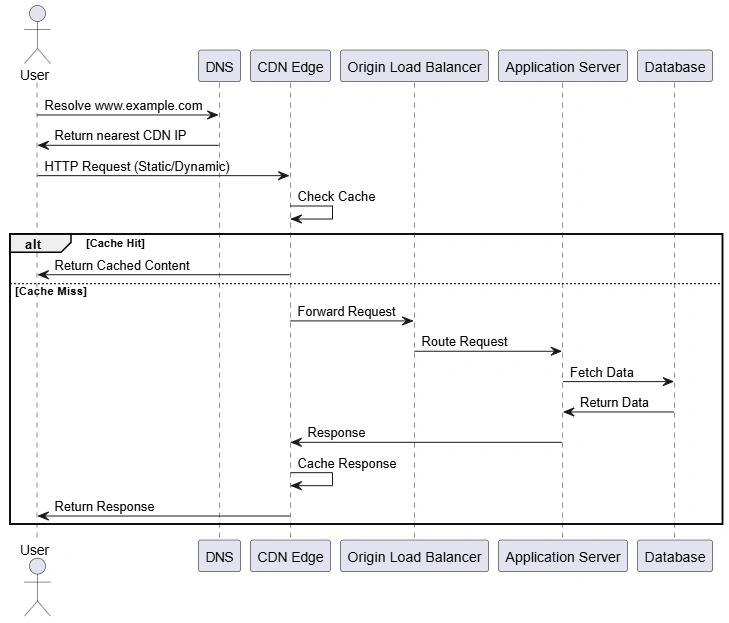
This sequence diagram shows how a user request flows through an enterprise CDN architecture. The user first resolves the domain via DNS, which points to the nearest CDN edge. The CDN checks if the requested content exists in its cache. If found, it responds immediately, reducing latency. If not, the request is forwarded to the origin infrastructure through a load balancer. The response is cached at the edge for future requests. This mechanism ensures fast response times, backend protection, and scalability.
Key points:
DNS directs traffic to nearest edge
Cache hit avoids origin access
Cache miss fetches from backend
Responses are cached for reuse
Backend load is significantly reduced
Component Diagram
This component diagram represents logical responsibilities within an enterprise CDN setup. The client interacts directly with the CDN edge cache, which serves content or forwards requests. Security enforcement such as WAF occurs at the CDN layer. The origin layer contains scalable backend services behind a load balancer. The data layer remains isolated and protected. This separation of concerns ensures modularity, scalability, and secure traffic handling.

Key points:
CDN acts as first contact point
Security enforced before origin
Load balancer distributes traffic
Backend services remain protected
Clear separation of responsibilities
Deployment Diagram
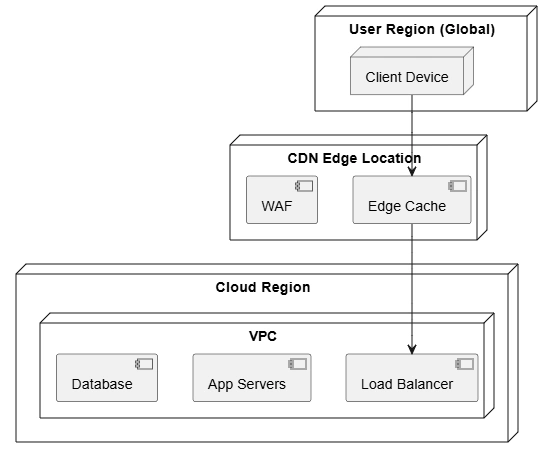
The deployment diagram illustrates the physical distribution of the CDN architecture. Users are globally distributed and connect to the nearest CDN edge location. Edge nodes host caching and security components. Requests that cannot be served from cache are forwarded to centralized cloud regions hosting the origin infrastructure. This deployment minimizes latency while maintaining centralized data control and compliance.
Key points:
Edge nodes are globally distributed
Origin remains centralized
Reduced cross-region latency
Secure and scalable deployment
Optimized for global enterprises
Advantages
Low latency – Content delivered from nearby edge locations
High availability – Distributed architecture prevents outages
Scalability – Handles sudden traffic spikes easily
Security – DDoS and WAF at edge layer
Cost optimization – Reduced origin bandwidth usage
Improved user experience – Faster load times globally
Summary
An enterprise-level CDN is a critical infrastructure component for modern distributed applications. It enhances performance, security, and reliability by moving content closer to users while protecting backend systems. By integrating caching, traffic management, and security at the edge, enterprises can scale globally without compromising user experience or operational stability. CDNs are no longer optional—they are foundational to resilient, high-performance enterprise architectures.
Join the conversation! Your thoughts help the community grow.