

Modern databases dema
nd secure authentication to protect sensitive data and ensure compliance.
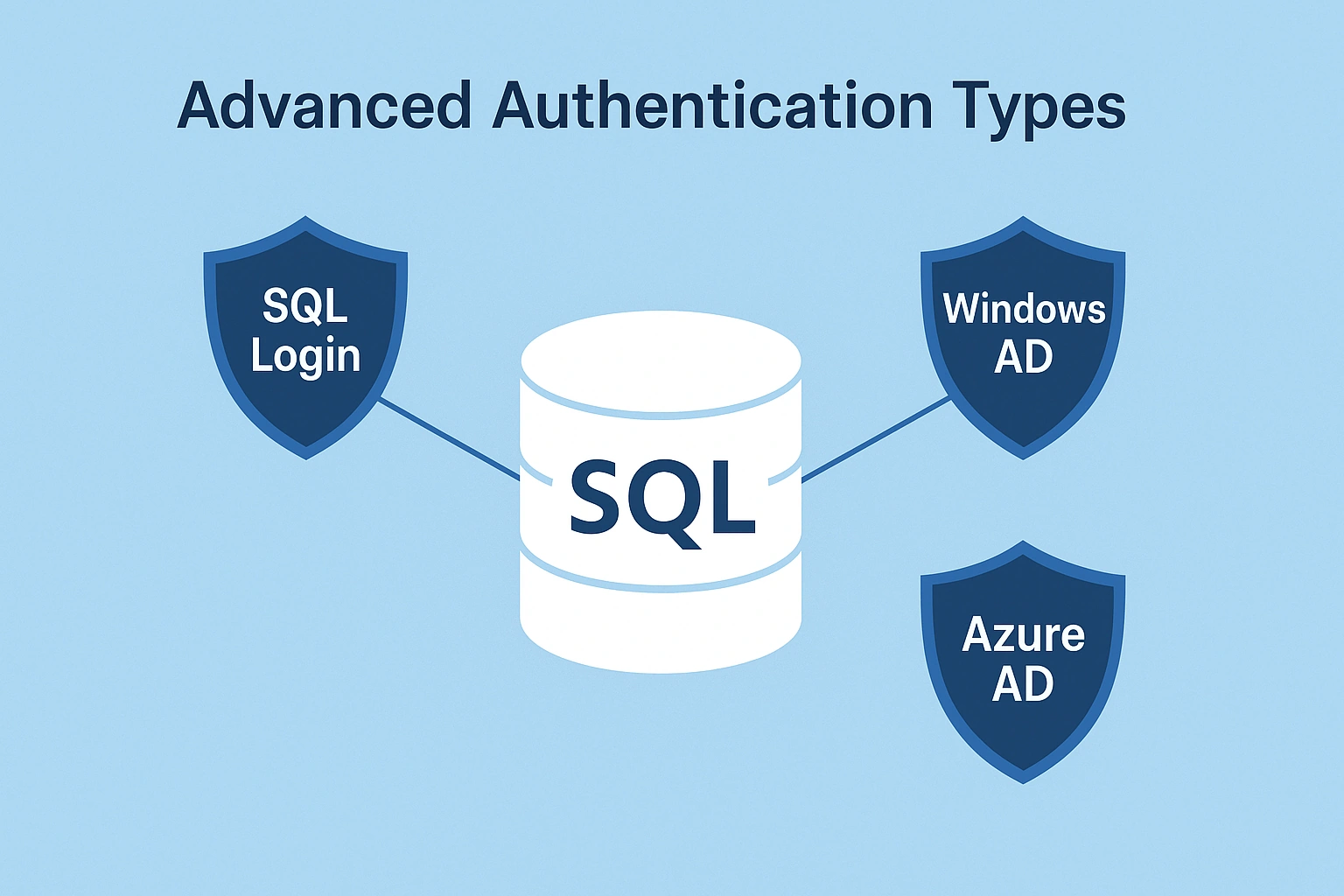
SQL Server and other major database platforms (like Oracle, PostgreSQL, and MySQL) offer several authentication options—each suited to different security and infrastructure needs.This article focuses on the three most common and secure authentication types: SQL Authentication, Windows Authentication, and Azure Active Directory (Azure AD).
1️⃣ SQL Authentication
SQL Authentication, also known as SQL Login, stores credentials (username and password) inside the SQL Server instance. It’s a database-managed authentication model, independent of Active Directory or Windows accounts.
🔸 Features
Uses login name and password stored in SQL Server.
Ideal for non-domain clients or cross-platform applications.
Supports backward compatibility for legacy systems.
🔸 Advantages
Works outside of domain networks.
Simple to set up for service accounts or third-party tools.
Enables easy app-level authentication control.
🔸 Disadvantages
Passwords must be managed manually.
No centralized policy enforcement (e.g., MFA).
Slightly higher attack surface if passwords are weak.
🔸 Best Practices
Use strong password policies and encrypt connections (TLS).
Restrict login privileges.
Periodically rotate credentials and audit logins.
2️⃣ Windows Authentication
Windows Authentication (also known as Integrated Security or Trusted Connection) uses the Windows or Active Directory identity of the user to authenticate.
It’s the most secure and preferred option for enterprise setups.
🔸 Features
Uses Kerberos or NTLM protocols for verification.
Credentials are not sent directly to SQL Server.
Enables Single Sign-On (SSO) via Active Directory.
🔸 Advantages
Centralized identity control via AD.
Strong password and lockout policies automatically applied.
Easy role-based access using AD groups.
🔸 Disadvantages
Requires domain membership or trust relationships.
Not ideal for external or Linux-based clients.
🔸 Best Practices
Prefer Kerberos over NTLM for better security.
Use AD groups for permission management.
Audit AD memberships regularly.
3️⃣ Azure Active Directory (Azure AD) Authentication
Azure AD Authentication (now part of Microsoft Entra ID) is a cloud-based identity solution that allows secure, passwordless access to Azure SQL Database and SQL Managed Instances.
🔸 Features
Supports MFA, Conditional Access, and SSO.
Allows Managed Identity authentication (no secrets stored).
Centralized governance for hybrid and cloud SQL systems.
🔸 Advantages
Enhanced security through modern identity standards.
Simplified access for cloud applications and users.
Unified control with Azure RBAC and auditing.
🔸 Disadvantages
Requires Azure subscription and configuration.
May need client updates for legacy tools.
🔸 Best Practices
Use Managed Identities for application authentication.
Apply Conditional Access and MFA for users.
Monitor sign-in logs via Entra ID insights.
🧩 Other Authentication Methods (Short Notes)
| Authentication Type | Description | Typical Use |
|---|---|---|
| Certificate-Based Authentication | Uses X.509 certificates for passwordless access. | Secure app-to-app or server-to-server communication. |
| OAuth 2.0 / OpenID Connect | Token-based identity used in web and cloud APIs. | SaaS and microservice applications. |
| Kerberos Delegation | Extends Windows auth for multi-tier app scenarios. | Linked servers or service accounts. |
| External Identity Providers (Okta, Ping, etc.) | Federated identity integration across platforms. | Enterprise SSO environments. |
🧩 Summary Table
| Type | Security Level | Identity Source | Ideal For |
|---|---|---|---|
| SQL Authentication | Moderate | SQL Server | Legacy or non-domain systems |
| Windows Authentication | High | Active Directory | On-prem enterprise setups |
| Azure AD Authentication | Very High | Entra ID | Cloud or hybrid systems |
💡 Note
Choosing the right authentication type depends on your infrastructure, security requirements, and integration ecosystem.
For modern deployments, Windows Authentication remains the go-to choice for on-premises, while Azure AD Authentication leads in cloud and hybrid models.
Join the conversation! Your thoughts help the community grow.