
Introduction
As Layer 2 (L2) networks proliferate across the Ethereum ecosystem, each brings its own economic design, governance strategy, and incentive mechanism. Base, the L2 blockchain developed by Coinbase and built using the OP Stack, takes a notably unconventional approach: it has no native token. This article explores Base's tokenomic philosophy in depth, analyzes the design decision from multiple angles, and reflects on its long-term implications for decentralization, governance, and economic alignment.
1. Base's Design Philosophy
Base was launched with a focus on scaling Ethereum, not creating a speculative ecosystem. Built on the Optimism (OP) Stack, it is part of the broader Superchain vision, where multiple rollups are composable and interoperable.
- No Base Token: Unlike other rollups like Arbitrum (ARB) or Optimism (OP), Base did not introduce a token upon launch.
- ETH as Gas: Transaction fees on Base are paid in ETH, creating a seamless experience for Ethereum-native applications and users.
Note. This tokenless approach is a deliberate move to prioritize utility, user onboarding, and integration with Coinbase’s existing infrastructure.
2. Does Base Have a Native Token?
No. The base does not have its own native token. Instead:
- All transaction fees are paid in ETH
- Governance decisions are currently handled by Coinbase in collaboration with the OP Stack contributors
- There is no staking mechanism because Base doesn’t require validators; it uses centralized sequencers.
This flowchart visualizes Base's model
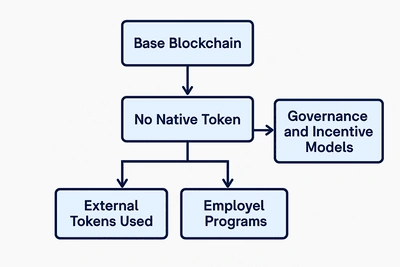
This design aligns with Coinbase’s strategic vision: streamline onboarding, reduce complexity, and maintain close compatibility with Ethereum’s ecosystem.
3. Comparative Landscape
Rollup Token Models
| L2 | Token | Governance Role | Incentive Role |
|---|---|---|---|
| Optimism | OP | RetroPGF, governance | Treasury distributions |
| Arbitrum | ARB | DAO voting | Grants, incentives |
| zkSync Era | ZK | Not launched | TBD |
| Base | - | None | None |
This divergence invites important questions.
- How will Base govern itself without a token?
- Can it remain decentralized and incentive-aligned?
4. Governance without a Token
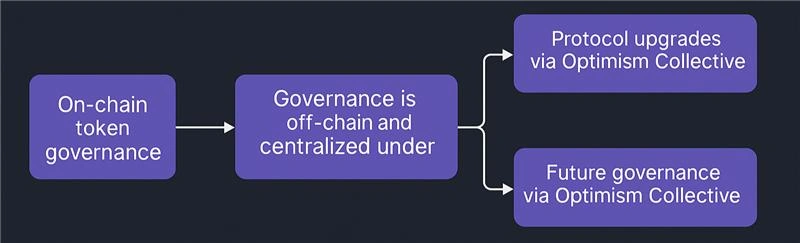
A traditional governance token provides on-chain voting rights, treasury control, and protocol upgrade influence. In Base’s model:
- Governance is off-chain and centralized under Coinbase's stewardship.
- Protocol upgrades are deployed by Coinbase and Optimism maintainers.
- Future evolution may include governance via Optimism Collective, aligning with the Superchain vision.
While this raises concerns around centralization, it also allows for,
- Faster development cycles
- Reduced regulatory friction
- Focused onboarding via Coinbase products
5. Incentives and Ecosystem Funding
Without a token, Base does not offer liquidity mining, staking rewards, or ecosystem airdrops (yet). Instead, incentives take alternative forms
- Grants via Optimism RetroPGF: Projects building on Base may still qualify.
- Coinbase Onramps: Preferential listing or integrations for Base dApps.
- Institutional onboarding: Focused on real-world asset tokenization and enterprise use.
This non-tokenized model could foster
- Fewer mercenary users
- More product-focused builders
- Regulatory clarity
6. Future Outlook - Will Base Launch a Token?
While Base currently has no token, speculation continues
- Technical Capability: The OP Stack supports token integration.
- Market Pressure: Competing L2s have tokens; the community may push for one.
- Governance Transition: Future transition to DAO may necessitate a token.
That said, a token launch could bring.
- Liquidity incentives and growth
- Decentralized governance
- Network alignment with Superchain
But also risks:
- Regulatory scrutiny (esp. Coinbase involvement)
- Short-term speculation vs long-term sustainability
7. Base and Superchain: Incentives at Scale
The Superchain concept aims to link Base with other OP Stack chains under a shared governance and incentive layer:
- OP token governs the Optimism Collective
- Revenue from Base contributes to the Collective
- Builders on Base may benefit from OP grants and governance
So while Base has no token, it participates in a meta-tokenomic system powered by Optimism.
Conclusion
Base’s tokenomics challenge conventional crypto narratives. By eschewing a native token, Base prioritizes usability, composability, and regulatory compliance. It relies on Ethereum for economic finality and on Optimism for long-term alignment. While it may eventually evolve into a token-governed protocol, its current model provides a compelling case study in post-token design. For developers, users, and investors, Base represents both an opportunity and a paradigm shift. Understanding its economic framework is crucial for building responsibly on this emerging Layer 2 ecosystem.
Join the conversation! Your thoughts help the community grow.