

Problem statement
Modern applications commonly serve multiple clients—such as web and mobile—through a shared set of backend APIs. However, these generic APIs rarely map cleanly to the specific requirements of each frontend, leading to over-fetching or under-fetching of data. As a consequence, frontend teams are forced to implement complex data composition and transformation logic on the client side. This tightens the coupling between frontends and backend services, limits independent UI evolution, and can negatively impact performance due to additional network calls. To address these challenges, there is a need for frontend-specific APIs that tailor responses to client needs while preserving the reusability and scalability of backend services.
Solution
This is where the Backend-for-Frontend (BFF) pattern becomes valuable. The BFF pattern is an architectural strategy that introduces a dedicated backend service for each frontend application. Rather than relying on a single, shared API to serve all clients, each frontend is supported by a purpose-built backend tailored to its specific requirements. This approach streamlines frontend development, reduces complexity, and delivers a more optimized and responsive user experience.
This pattern is typically implemented by introducing an additional layer that focuses exclusively on interface-specific requirements. This layer, referred to as the Backend-for-Frontend (BFF) service, sits between the frontend client and the underlying backend services. When an application supports multiple interfaces—such as a web application and a mobile app—a separate BFF service is created for each interface to address its distinct needs.
For example:
A Web BFF addresses browser-specific concerns such as search engine optimization (SEO), caching strategies, and page performance.
A Mobile BFF is designed to reduce payload sizes, minimize network calls, and optimize interactions for low-bandwidth or high-latency environments.
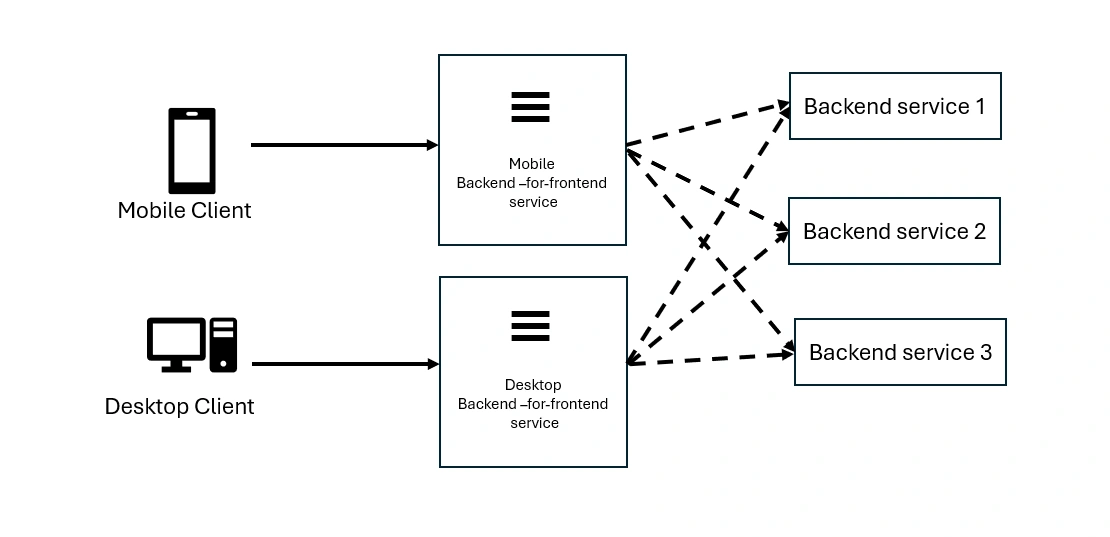
Why Use the Backend-for-Frontend (BFF) Pattern?
Challenges with a Single, Shared Backend
Over-fetching or under-fetching of data: Generic APIs often return more data than a client needs or require multiple requests to retrieve all required information.
Increased client-side complexity: Frontend applications are forced to handle data aggregation, transformation, and orchestration logic, making them harder to maintain.
Performance limitations: Mobile and resource-constrained clients can suffer from large payloads, excessive network calls, and slower response times.
When Should You Use the Backend for Frontend (BFF) Pattern?
The Backend for Frontend (BFF) pattern is most effective in the following situations:
Multiple and Diverse Client Applications: When an application serves different types of clients—such as web applications, mobile apps, or IoT devices—each with unique data, performance, or interaction needs. A dedicated backend for each client ensures responses are tailored specifically to that frontend's requirements.
Handling Complex or Large API Responses: If backend services expose large or complex data structures that require extensive transformation, aggregation, or filtering, a BFF layer can handle this processing. This simplifies frontend logic and keeps client applications lightweight.
Performance and Payload Optimization: When performance optimization is essential—especially for resource-constrained devices like mobile apps—BFFs can deliver optimized, minimal payloads. Each frontend receives only the data it needs, improving responsiveness and reducing network overhead.
Independent Frontend Development and Evolution: If different frontends evolve independently or follow separate release cycles, the BFF pattern allows each frontend to have its own backend. This enables faster changes and minimizes the risk of impacting other clients.
Client-Specific Security and Access Control: When different client types require varying security policies, permission levels, or authentication mechanisms, a BFF can enforce client‑specific authorization rules, data filtering, and access controls, ensuring secure and appropriate data exposure.
When Should You Avoid the Backend for Frontend (BFF) Pattern?
The Backend for Frontend (BFF) pattern may not be the optimal architectural choice in the following scenarios:
Simple or Single-Client Applications: If your application supports only one type of frontend—such as a single web application—or if the differences between clients are minimal, introducing multiple backend layers can add unnecessary complexity without delivering meaningful benefits.
Increased Operational and Maintenance Overhead: Implementing and maintaining multiple BFF services requires additional infrastructure, monitoring, deployment pipelines, and development effort. For teams with limited resources or smaller applications, this added overhead may outweigh the advantages.
Existing Backend Already Meets All Client Needs: When your current backend efficiently serves multiple clients without requiring extensive data transformation or client‑specific logic, adding BFFs can be redundant and offer little architectural value.
Additional Latency and Communication Overhead: Since BFFs act as intermediary layers between frontend clients and core backend services, they can introduce added latency, extra network hops, and more potential points of failure if not carefully designed and managed.
Strong Frontend–Backend Coupling:If frontend and backend components are tightly coupled—where changes on one side frequently require synchronized updates—maintaining separate BFFs for each client may complicate development workflows and slow down deployment cycles.
Microservices Already Provide Client-Specific Customization: In architectures where microservices are already designed to expose tailored APIs for different frontend needs, introducing an additional BFF layer may be unnecessary and could duplicate responsibilities already handled by the backend services.
Best Practices
Keep the BFF lightweight: Minimize business logic within the BFF and delegate complex processing to core backend services.
Enforce strong security measures: Properly validate incoming requests and handle authentication and authorization at the BFF layer.
Continuously monitor performance: Ensure the BFF remains efficient and does not become a performance bottleneck or single point of failure.
Enable independent deployments: Automate build and deployment pipelines so each BFF can be deployed and scaled independently without impacting other services.
Real-World Examples of the Backend for Frontend (BFF) Pattern
Netflix: Implements BFFs to tailor APIs for a wide range of devices—including smart TVs, mobile apps, and web clients—ensuring optimal performance and user experiences across platforms.
Spotify: Uses client-specific backends to customize API responses for mobile and desktop applications, optimizing payload sizes and interaction patterns for each device.
Amazon: Leverages BFF-style layers to support diverse frontend experiences such as web, mobile, and voice-based interfaces (e.g., Alexa), enabling client-specific data aggregation and performance optimization.
Uber: Employs BFFs to serve different consumer applications (rider, driver, and internal tools), allowing each frontend to receive tailored data and workflows while scaling independently.
Microsoft: Uses BFF-style architectures across products like Microsoft 365 to support multiple client platforms (web, desktop, mobile) while enabling independent development and deployment cycles.
Not to be confused with API Gateway
Although BFF and API Gateway are often confused, they address different concerns and are typically used together rather than as competing solutions.
| Aspect | Backend-for-Frontend (BFF) | API Gateway |
|---|---|---|
| Primary purpose | Tailor APIs to a specific frontend | Centralized entry point for all clients |
| Scope | Per frontend (Web, Mobile, etc.) | Cross-cutting for all services |
| Client awareness | Strongly frontend-aware | Client-agnostic |
| Business logic | May include orchestration and aggregation | Minimal or none |
Key Takeaways
The Backend for Frontend (BFF) pattern provides a dedicated backend layer for each type of frontend, enabling APIs that are tailored to specific client needs.
BFF helps simplify frontend development by moving data aggregation, transformation, and orchestration logic to the backend.
It improves performance and user experience by delivering optimized, device‑specific payloads, especially for mobile and bandwidth‑constrained environments.
The pattern supports independent evolution and deployment of frontend applications, allowing teams to move faster without impacting other clients.
BFFs should remain lightweight, focusing on coordination rather than core business logic, which should reside in shared services.
While powerful, the BFF pattern introduces additional operational complexity and should be adopted only when its benefits clearly outweigh the overhead.
BFF and API Gateway address different concerns and are often used together to create a scalable, secure, and flexible architecture.
Join the conversation! Your thoughts help the community grow.