

Pre-requisite to understand this
To understand Backblaze B2, it helps to have basic knowledge of:
Cloud computing concepts
Object storage (files stored as objects with metadata, not as block/file systems)
REST APIs
HTTP/HTTPS
Basic familiarity with:
AWS S3–like storage
Authentication using API keys
Upload/download workflows
No deep cloud expertise is required, but knowing how applications interact with cloud services is useful.
Introduction
Backblaze B2 Cloud Storage is a scalable, cloud-based object storage service designed to store large volumes of unstructured data in a cost-effective and reliable manner. It allows users and applications to store, retrieve, and manage data such as backups, media files, logs, and archives through APIs or compatible tools. One of the key goals of Backblaze B2 is to provide a simpler and more affordable alternative to traditional cloud storage providers, while still offering enterprise-grade durability and availability. The service supports native APIs as well as S3-compatible APIs, making it easy to integrate into existing systems.
It is designed for storing large amounts of unstructured data such as:
Backups
Media files (images, videos)
Logs
Archives
Static website assets
What problem we can solve with this?
Backblaze B2 addresses the problem of storing and managing large amounts of data without incurring high infrastructure or operational costs. Many organizations struggle with the expense and complexity of scaling on-premises storage or paying unpredictable cloud storage fees. B2 solves this by offering predictable, low-cost object storage that automatically scales as data grows. It is particularly useful for backup and disaster recovery scenarios, long-term data archiving, and applications that need to store and serve large files globally. By abstracting away hardware management, replication, and durability concerns, Backblaze B2 allows teams to focus on application logic rather than storage infrastructure.
How to implement/use this?
The following PlantUML sequence diagram illustrates a typical file upload flow from a client application to Backblaze B2.
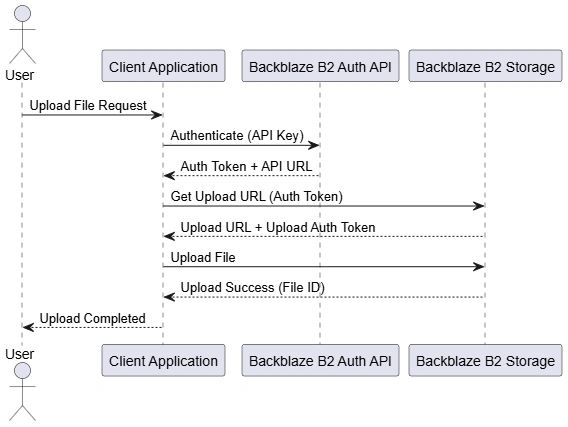
Using Backblaze B2 typically starts with creating an account and setting up one or more buckets, which act as containers for stored objects. Buckets can be configured as public or private depending on access requirements. After creating a bucket, application keys are generated to authenticate API requests. An application first authenticates with the Backblaze B2 authorization service to obtain an authorization token and API endpoint. With this token, the application requests an upload URL and then uploads files directly to that URL. Once uploaded, files can be downloaded, listed, or deleted using the B2 API or through S3-compatible tools. Optional features such as lifecycle rules, object versioning, and access controls can be configured to manage data retention and security.
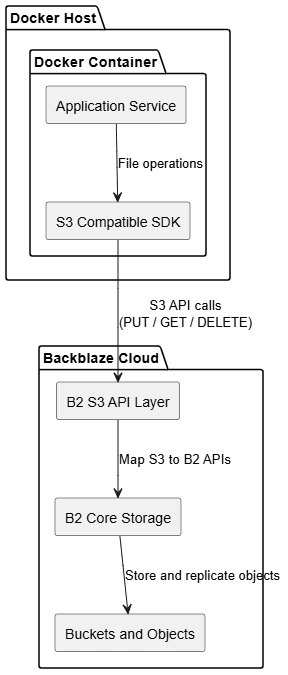
The Docker Host runs a Docker Container that encapsulates the application and its dependencies, ensuring portability and consistent runtime behaviour.
Inside the Docker Container, the Application Service contains the business logic and delegates all object storage operations to an S3-compatible SDK.
The S3-Compatible SDK (such as AWS SDK, boto3, or MinIO client) communicates with Backblaze B2 using standard S3 API calls like PUT, GET, and DELETE.
These S3 API requests are sent over HTTPS to the Backblaze B2 S3 API Layer, which provides compatibility with Amazon S3–style interfaces.
The S3 API Layer translates incoming S3 requests into native Backblaze B2 API operations.
The B2 Core Storage component handles object storage responsibilities such as data persistence, replication, and durability.
Actual files are stored as objects inside B2 buckets, represented by the Buckets and Objects component.
This architecture allows the application to remain cloud-agnostic, scalable, and cost-efficient while leveraging Backblaze B2 for reliable object storage.
Advantages
Cost-effective: Lower storage and bandwidth costs compared to many competitors.
Simple pricing model: Pay only for Storage used. Data downloaded
S3-compatible API: Use existing tools and SDKs
High durability and availability:
Designed for 11+ nines of durability.
Automatic replication
Flexible access control:
Public or private buckets.
Time-limited URLs.
Fine-grained API keys
Easy automation:
REST APIs
CLI tools
SDKs for multiple languages
Summary
Backblaze B2 Cloud Storage is a robust object storage solution designed to provide affordable, scalable, and reliable cloud storage. It helps solve common challenges related to data growth, backup, and long-term retention without the complexity of managing physical infrastructure. By offering simple APIs, S3 compatibility, and predictable pricing, Backblaze B2 enables developers and organizations to store and access data efficiently while keeping costs under control.
Join the conversation! Your thoughts help the community grow.