

Introduction
Modern distributed systems rely heavily on how services communicate - whether synchronously (blocking) or asynchronously (non-blocking/event-driven). Choosing the right approach directly affects scalability, performance, and architectural complexity.
This article explains synchronous vs asynchronous communication and how it applies to:
FastAPI
Flask
Django
Synchronous Communication
Definition
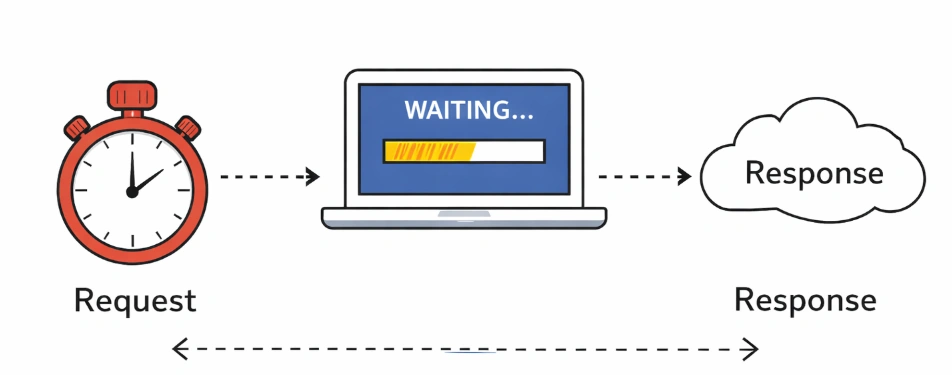
Synchronous communication follows a request–response model:
Client sends request
Server processes
Server returns response
Client waits until response arrives
The caller is blocked until the operation completes.
Example: Sync Endpoint (Flask)
from flask import Flask
import time

app = Flask(__name__)

@app.route("/sync")
def sync_endpoint():
    time.sleep(5)  # Blocking operation
    return {"message": "Done"}
If 100 users call this endpoint:
Each request occupies a worker thread/process
The server must scale using more threads/processes
Characteristics
Simple mental model
Easier debugging
Thread/process-based concurrency
Limited scalability for I/O-heavy workloads
When Sync Works Well
CPU-bound operations
Simple CRUD APIs
Traditional enterprise applications
Internal systems with moderate traffic
Asynchronous Communication
Definition
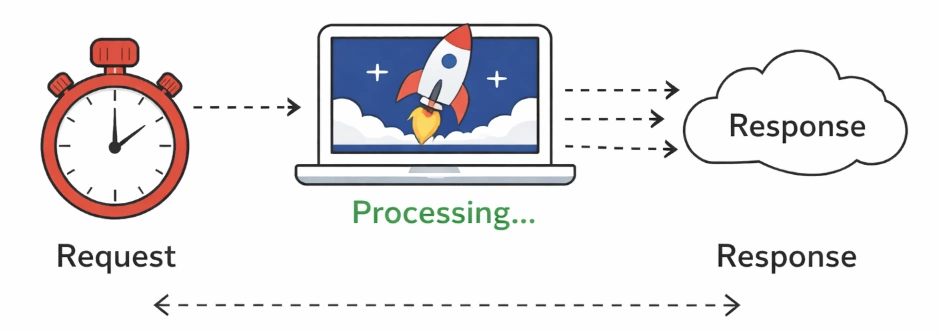
Asynchronous communication allows non-blocking execution:
Request is sent
Processing happens without blocking the main thread
Other requests continue processing
Response returned when ready
Based on event loops and cooperative multitasking.
Example: Async Endpoint (FastAPI)
from fastapi import FastAPI
import asyncio

app = FastAPI()

@app.get("/async")
async def async_endpoint():
    await asyncio.sleep(5)  # Non-blocking
    return {"message": "Done"}
While waiting:
Event loop processes other requests
No thread is blocked
Characteristics
High concurrency
Efficient for I/O-bound tasks
Uses event loop instead of threads
Better resource utilization
When Async Works Best
External API calls
Database queries
File I/O
WebSockets
Streaming APIs
Microservices communication
Framework-Level Comparison
FastAPI
FastAPI is:
ASGI-based
Async-first
Built on Starlette
Supports both
async defanddef
Runs on ASGI servers such as:
Uvicorn
Hypercorn
Internal Handling
async def→ Runs in event loopdef→ Automatically executed in threadpool
FastAPI is ideal for high-concurrency APIs and microservices.
Flask
Flask is:
WSGI-based
Primarily synchronous
Thread/process concurrency model
Although modern Flask versions allow async views, it is not truly async-native.
Runs typically on:
Gunicorn (WSGI mode)
Concurrency is handled by:
Multiple processes
Multiple threads
Best suited for traditional synchronous web apps.
Django
Django historically:
WSGI-based
Fully synchronous
Modern Django versions support ASGI and async views.
However:
ORM is still largely synchronous
Middleware ecosystem is mostly sync
Async support is partial
Django excels in:
Full-stack applications
Admin dashboards
Enterprise web platforms
WSGI vs ASGI
For detail understanding of WSGI and ASGI, you can check my article WSGI vs ASGI Application Servers in Python.
| Feature | WSGI | ASGI |
|---|---|---|
| Communication Model | Sync | Async |
| Concurrency | Threads/Processes | Event Loop |
| WebSockets | Not supported | Supported |
| Streaming | Limited | Native |
| Ideal For | Traditional apps | Modern APIs |
WSGI frameworks:
Flask
Traditional Django
ASGI frameworks:
FastAPI
Modern Django (ASGI mode)
Architectural Async vs Code-Level Async
There are two types of async:
Code-Level Async (async/await)
Non-blocking execution inside a service
Example: FastAPI endpoint
Architectural Async (Event-driven)
Services communicate through message brokers
No direct request-response
Common tools:
Apache Kafka
RabbitMQ
Example flow:
Order Service → Event → Kafka → Payment ServiceThis is asynchronous communication between services.
Performance Perspective
Sync Model
If each request takes 2 seconds:
100 concurrent users require 100 threads/processes
Higher memory usage
Async Model
If 90% of time is waiting (I/O):
Single event loop can handle thousands of connections
Much lower memory footprint
Async is superior for:
I/O-heavy workloads
High-concurrency APIs
Sync is fine for:
CPU-heavy workloads
Moderate traffic
Choosing Between FastAPI, Flask, and Django
| Requirement | Recommended Framework |
|---|---|
| High-concurrency API | FastAPI |
| Traditional web app | Django |
| Lightweight REST API | Flask |
| WebSockets/SSE | FastAPI |
| Full admin + ORM | Django |
Hybrid Approach in Real Systems
Modern systems often combine:
Synchronous REST APIs for user-facing operations
Asynchronous messaging for background processing
Example:
User creates order (sync)
Order event published (async)
Inventory and payment services process independently
This approach provides:
Responsiveness
Scalability
Loose coupling
Conclusion
Synchronous and asynchronous communication are architectural choices — not just programming styles.
Flask - Primarily synchronous
Django - Traditionally synchronous, partially async
FastAPI - Async-first, modern API framework
There is no universal “best.”
Use synchronous communication for simplicity and CPU-heavy workloads.
Use asynchronous communication for scalability, I/O-heavy systems, and distributed microservices.
Join the conversation! Your thoughts help the community grow.