

Architecture of AI (Artificial Intelligence) that refers the component of AI enable an AI system to perceive inputs, process information, make decisions, and execute the produce outputs
Components of AI Architecture
Input data which collected form user in various ways like databases, sensors or images, then undergoes preprocessing, where it is cleaned, transformed, and relevant features are extracted to improve its quality. After that processed data sending to AI/ML Models. Then system learns patterns and makes decisions based on the training it has received. The trained model performs prediction on collated data to generate results. These predicted results are presented such as classifications, recommendations, or forecasts. Finally, to improve accuracy of AI system evaluates the model performance using new data and user feedback
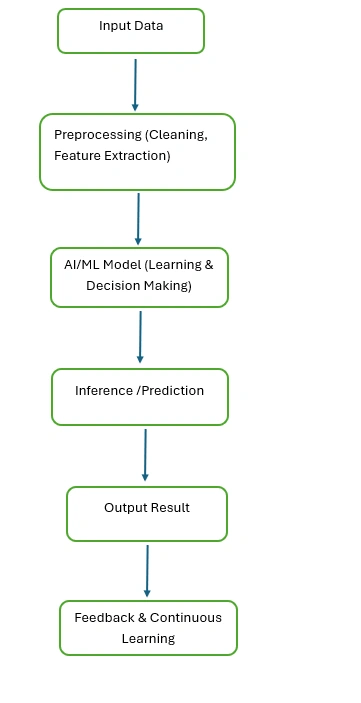
Flow of AI
Input Data → Preprocessing → AI/ML Model → Inference/Prediction → Output Result → Feedback & Continuous Learning.
Applications
Fraud detection
Autonomous vehicles
Virtual assistants (chatbots and voice assistants)
Image and speech recognition
Medical diagnosis
Recommendation systems
Generative AI( example :Chat-GPT)
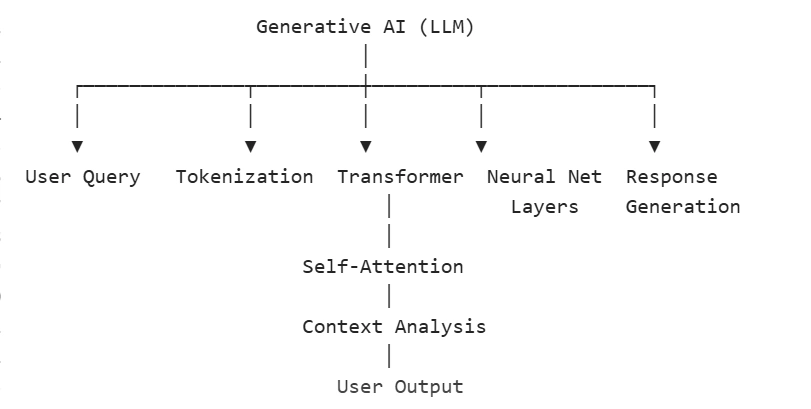
Three-Layer AI Architecture
Data Layer
Data collection and storage.
Model Layer
Training and learning algorithms.
Application Layer
User applications such as chatbots, autonomous systems and recommendation systems.
Key Technologies
Large Language (LLMs) Models
Deep Learning
Neural Networks
Transformers
Attention Mechanisms
Summary
To Summary architecture of AI is a structured framework consisting of raw data collection, preprocessing, model training, decision-making, output generation, and feedback. Modern AI systems such as Chat-GPT mainly built on deep learning architectures.
Join the conversation! Your thoughts help the community grow.