

Introduction
For more than a decade, blockchain technology has been recognized as one of the most secure methods for storing and sharing digital information. Its decentralized architecture, immutable ledger, and cryptographic protection have made it a trusted solution for cryptocurrencies, supply chain management, healthcare, finance, and many other digital services.
However, technology never stands still.
The rapid progress of quantum computing has introduced a new challenge for cybersecurity researchers. Although today's blockchain systems are considered highly secure against classical computers, many of their cryptographic foundations were never designed to withstand large-scale quantum attacks. Algorithms such as RSA and Elliptic Curve Cryptography (ECC), which are widely used for authentication and digital signatures, could eventually become vulnerable when practical quantum computers become a reality.
This does not mean blockchain is becoming obsolete. Instead, it highlights the need for the next stage of its evolution.
This is where Quantum Blockchain comes into the picture.
Rather than replacing blockchain, Quantum Blockchain enhances it by integrating post-quantum cryptographic algorithms that are specifically designed to resist attacks from both classical and quantum computers. The objective is simple: preserve the trust, integrity, and security that blockchain offers today while ensuring that these guarantees remain valid in the quantum era.
The importance of this transition becomes even more evident when we look at industries that handle sensitive information every second. Hospitals manage confidential patient records, banks process millions of financial transactions, governments explore secure electronic voting, and digital identity platforms authenticate users across countless online services. These systems cannot afford to lose trust because of future cryptographic vulnerabilities.
In this article, we will explore how Quantum Blockchain can strengthen four critical application domains:
Healthcare Records
Banking and Financial Services
Electronic Voting (E-Voting)
Digital Identity Management
Rather than focusing only on theoretical concepts, the discussion emphasizes how quantum-resistant blockchain can help organizations prepare for the cybersecurity challenges of the next generation.
Keywords : Quantum Blockchain, Blockchain Security, Post-Quantum Cryptography, Quantum Computing, Healthcare Security, Banking Security, Electronic Voting (E-Voting), Digital Identity, Cybersecurity, Future Digital Security
Why Should We Prepare Now?
A common question is, "If powerful quantum computers are not yet widely available, why should organizations start preparing today?"
The answer lies in the long lifespan of sensitive data.
Medical records, banking histories, legal documents, and identity credentials often remain valuable for many years. Information encrypted today may still need to remain confidential decades from now. If attackers capture encrypted data today and store it, they may be able to decrypt it in the future once sufficiently powerful quantum computers become available. This strategy is commonly described as "harvest now, decrypt later."
Preparing early by adopting quantum-resistant security mechanisms helps reduce this long-term risk and supports a smoother transition as post-quantum standards continue to mature.
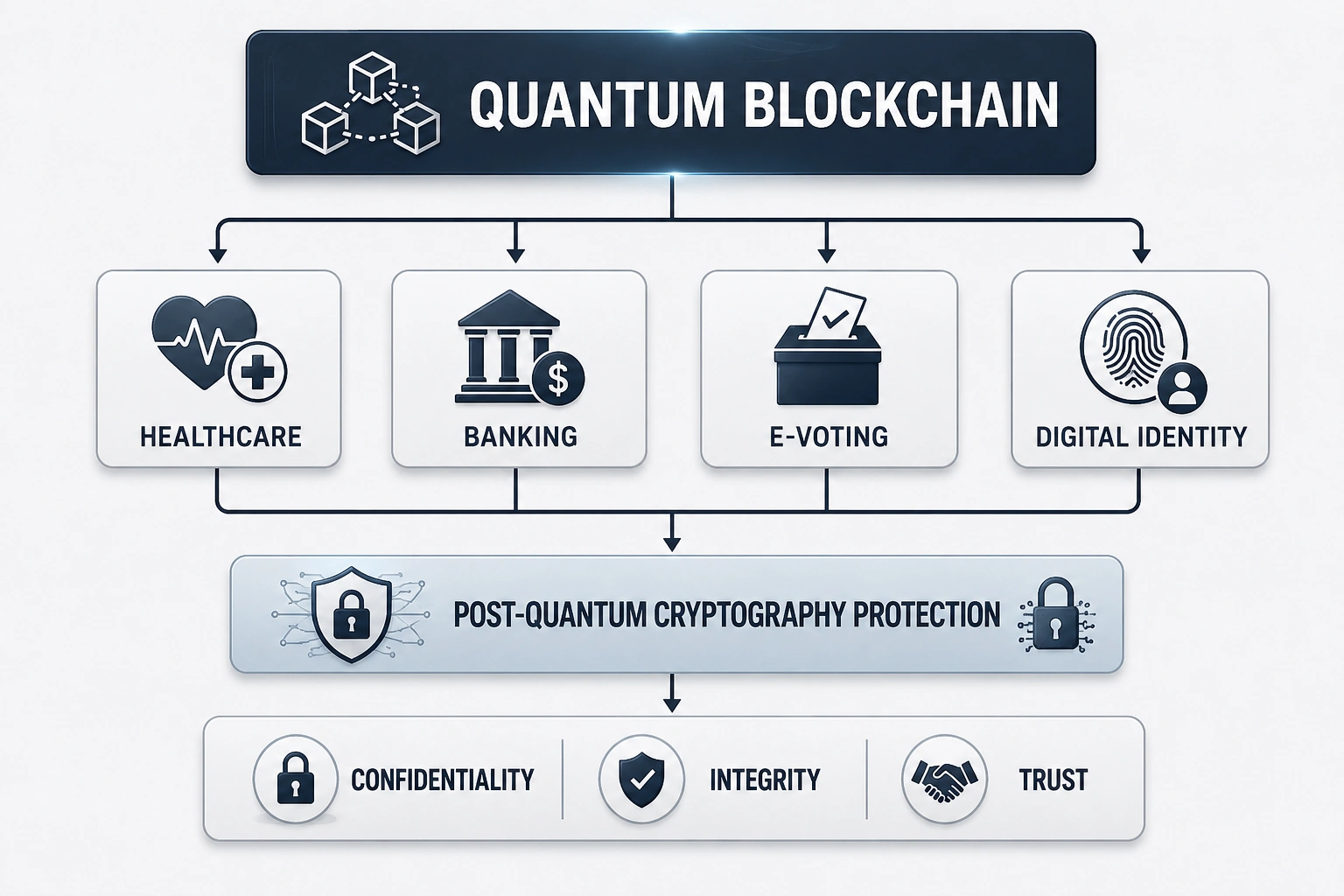
Figure 1. Conceptual overview of Quantum Blockchain protecting critical digital sectors using post-quantum cryptography.
I- Healthcare Records: Building a Quantum-Secure Healthcare Ecosystem
Healthcare is one of the most data-intensive sectors in the world. Every visit to a hospital generates valuable information, including patient demographics, medical history, laboratory reports, diagnostic images, prescriptions, insurance details, and treatment records. As healthcare services become increasingly digital, protecting this information has become just as important as providing medical care itself.
Today, most healthcare organizations rely on centralized databases or cloud-based systems to manage patient records. While these solutions have significantly improved accessibility and operational efficiency, they also introduce challenges such as data breaches, unauthorized access, ransomware attacks, and accidental data modification.
Blockchain technology was introduced as a promising solution to these challenges because it stores information in a decentralized and tamper-resistant ledger. Every authorized update is recorded chronologically, creating a transparent audit trail that helps maintain the integrity of medical records.
However, there is another challenge that healthcare systems must prepare for, the emergence of quantum computing.
Many blockchain platforms currently depend on cryptographic algorithms such as Elliptic Curve Cryptography (ECC) to authenticate users and validate digital signatures. Although these algorithms remain secure today, researchers believe that sufficiently powerful quantum computers could eventually weaken their security.
For healthcare, this is a serious concern because medical records are not short-lived data. A patient's medical history may need to remain confidential for several decades. If encrypted healthcare information is collected today and stored by attackers, it could potentially be decrypted in the future using advanced quantum computers. This long-term risk highlights the importance of transitioning toward quantum-resistant security before the threat becomes practical.
Quantum Blockchain addresses this challenge by combining blockchain technology with post-quantum cryptographic algorithms. Instead of relying solely on conventional encryption methods, future healthcare systems can adopt cryptographic techniques specifically designed to resist attacks from quantum computers. This approach ensures that patient records remain confidential, authentic, and tamper-resistant over the long term.
Another significant advantage of Quantum Blockchain is secure interoperability between healthcare institutions. Hospitals, diagnostic laboratories, pharmacies, and insurance providers often need to exchange patient information. Instead of repeatedly copying sensitive records across multiple databases, organizations can securely share verified information through a quantum-secure blockchain network while maintaining strict access control and complete traceability.
Imagine a patient receiving emergency treatment in another city. With appropriate authorization, doctors could securely access the patient's verified medical history through a Quantum Blockchain network without depending on multiple disconnected hospital databases. This could improve treatment decisions while reducing administrative delays and preserving patient privacy.
Although large-scale implementation of Quantum Blockchain in healthcare is still under active research, it represents a promising direction for building healthcare systems that remain secure not only against today's cyber threats but also against the computational capabilities of future quantum computers.
Key Advantages of Quantum Blockchain in Healthcare
Long-term protection of sensitive medical records.
Quantum-resistant authentication for healthcare professionals.
Secure sharing of patient information across hospitals and laboratories.
Tamper-resistant audit trails for clinical records.
Improved patient trust through stronger privacy protection.
Reduced dependence on centralized healthcare databases.
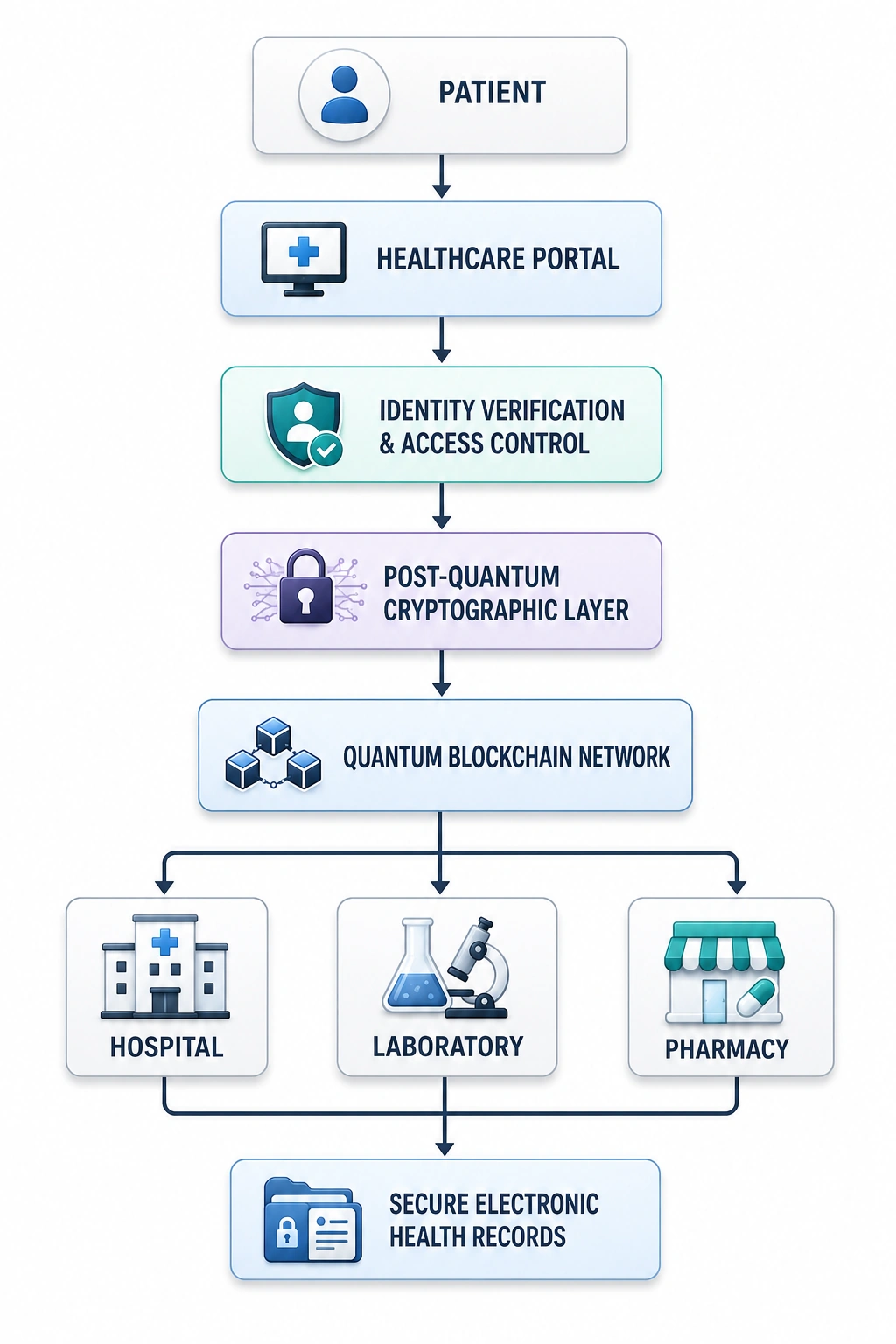
Figure 2. Illustrative architecture showing how healthcare organizations can securely exchange electronic health records using a quantum-resistant blockchain network.
Healthcare data often remains valuable throughout an individual's lifetime. As digital healthcare continues to expand through telemedicine, wearable devices, AI-assisted diagnosis, and cloud-based health services, the need for future-ready cybersecurity will become increasingly important. Quantum Blockchain has the potential to provide a resilient foundation that protects patient information for decades while supporting secure collaboration among healthcare providers.
Traditional Blockchain vs. Quantum Blockchain in Healthcare
| Feature | Traditional Blockchain | Quantum Blockchain |
|---|---|---|
| Cryptographic Security | Vulnerable to future quantum attacks | Protected using post-quantum cryptography |
| Patient Record Integrity | High | Very High |
| Long-Term Data Confidentiality | Limited in the quantum era | Designed for long-term protection |
| Hospital-to-Hospital Data Sharing | Secure | More secure with quantum-resistant authentication |
| Future Readiness | Moderate | High |
Table 1. Comparison of traditional blockchain and quantum blockchain for healthcare applications.
Unlike financial data, medical information may need to remain confidential for an individual's entire lifetime. This makes healthcare one of the strongest candidates for adopting Quantum Blockchain as organizations transition toward post-quantum cybersecurity.
II- Banking and Financial Services: Strengthening Trust in the Quantum Era
The banking and financial sector is one of the largest users of cryptographic technologies. Every day, millions of online transactions, ATM withdrawals, credit card payments, fund transfers, and digital banking sessions rely on encryption to protect customer information and financial assets.
Whenever a customer logs into an online banking application or authorizes a payment, cryptographic algorithms work behind the scenes to verify identities, secure communication channels, and ensure that transaction details cannot be altered during transmission. These security mechanisms have protected the global financial ecosystem for many years.
However, the emergence of quantum computing has introduced a new cybersecurity challenge.
Most existing financial systems depend on public-key cryptographic algorithms such as RSA and Elliptic Curve Cryptography (ECC). These algorithms are considered computationally secure against today's classical computers. In the future, however, sufficiently powerful quantum computers could solve the mathematical problems behind these algorithms much more efficiently, potentially weakening the security of digital signatures and encrypted communications.
It is important to note that this is not an immediate threat. Current banking systems remain secure, and practical quantum computers capable of breaking widely deployed encryption do not yet exist. Nevertheless, financial institutions deal with highly valuable and long-lived data, making early preparation essential rather than optional.
Quantum Blockchain provides a forward-looking approach by combining decentralized ledger technology with post-quantum cryptographic algorithms. Instead of relying only on traditional public-key encryption, future blockchain-based financial systems can authenticate users and validate transactions using cryptographic techniques specifically designed to resist quantum attacks.
This approach offers benefits beyond stronger encryption. Every transaction recorded on a blockchain is time-stamped, traceable, and resistant to unauthorized modification. When enhanced with post-quantum security, the integrity of financial records can be preserved even in a future where quantum computing becomes commercially practical.
Consider an international money transfer between two banks. Today, the transaction passes through multiple verification and settlement processes before reaching the recipient. In a Quantum Blockchain-enabled environment, the transaction could be authenticated using quantum-resistant digital signatures, validated through a decentralized blockchain network, and permanently recorded in a tamper-resistant ledger. This would improve transparency while reducing the long-term risks associated with evolving cryptographic attacks.
Another promising application is Central Bank Digital Currencies (CBDCs). Many countries are actively exploring or piloting digital currencies issued by their central banks. As these systems are expected to operate for decades, integrating post-quantum security from the beginning can help ensure that national digital payment infrastructures remain secure against future technological advancements.
Similarly, smart contracts used in decentralized finance (DeFi) and tokenized financial services could also benefit from quantum-resistant authentication, reducing the possibility of future signature forgery or unauthorized execution.
Although Quantum Blockchain is still an emerging research area, its integration into banking represents a proactive strategy. Rather than waiting for quantum computing to become a security problem, financial institutions can gradually modernize their cryptographic infrastructure and prepare for the next generation of secure digital banking.
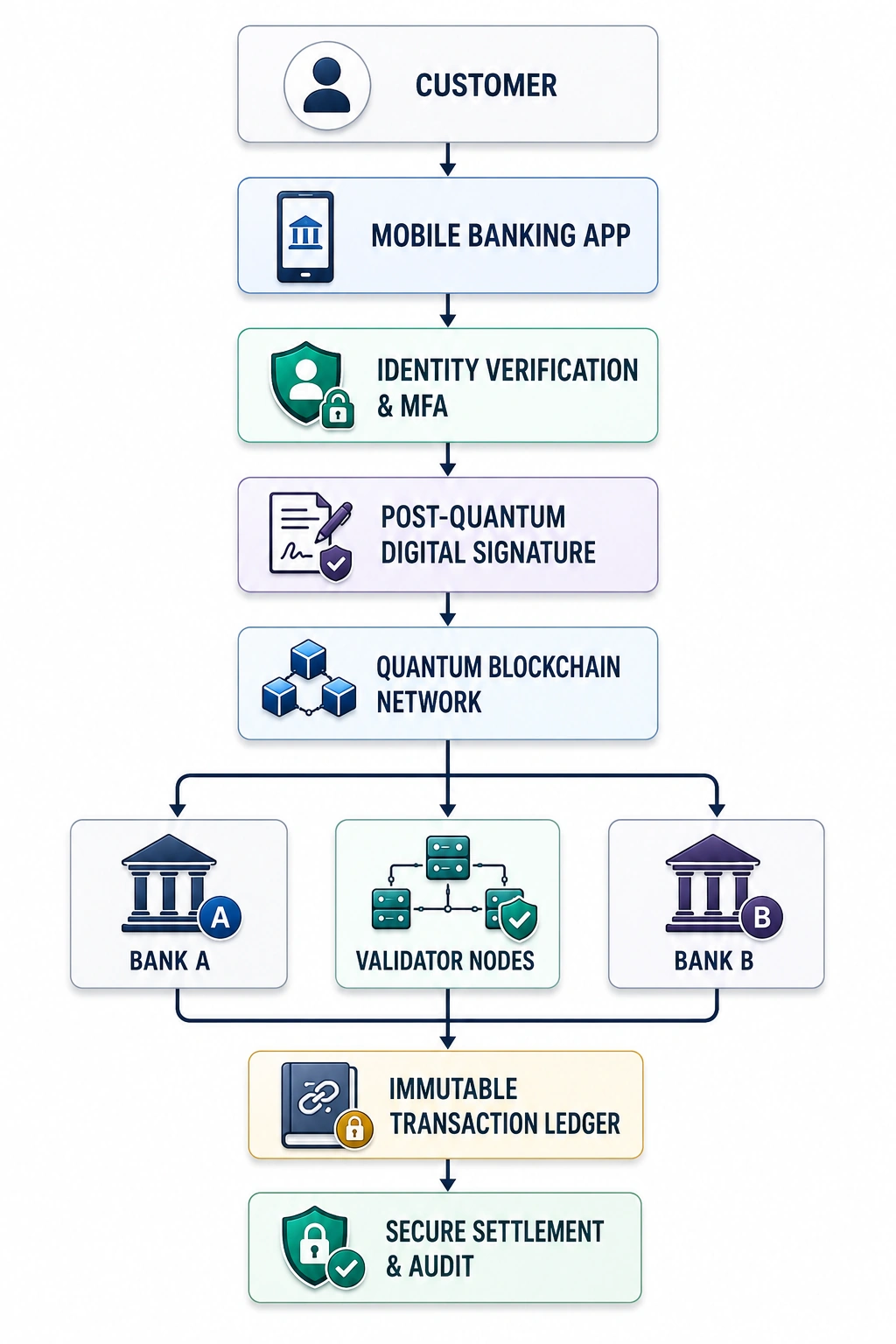
Figure 3. Illustrative workflow showing how Quantum Blockchain can secure financial transactions using post-quantum authentication and decentralized ledger verification.
Key Advantages of Quantum Blockchain in Banking
Quantum-resistant authentication for customers and financial institutions.
Enhanced protection for digital payments and online banking services.
Tamper-resistant financial transaction records.
Improved transparency in interbank settlements.
Stronger security for blockchain-based digital assets and smart contracts.
Long-term protection for emerging digital currency ecosystems.
Traditional Banking Security vs. Quantum Blockchain-Based Security
| Feature | Conventional Banking Security | Quantum Blockchain-Based Security |
|---|---|---|
| Authentication | RSA / ECC-based | Post-Quantum Cryptography |
| Transaction Records | Centralized databases | Distributed immutable ledger |
| Data Integrity | High | Very High |
| Resistance to Quantum Attacks | Limited | High |
| Long-Term Security | Requires future migration | Designed for quantum resilience |
| Transparency | Organization-controlled | Blockchain audit trail |
Table 2. Comparison of conventional banking security mechanisms with Quantum Blockchain-based financial systems.
The banking industry has always evolved alongside technological innovation—from paper-based transactions to online banking and mobile payments. Quantum computing represents the next technological milestone that will influence cybersecurity strategies. By adopting Quantum Blockchain and post-quantum cryptography, financial institutions can strengthen customer trust while ensuring that today's financial infrastructure remains secure for the decades ahead.
Example Use Cases
| Financial Service | Potential Role of Quantum Blockchain |
|---|---|
| Online Banking | Quantum-resistant customer authentication |
| Cross-Border Payments | Secure and transparent transaction validation |
| Central Bank Digital Currency (CBDC) | Long-term cryptographic protection |
| Trade Finance | Tamper-resistant documentation and audit trails |
| Digital Asset Management | Secure ownership verification and transfer |
Financial records often need to remain trustworthy for decades due to regulatory, legal, and auditing requirements. Preparing banking infrastructure with post-quantum cryptography today can reduce future migration risks and help maintain confidence in digital financial systems.
III- Electronic Voting (E-Voting): Towards Secure and Transparent Digital Elections
Conducting free and fair elections is one of the most fundamental responsibilities of any democratic nation. As governments continue to digitize public services, electronic voting (E-Voting) has emerged as a promising approach to improve accessibility, reduce manual effort, and accelerate vote counting. However, despite these advantages, concerns related to cybersecurity, voter privacy, and election integrity continue to limit its widespread adoption.
For an electronic voting system to be trusted, it must satisfy several essential requirements. Each eligible voter should be able to cast only one vote, voter identities must remain confidential, votes must not be altered after submission, and the final election results should be verifiable without compromising individual privacy.
Blockchain technology naturally addresses several of these challenges by maintaining an immutable and transparent ledger. Once a vote is recorded on the blockchain, it becomes extremely difficult to modify or delete without detection. This creates a reliable audit trail that can strengthen confidence in the election process.
However, the security of blockchain-based voting systems still depends on the strength of the underlying cryptographic algorithms. If future quantum computers become capable of breaking today's public-key cryptography, digital signatures used for voter authentication and vote validation could become vulnerable. Although this threat is not immediate, election systems are part of a country's critical infrastructure and therefore require long-term security planning.
Quantum Blockchain extends the capabilities of conventional blockchain by incorporating post-quantum cryptographic algorithms into the voting process. These algorithms are designed to remain secure even against future quantum attacks, helping preserve the authenticity of digital signatures and the integrity of recorded votes.
In a Quantum Blockchain-enabled voting system, a voter could first authenticate using a quantum-resistant digital identity. After successful verification, the vote would be digitally signed using post-quantum cryptography and securely recorded on a decentralized blockchain network. Once stored, the vote would become part of a tamper-resistant ledger that authorized election officials could audit without revealing the identity of individual voters.
Such an approach has the potential to improve transparency while maintaining voter confidentiality. Independent auditors could verify that every recorded vote has been counted correctly, reducing disputes and increasing public confidence in the election process.
It is important to recognize that Quantum Blockchain is not a complete solution to every challenge associated with electronic voting. Practical implementation would also require secure voting devices, reliable identity verification, legal compliance, accessibility measures, and public acceptance. Nevertheless, combining blockchain with post-quantum cryptography represents a promising research direction for building resilient election systems capable of withstanding future technological threats.
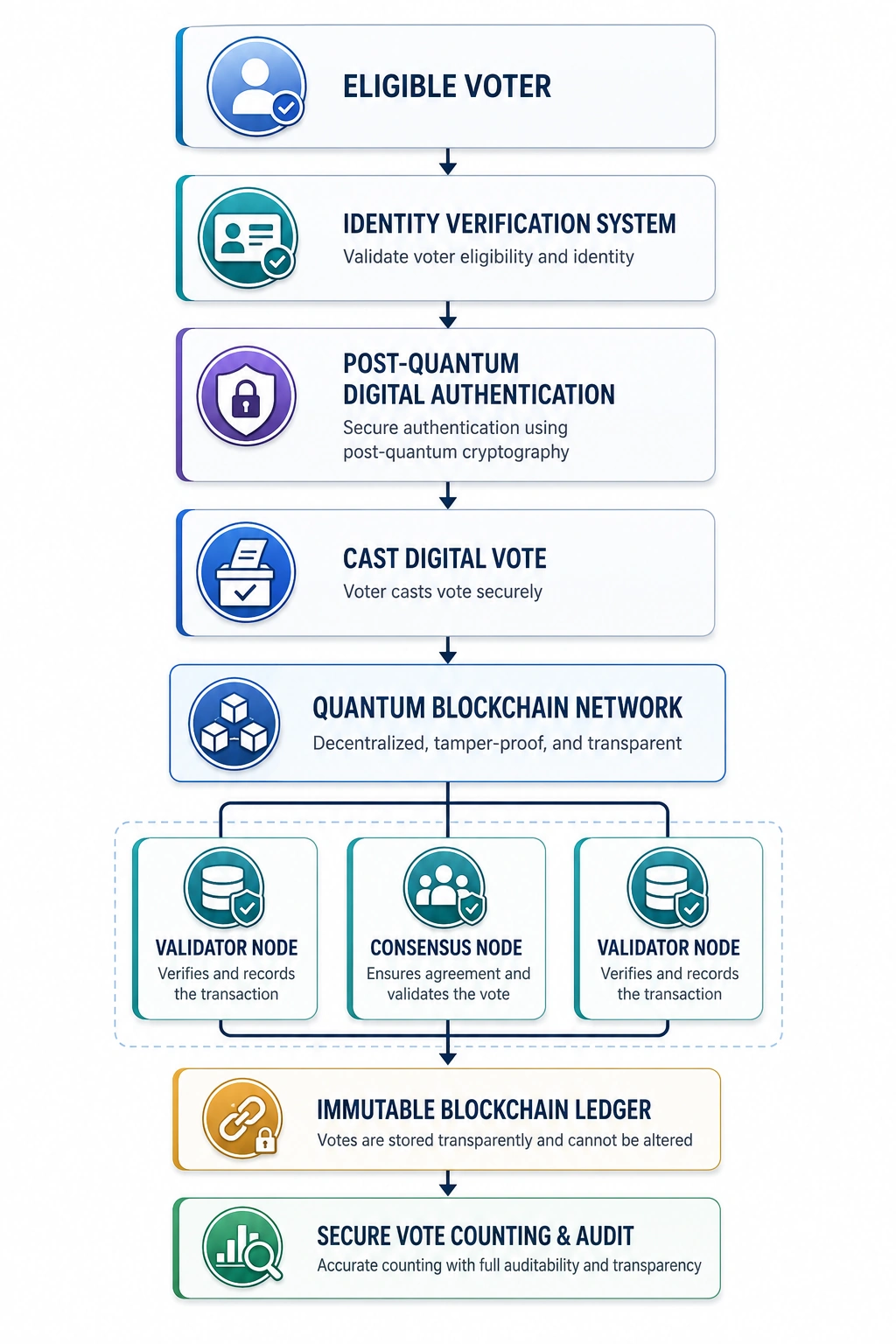
Figure 4. Illustrative workflow of a Quantum Blockchain-enabled electronic voting system showing voter authentication, blockchain validation, and secure vote auditing.
Several countries continue to explore digital voting technologies for local or specialized elections. As post-quantum cryptography becomes standardized and blockchain platforms continue to evolve, Quantum Blockchain may become an important component of next-generation electronic voting systems, particularly where long-term security and public trust are essential.
Key Advantages of Quantum Blockchain in E-Voting
Quantum-resistant voter authentication.
Tamper-resistant storage of digital ballots.
Transparent and verifiable election audit trails.
Protection against future cryptographic attacks.
Improved trust in electronic election systems.
Reduced dependence on centralized vote storage.
Conventional E-Voting V/S. Quantum Blockchain Based E-Voting
| Feature | Conventional E-Voting | Quantum Blockchain E-Voting |
|---|---|---|
| Vote Storage | Centralized Database | Distributed Blockchain Ledger |
| Voter Authentication | Conventional Digital Signatures | Post-Quantum Digital Signatures |
| Vote Integrity | High | Very High |
| Transparency | Limited | Enhanced through Blockchain Audit Trail |
| Resistance to Quantum Threats | Limited | Designed for Quantum Resilience |
| Long-Term Security | Requires Future Migration | Future-Oriented Security Model |
Table 3. Comparison between conventional electronic voting systems and a future Quantum Blockchain-based voting model.
The primary objective of Quantum Blockchain in electronic voting is not simply to digitize elections, but to ensure that the integrity, authenticity, and confidentiality of every vote remain protected even as cryptographic threats evolve in the future.
IV- Digital Identity Management: Building Trust in a Connected World
Every digital service begins with a simple question: "Who are you?" Whether accessing an online banking portal, booking a medical appointment, signing an electronic document, or participating in an online election, the system must first verify the identity of the user. As more services move online, digital identity has become one of the most valuable assets in today's connected world.
Traditional identity management systems generally rely on centralized databases that store usernames, passwords, identity documents, and authentication records. While these systems have supported digital services for many years, they also present an attractive target for cybercriminals. A successful attack on a centralized identity repository can expose the personal information of millions of users in a single incident.
Blockchain technology offers a different approach by enabling decentralized identity management. Instead of storing identity information under the control of a single organization, blockchain allows trusted credentials to be securely verified through a distributed network. This reduces dependence on centralized infrastructure while improving transparency and data integrity.
However, as with other blockchain applications, the long-term security of digital identities depends on the strength of the underlying cryptographic algorithms. If future quantum computers become capable of compromising current public-key cryptography, digital certificates, authentication mechanisms, and electronic signatures may require stronger protection.
Quantum Blockchain addresses this challenge by integrating post-quantum cryptography into decentralized identity systems. Rather than replacing digital identity frameworks, it enhances them with cryptographic algorithms specifically designed to withstand future quantum attacks.
In a Quantum Blockchain-based identity ecosystem, users could possess a secure digital identity protected by quantum-resistant cryptographic keys. When accessing a healthcare portal, online banking service, government platform, or educational institution, the system would verify the user's identity without exposing unnecessary personal information. The authentication process would remain secure even as computational capabilities continue to evolve.
This model also supports the concept of Self-Sovereign Identity (SSI), where individuals have greater control over their own digital credentials. Instead of repeatedly submitting copies of identity documents to different organizations, users can selectively share only the information required for a particular service. For example, proving that a person is over 18 years of age does not necessarily require revealing their complete date of birth or residential address.
Another significant advantage is interoperability. A single quantum-secure digital identity could be recognized across multiple trusted services, reducing repetitive verification procedures while maintaining strong privacy protection. Such an ecosystem has the potential to simplify secure access across healthcare, banking, education, taxation, and e-governance platforms.
Although widespread implementation will require international standards, regulatory frameworks, and interoperability among different organizations, Quantum Blockchain provides a promising foundation for building digital identity systems that remain secure throughout the coming decades.
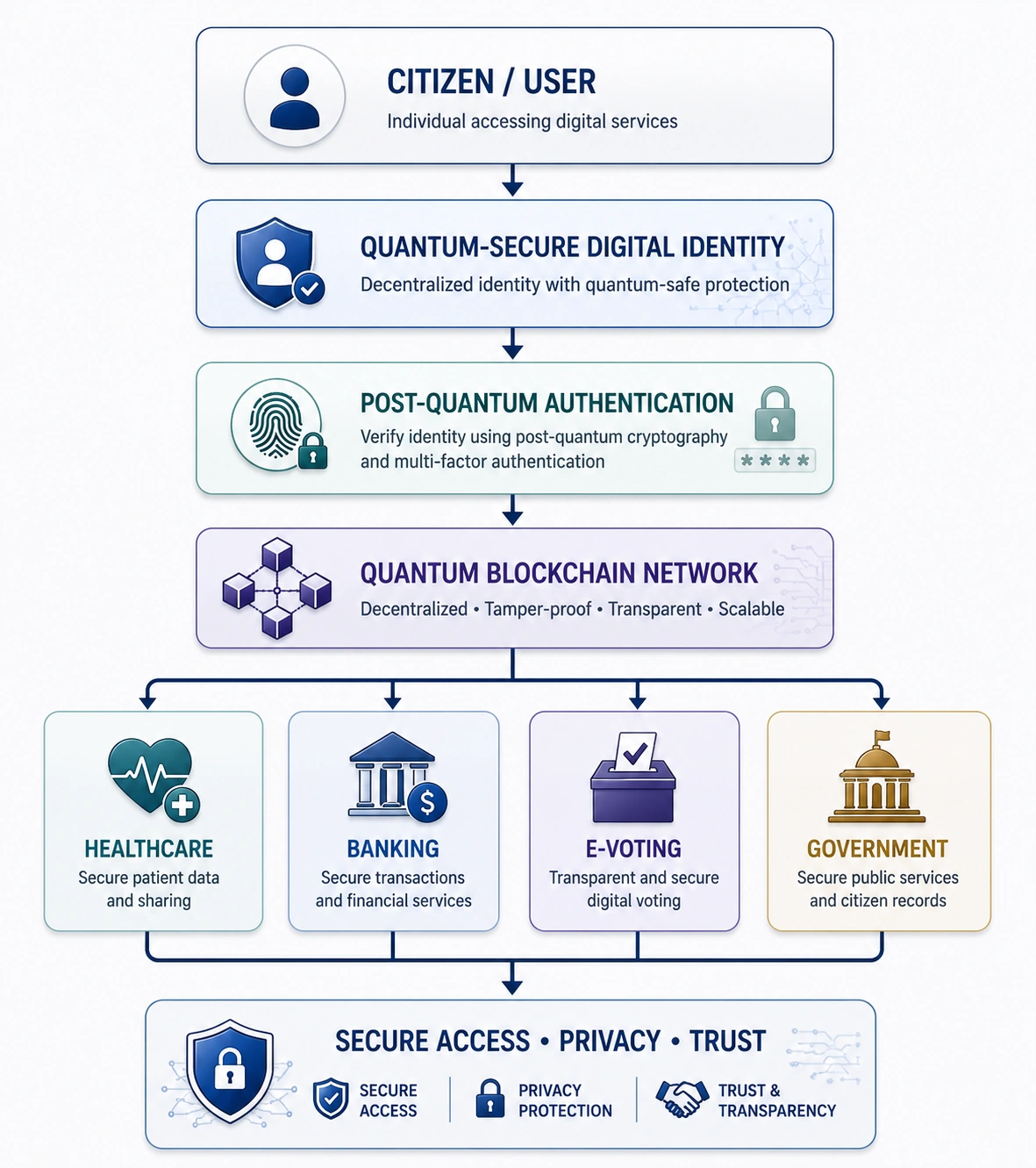
Figure 5. Conceptual view of a Quantum Blockchain-based digital identity ecosystem supporting secure authentication across multiple digital services.
Conventional Digital Identity vs. Quantum Blockchain-Based Digital Identity
| Feature | Conventional Identity Systems | Quantum Blockchain-Based Identity |
|---|---|---|
| Identity Storage | Centralized Databases | Decentralized Blockchain Network |
| Authentication | RSA / ECC-based | Post-Quantum Cryptography |
| Privacy Control | Organization-controlled | User-centric with selective disclosure |
| Identity Verification | Centralized Authority | Distributed Trust Model |
| Resistance to Quantum Threats | Limited | High |
| Long-Term Security | Requires Future Migration | Designed for Quantum Resilience |
Table 4. Comparison between traditional digital identity management and a Quantum Blockchain-enabled identity ecosystem.
Example Use Cases
| Application | Potential Role of Quantum Blockchain |
|---|---|
| Online Banking | Quantum-resistant customer login and authentication |
| Healthcare Portals | Secure patient identity verification |
| E-Governance | Trusted citizen authentication for digital public services |
| Universities | Secure digital student credentials and certificates |
| Professional Licensing | Tamper-resistant verification of qualifications |
| Enterprise Access | Secure workforce identity and access management |
Digital identity is the common foundation for healthcare, banking, and electronic voting. As organizations prepare for the post-quantum era, strengthening identity systems with quantum-resistant cryptography may become one of the most important cybersecurity investments for the future.
Challenges in Adopting Quantum Blockchain
Although Quantum Blockchain offers a promising solution for future cybersecurity, its large-scale adoption still faces several practical challenges.
Limited Maturity of Quantum Technology: Practical quantum computers capable of breaking current encryption are still under development, making it difficult for organizations to decide the right time to migrate.
Migration Complexity: Existing blockchain platforms rely on traditional cryptographic algorithms. Upgrading to post-quantum cryptography requires changes to infrastructure, applications, and security protocols.
Performance Overhead: Many post-quantum cryptographic algorithms use larger keys and signatures, which may increase storage requirements and computational costs.
Lack of Global Standards: While international organizations are developing post-quantum cryptography standards, widespread adoption and interoperability across industries will take time.
Cost and Skilled Workforce: Implementing Quantum Blockchain requires investment in new technologies and professionals with expertise in both blockchain and post-quantum cryptography.
Despite these challenges, organizations can begin preparing today by adopting a phased migration strategy and monitoring the development of post-quantum security standards.
Conclusion
Quantum computing is expected to reshape the future of cybersecurity by challenging many of the cryptographic techniques used in today's digital systems. While practical large-scale quantum computers are still evolving, preparing for this technological shift has become an important consideration for organizations that manage sensitive and long-lived data.
Quantum Blockchain combines the strengths of blockchain technology with post-quantum cryptography to provide a more resilient foundation for future digital security. As discussed in this article, its potential applications extend across healthcare, banking, electronic voting, and digital identity management, where maintaining confidentiality, integrity, and trust is essential.
Although challenges such as migration complexity, standardization, and implementation costs remain, ongoing research and the development of post-quantum cryptographic standards are steadily moving this field forward. Rather than replacing existing blockchain systems overnight, Quantum Blockchain represents a gradual evolution toward a more secure and future-ready digital ecosystem.
As organizations continue their digital transformation, exploring quantum-resistant technologies today can help ensure that the systems built for tomorrow remain secure against the cybersecurity challenges of the quantum era.
Join the conversation! Your thoughts help the community grow.