

I wrote several articles in May, including one: C# Versions. While other articles have a range of reading times from 1.8 k to 5.5 k, C# Versions has 6.4 k, which suggested this kind of article(s) are very welcome by readers.
This is a similar article for C# Versions, but for Angular.
Note
After I finished this article, and published it, the next day, I got a notice from C# Corner editor: "We noticed you already have an article for the same topic. ......" From the link, I found out, yes, I did have an article Angular Versions on 06/07/2021, that I totally forgot. Yes, as the editor said: "it is not good to have two articles on the same topic". However, I do not want to discard my article, discard what I have made effort on it, I try to get rid of some duplicated staff, and leave some new staff in, with a different title, hopefully, this article can pass the "censor" and survive. I put another article as pair here:
- Angular Versions
- Angular Version Change Frequency --- this article
Introduction
We had an Angular project. One of my colleagues told me that she is new to Angular. I said to her, "Don’t worry about it. Angular itself is new, just popular, say, in recent 5 years. After this project, you will be an Angular expert for sure."
How new of Angular? This is the question that we want to answer in this article. The structure of this article,
- Introduction
- A - Get Angular Version
- B - Angular Version Release History
- C - Angular Version-Release Frequency
- D - Major Features for different Angular Versions
A - Get Angular Version
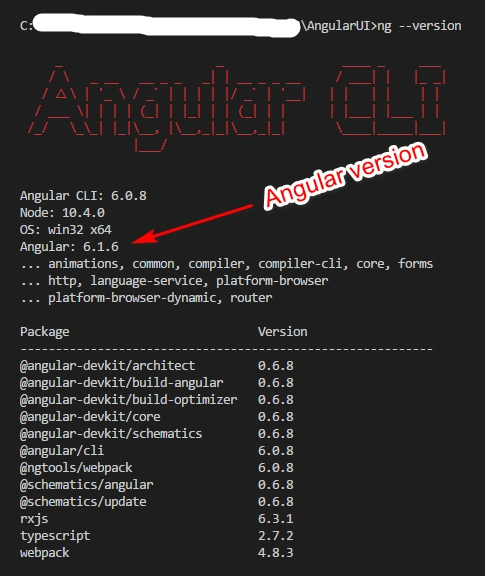
In the command line Prompt, type in: ng --version or ng version, or just ng v, you should get it,
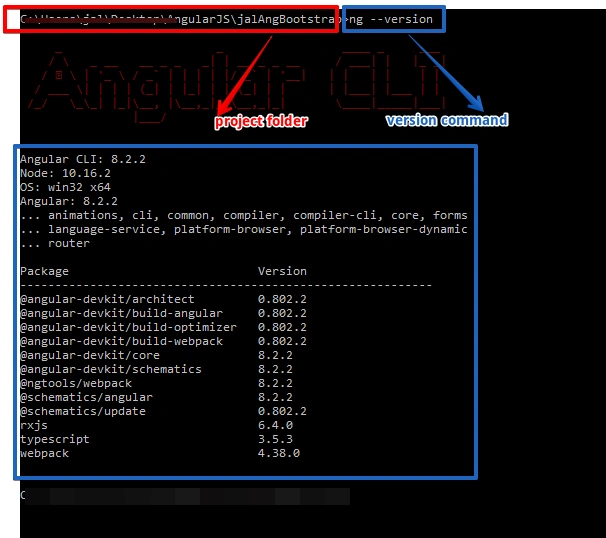
It will show the version,
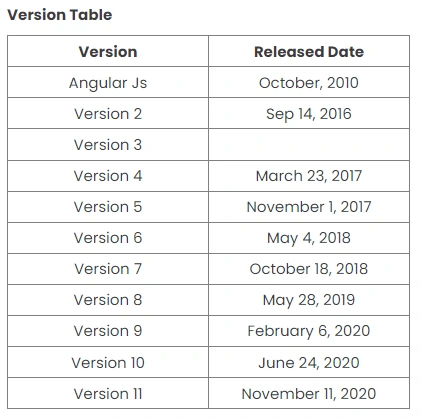
B - Angular Version Release History[ref] --- till v.11
C: Angular Version-Release Frequency[ref]
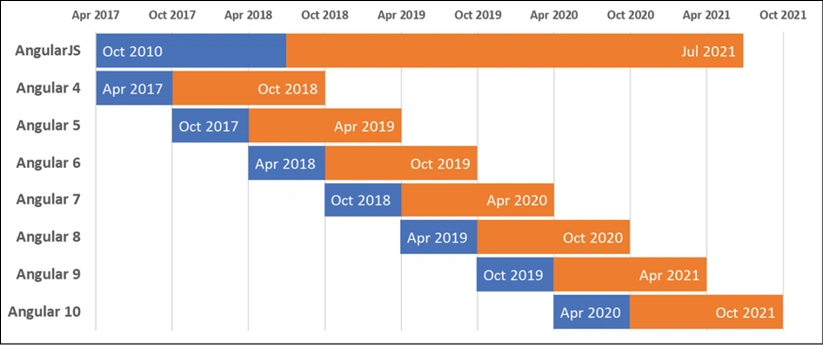
The Angular team at Google has committed to a deterministic release schedule with major versions released every 6 months.
After this 6-month development window, starting with Angular 4, all major releases receive LTS with bug fixes and security patches for an additional 12 months. From release to end-of-life, each major version receives updates for 18 months. Refer to the following chart for the tentative release and support schedule for AngularJS and Angular.
D - Major Features for different Angular Versions
See Angular Versions --- my article.
Reference
- Introduction to Angular --- subscription.packtpub.com
- Angular (web framework) --- wiki
- Angular versioning and releases --- Angular.io
- Angular History --- ngdevelop.tech
- Angular Version History --- tutorialslink.com
- Angular Versions --- my article
Pranam BhatPosted Oct 26, 2021, 3:56 AM
1) You forgot to mention Angular 12. 2) There is nothing called "Angular Version 3". 3) Image on "C: Angular Version-Release Frequency" is totally wrong information. For example, Angular 10 is Released on Jun 24, 2020. Active Support Ends on Dec 24, 2020. Long Term Support Ends on Dec 24, 2021. 4) There is no term called Angular Js". It is "AngularJS"!!!! 5) After all, this all information is available over Angular "https://angular.io/".