

Introduction
In today's tech-driven world, terms like AI, machine learning, deep learning, and data science are often used interchangeably, leading to confusion among professionals and enthusiasts alike. Understanding the unique roles of each is crucial, especially for professionals navigating the rapidly evolving field of technology. Let's delve into each one to understand their unique characteristics and applications.
Artificial Intelligence (AI)
At its core, AI refers to machines' simulation of human intelligence processes, enabling them to perform tasks that typically require human intelligence. These tasks encompass various activities, including problem-solving, decision-making, speech recognition, and language translation. AI aims to create systems capable of learning, reasoning, and self-correction.
Machine Learning (ML)
ML is a subset of AI that focuses on developing algorithms and statistical models that enable computers to perform tasks without explicit instructions. Instead, ML algorithms learn from data, identify patterns, and make data-driven decisions or predictions. It emphasizes constructing systems that can learn and improve from experience without being explicitly programmed.
Deep Learning
Deep Learning is a specialized field within ML that focuses on developing and training artificial neural networks, which are inspired by the structure and function of the human brain. These neural networks consist of interconnected layers of nodes (neurons) that process information and extract features from raw data. Deep Learning excels in tasks such as image recognition, natural language processing, and speech recognition, achieving remarkable performance by automatically learning hierarchical representations of data.
Data Science
Data science is a multidisciplinary field that combines domain knowledge, programming skills, and statistical expertise to extract insights and knowledge from structured and unstructured data. Data scientists employ various techniques, including statistical analysis, machine learning, data mining, and visualization, to uncover hidden patterns, trends, and correlations in data. The insights derived from data science can inform business decisions, optimize processes, and drive innovation across industries.
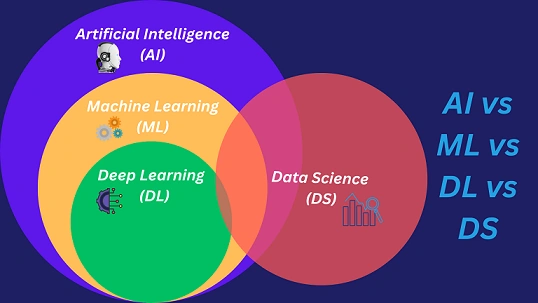
Key Differences between AI, Machine Learning, Deep Learning, and Data Science
- Scope: AI is the broadest term, encompassing all efforts to mimic human intelligence in machines. Machine learning is a subset of AI, focusing on algorithms that learn from data. Deep learning is a subset of machine learning, emphasizing neural networks with multiple layers. On the other hand, data science is a multidisciplinary field combining statistics, programming, and domain expertise to extract insights from data.
- Approach: AI encompasses various approaches beyond machine learning, including expert systems, rule-based systems, and evolutionary algorithms. Machine learning emphasizes learning patterns from data, while deep learning involves learning hierarchical representations. Data science integrates statistical methods with programming and domain knowledge to extract actionable insights from data.
- Applications: AI finds applications in diverse fields, including robotics, natural language processing, and autonomous vehicles. Machine learning is widely used in recommendation systems, predictive analytics, and fraud detection. Deep learning excels in image recognition, speech recognition, and natural language processing tasks. Data science is applied across industries for customer segmentation, demand forecasting, and sentiment analysis tasks.
Summary
AI, ML, Data Science, and Deep Learning represent different facets of the broader field of artificial intelligence, each with its own set of techniques, methodologies, and applications. Professionals can better leverage these technologies to drive innovation and solve complex problems across diverse domains by understanding their distinctions.
Join the conversation! Your thoughts help the community grow.