

Introduction
In the previous article, we had a brief introduction of the two major terms Agile and Scrum with appropriate examples and how it is actually used in project management. In this article, we will look forward to the Agile Manifesto with the values and principles. These will make it easy to crack the PM examinations and move your profile to the management level.
Agile Manifesto
Do you know that 71% of companies around the world use Agile as their project management technique? When Agile was developed it cumulated in the Agile Manifesto. It lays out the four core values and 12 principles which describe the process and priorities of an Agile Team.
The four agile values are,
- Individuals and interactions over processes and tools.
- Working software over comprehensive documentation.
- Customer collaboration over contract negotiation
- Responding to a change over following a plan
Agile Philosophy creators crafted 12 principles, which is helpful to create a trustworthy bonding and product reliability with the organization and the customer in project management.
These are the 12 principles,
- Satisfy the customer through early and continuous delivery.
- Welcome changing requirements, even late in development.
- Deliver working software frequently with a preference for a shorter timescale.
- Business people and developers must work together daily throughout the project.
- Building projects around motivated individuals.
- Convey information to a development team through face-to-face conversation
- Working software is the primary major of a progress
- Agile processes promote sustainable development
- Continuous attention to technical excellence and good design enhances agility.
- Simplicity - the art of maximizing the amount of work not done - is essential
- The best architectures, requirements, and designs emerge from self-organizing teams.
- At regular intervals, the team reflects on how to become more effective.
Within the Agile methodology, two of the most widely used frameworks are Scrum and Kanban. Agile Scrum is the most popular framework these days. Now, we will see how the Agile Scrum Team works to deliver an efficient project.
- 1-4 week cycles called “sprints”
- Daily stand-up meetings
- Sprint retrospective at the end of the cycle
- Rapid feedback
- Close collaboration with customers and stakeholders.
- Agile Scrum teams are self-organizing in nature.
Typical role in Agile Scrum Team includes,
Team Lead/Scrum Master: Scrum Master ‘coaches’ the groups and paves the way to reach them to reach the project’s goals.
Team Member: Team members primarily work on the product. They could be the engineers, members of the creative team, or even the designers.
Product Owner: The product owner is responsible for product vision and priorities.
Kanban
Where scrum is cyclical in nature, Kanban is more like a river that flows. Instead of pushing tasks down the production line, they are, instead “pulled” based on what the project requires and what has already been completed.
Using Kanban framework in project management.
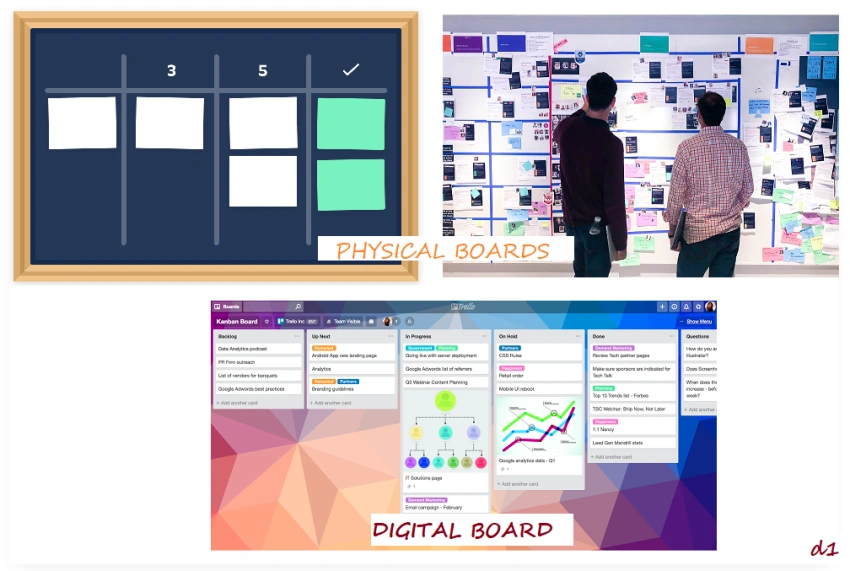
The Kanban method operates n=by moving tasks along with a Kanban board with at least three production phases (columns).
Phases are typically variations of “to-do”, “in progress” and “completed”. More columns can be added depending on your team workflow.
Tasks are represented as “cards” or sticky notes.
Check this image for different dashboards for ideal project management,
Five steps to implementing Kanaban method,
- Step:1 Visualize the workflow
- Step:2 Limit the Work-in-Progress(WIP)
- Step:3 Measure and manage the flow
- Step:4 Make process policies explicit
- Step:5 Use models to recognize improvement opportunities
Kanban is often ideal for projects where continuous delivery is essential. And, like Scrum, Kanban also prioritizes process improvement – an important principle of Agile.
 AGILE SCRUM |
 KANBAN |
| Supports incremental delivery | Supports continues delivery |
| Self-organizing teams | Less focus on roles and events |
| Short sprint lasting 1-4 weeks | Focused on workflow rather than sprints |
What is the best Agile Framework?
Scrum teams are cross-functional and interactive in nature.
Kanban represents a flexible Agile approach - favoring continuous task flows.
It’s all depends upon the project requirement and project team which one is the better option for your project.
Summary
In this article, we covered the actual difference between the Agile Scrum and Kanban frameworks, how both are useful and what are the strategies to apply these frameworks for an ideal project. Also check our upcoming articles for a deep discussion on Agile Methodology.
Sagar LadPosted Sep 22, 2021, 9:59 PM
Nice article